
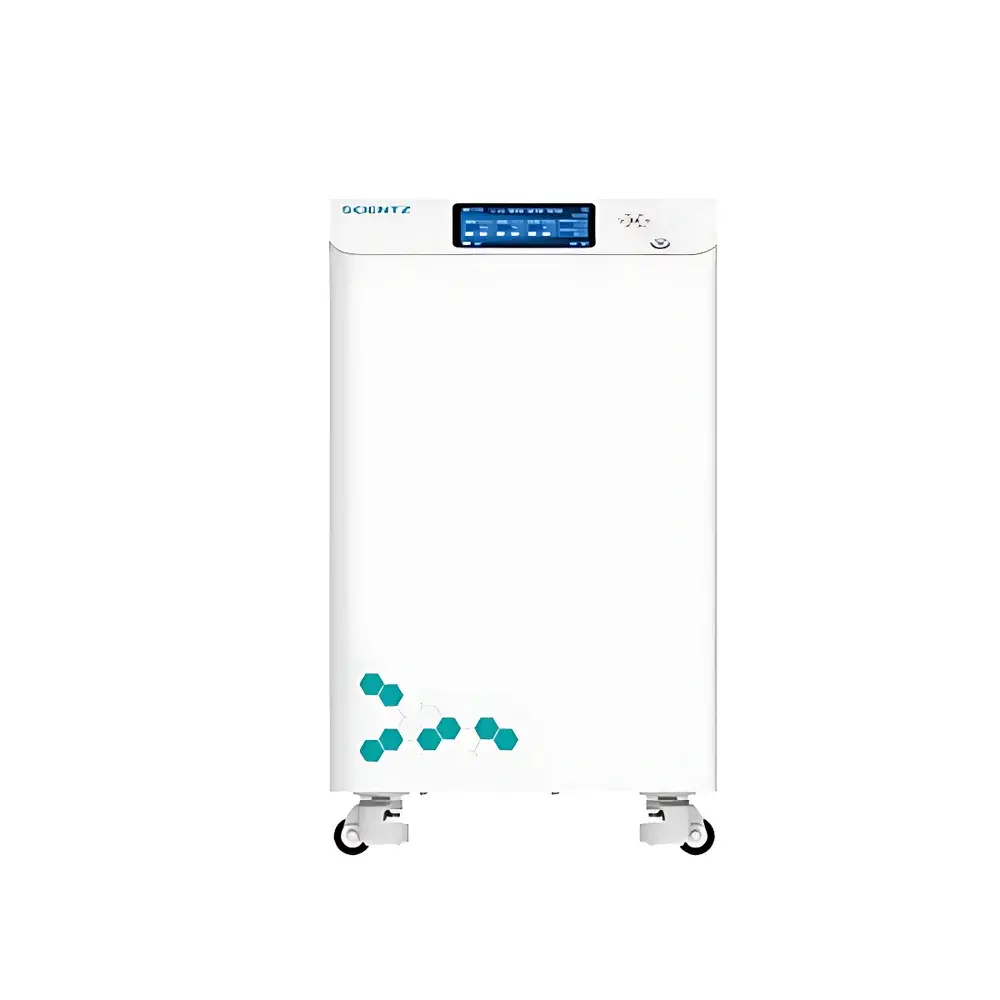
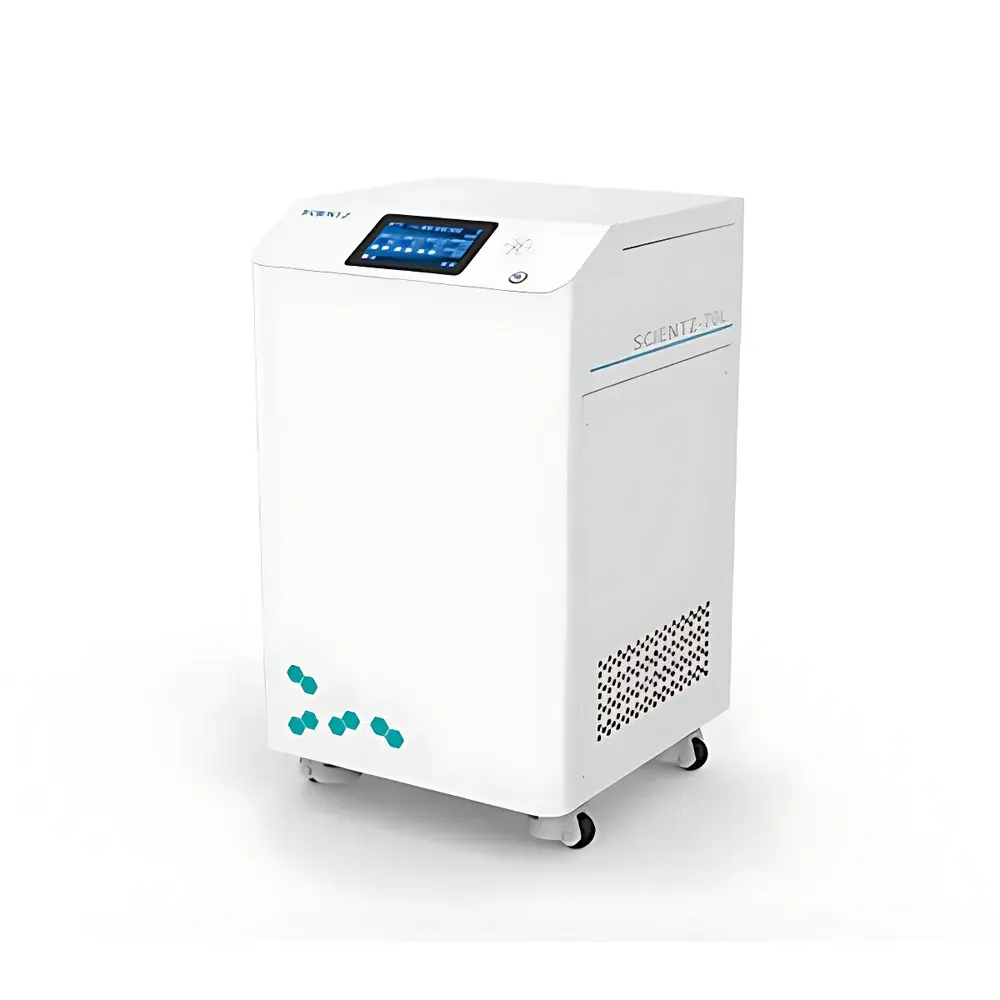
SCIENZ SCIENTZ-70L High-Throughput Tissue Grinder
| Brand | SCIENZ |
|---|---|
| Origin | Zhejiang, China |
| Manufacturer Type | Direct Manufacturer |
| Country of Origin | China |
| Model | SCIENTZ-70L |
| Pricing | Upon Request |
Overview
The SCIENZ SCIENTZ-70L High-Throughput Tissue Grinder is an engineered solution for rapid, reproducible mechanical homogenization of biological and non-biological samples using high-frequency vertical oscillation. It operates on the principle of bead-beating—where kinetic energy from reciprocating motion transfers to grinding beads (e.g., stainless steel, tungsten carbide, zirconia) inside sealed centrifuge tubes, generating shear forces and impact collisions sufficient to disrupt cellular membranes, extracellular matrices, and resilient particulate structures. Designed for laboratories requiring parallel processing without compromise in integrity, the SCIENTZ-70L integrates active refrigeration via a built-in compressor system, maintaining sample temperatures between –10 °C and +4 °C during operation—a critical feature for preserving labile biomolecules such as native RNA, phosphorylated proteins, and epigenetic markers. Its architecture supports fully enclosed, independent tube movement, eliminating inter-sample aerosol transfer and ensuring compliance with biosafety Level 2 (BSL-2) handling protocols.
Key Features
- High-throughput capacity: Simultaneous processing of up to 70 samples (2 mL or 5 mL tubes) per run, scalable via interchangeable adapters
- Programmable touch interface: Intuitive 7-inch color LCD display with preloaded and user-defined protocols (time: 1–999 s; frequency: 100–1800 rpm; pause intervals)
- Cryogenic compatibility: Integrated refrigeration unit enables real-time temperature control during grinding—no external liquid nitrogen required
- Enhanced safety architecture: Electromechanical door lock with automatic rotor stop upon lid opening; overheat and overload protection circuits
- Vibration-damped base and precision-balanced drive system ensure minimal operational noise (<65 dB) and long-term mechanical stability
- Material-flexible grinding: Supports dry, wet, and cryo-grinding modes; compatible with diverse bead materials including stainless steel, tungsten carbide, zirconia, alumina, agate, and PTFE
Sample Compatibility & Compliance
The SCIENTZ-70L accommodates heterogeneous sample classes across life science, environmental, agricultural, and industrial quality control workflows. Validated applications include soft animal tissues (liver, brain, spleen), fibrous plant material (roots, stems, seeds), microbial pellets (E. coli, yeast, spores), environmental matrices (soil, sludge, fecal matter), and synthetic polymers (PE, PS, resins). All grinding occurs within single-use, DNase/RNase-free centrifuge tubes—eliminating carryover risk and supporting GLP-compliant workflows. The instrument meets IEC 61000-6-3 (EMC emissions) and IEC 61000-6-2 (immunity) standards. While not certified under FDA 21 CFR Part 11, its audit-ready operation log (timestamped run records, parameter history) facilitates validation for ISO/IEC 17025-accredited testing labs and supports traceability requirements per USP Analytical Instrument Qualification.
Software & Data Management
No proprietary PC software is required for basic operation; all parameters are configured locally via the embedded controller. However, optional USB data export enables transfer of run logs (date/time, speed, duration, temperature setpoint, error codes) to LIMS or ELN platforms. Each protocol stores up to 100 user-defined methods with password-protected access levels (operator vs. administrator). System firmware supports over-the-air updates via secure HTTPS connection. For regulated environments, the device generates immutable electronic records compliant with ALCOA+ principles (Attributable, Legible, Contemporaneous, Original, Accurate, Complete, Consistent, Enduring, Available), enabling integration into GxP-aligned data governance frameworks.
Applications
- Nucleic acid extraction: Efficient lysis of Gram-positive bacteria, fungal cell walls, and frozen mammalian tissues for downstream qPCR, RNA-Seq, and ChIP-seq
- Proteomics sample prep: Mechanical disruption preserving post-translational modifications prior to LC-MS/MS analysis
- Environmental microbiome studies: Homogenization of soil aggregates and biofilm-coated sediments without bias toward culturable taxa
- Pharmaceutical QA/QC: Uniform particle size reduction of tablets and excipients for dissolution testing and content uniformity assays
- Food authenticity testing: Rapid comminution of heterogeneous food matrices (meat blends, dairy products, spices) prior to DNA barcoding or allergen detection
FAQ
What tube formats are supported?
Standard configurations accommodate 2 mL and 5 mL microcentrifuge tubes; custom adapters available for 0.2 mL PCR strips and 15 mL conical tubes.
Can the SCIENTZ-70L be validated for GMP use?
Yes—its deterministic mechanical design, parameter traceability, and stable thermal performance support IQ/OQ/PQ protocols; documentation templates available upon request.
How does bead selection affect downstream analysis?
Bead composition directly influences elemental contamination profiles: stainless steel introduces Fe/Cr; zirconia yields trace Zr/Y; PTFE avoids metal interference but offers lower energy transfer—selection must align with analytical sensitivity requirements (e.g., ICP-MS vs. Western blot).
Is remote monitoring supported?
Not natively—but Ethernet-enabled industrial controllers can be integrated via RS-485 Modbus RTU for centralized lab equipment monitoring systems.
What maintenance intervals are recommended?
Compressor oil inspection every 12 months; drive belt replacement at 5,000 operating hours; full calibration verification annually using NIST-traceable vibration and temperature sensors.



