
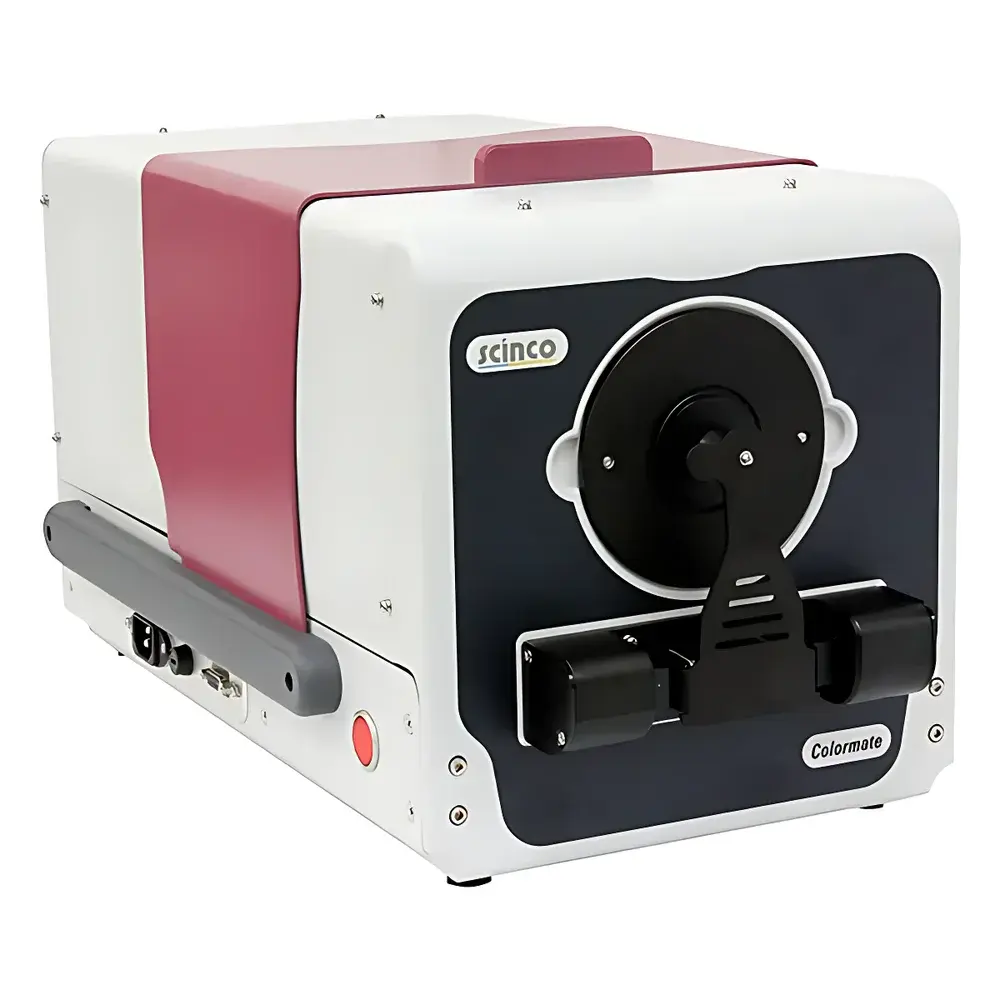
SCINCO ColorMate Desktop Spectrophotometer
| Brand | SCINCO |
|---|---|
| Model | ColorMate |
| Origin | South Korea |
| Instrument Type | Benchtop |
| Optical Geometry | 8°/diffuse (8°/d) |
| Light Source | Pulsed Xenon Lamp (150 W) |
| Spectral Range | 270–1000 nm |
| Measurement Time | ~0.8 s (full spectral scan) |
| Aperture Options | LAV (25.4 mm), MAV (12.7 mm), SAV (6.4 mm or 4.3 mm) |
| Spectral Reflectance Repeatability | <0.1% (STD) |
| Chromaticity Repeatability | ΔE*ab < 0.01 |
| Illuminants | A, C, D50, D55, D65, F1–F12 (17 total) |
| Color Spaces | CIE L*a*b*, L*u*v*, XYZ, Yxy, L*C*h*, Hunter LAB, FMCII, CMC(l:c), BFD(l:c), CIE94 |
| Color Indices | Whiteness, Yellowness, Blueness, Brightness, Opacity, ASTM D1209, Saybolt, APHA, Gardner, ASBC-10, EBC-10 |
| Interface | RS-232 |
| Dimensions (W×D×H) | 500 × 400 × 180 mm |
| Power Supply | AC 100–220 V, 50/60 Hz |
| OS Compatibility | Windows 98/ME/NT/2000/XP |
| Detector | 1024-channel PDA |
| Measurement Modes | Reflectance, Transmittance, Absorbance, Haze |
| Software | ColorMaster Plus (SCI/SCE/UV mode auto-switching, Pass/Fail evaluation, Trend Analysis, Spectral Data Export) |
Overview
The SCINCO ColorMate is a benchtop spectrophotometer engineered for high-precision color measurement and spectral analysis across industrial quality control and R&D environments. Operating on the principle of diffuse illumination with 8° viewing geometry (8°/d), it conforms to ISO 7724-1, CIE No. 15, and ASTM E308 standards for colorimetric instrumentation. The system employs a pulsed 150 W xenon lamp as its broadband light source, delivering stable, flash-based illumination across the full UV-Vis-NIR range (270–1000 nm). This enables accurate quantification of spectral reflectance and transmittance without thermal drift or lamp aging artifacts—critical for long-term calibration stability in regulated settings. Its 1024-channel photodiode array (PDA) detector ensures high spectral resolution and signal-to-noise ratio, supporting robust quantification of subtle chromatic differences down to ΔE*ab < 0.01 under repeatability conditions.
Key Features
- Benchtop architecture with compact footprint (500 × 400 × 180 mm) optimized for integration into QC laboratories and production line testing stations.
- Triple-aperture configuration: Large Area View (LAV, 25.4 mm), Medium Area View (MAV, 12.7 mm), and Small Area View (SAV, 6.4 mm or 4.3 mm) for flexible sample coverage—from textured coatings to small pharmaceutical tablets.
- Full-spectrum acquisition completed in approximately 0.8 seconds per measurement, enabling rapid batch verification and real-time process feedback.
- Automated optical mode switching between Specular Component Included (SCI) and Specular Component Excluded (SCE), with optional UV component control for fluorescence compensation in whitened or optically brightened materials.
- Comprehensive illuminant library (17 standard illuminants including D65, A, F1–F12) and observer angles (2° and 10°) compliant with ISO/CIE conventions.
- Multi-mode measurement capability: reflectance, transmittance, absorbance, and haze—supporting both opaque and translucent material characterization.
Sample Compatibility & Compliance
The ColorMate accommodates solid, liquid, and powdered samples across diverse industrial sectors—including paints & coatings, automotive OEM finishes, food packaging inks, textile dyes, pharmaceutical excipients, and cosmetic emulsions. Its optical design meets requirements for ASTM D2244 (color difference calculation), ASTM E308 (instrumentation for colorimetry), and ISO 11664 (CIE colorimetric standards). For regulated environments, the instrument supports GLP-compliant data handling when used with ColorMaster Plus software, including user-access logs, audit-trail-enabled parameter changes, and timestamped spectral data export (ASCII, CSV, XML). While not natively 21 CFR Part 11 compliant, its raw data output and metadata structure facilitate integration into validated LIMS or ELN systems requiring electronic record integrity.
Software & Data Management
ColorMaster Plus serves as the native control and analysis platform, running on Windows 98 through XP (32-bit). It provides real-time spectral visualization, comparative overlay of reference/standard spectra, and automated pass/fail evaluation against user-defined tolerances. Trend analysis tools enable longitudinal monitoring of color drift over time—essential for stability studies and supplier qualification. All spectral data are stored with full metadata (illuminant, observer, aperture, geometry, date/time, operator ID), ensuring traceability. Export formats include ASCII text for third-party statistical analysis (e.g., JMP, Minitab) and industry-standard .spc files compatible with major color formulation platforms. Calibration verification routines support regular performance checks using NIST-traceable ceramic tiles or liquid standards.
Applications
- Paint & Coatings: Batch-to-batch color consistency validation per ASTM D2244; gloss-independent color matching in metallic and pearlescent finishes.
- Pharmaceuticals: Excipient color assessment per USP <631>; capsule shell uniformity testing; dissolution media clarity monitoring.
- Food & Beverage: Color grading of oils (ASTM D1209, APHA, Gardner), dairy powders, and confectionery coatings.
- Plastics & Polymers: In-line QC of colored resins; weathering studies tracking UV-induced yellowness index shifts.
- Textiles: Shade matching across dye lots; compliance verification against retailer-specific color standards (e.g., Walmart, H&M).
FAQ
What is the difference between SCI and SCE measurement modes?
SCI includes specular reflection and measures total reflectance—ideal for appearance-independent color specification. SCE excludes specular reflection and correlates more closely with human visual perception under typical viewing conditions.
Can the ColorMate measure transparent liquids?
Yes—using the transmittance mode with matched quartz cuvettes; optional liquid holders support standardized path lengths (10 mm, 20 mm, 50 mm) per ASTM D1209 and APHA protocols.
Is NIST-traceable calibration available?
SCINCO offers factory-calibrated ceramic tile standards (certified for reflectance at 400–700 nm) and liquid standards traceable to NIST SRM 930 series upon request.
Does the system support custom color formulas?
ColorMaster Plus does not perform formulation prediction but exports full spectral data compatible with third-party software such as X-Rite Color iMatch or Datacolor MATCHTEXT for recipe development.
What maintenance is required for long-term accuracy?
Annual recalibration is recommended; daily verification using supplied white tile is advised. Xenon lamp lifetime exceeds 1 million flashes—typically 3–5 years under normal QC usage.



