
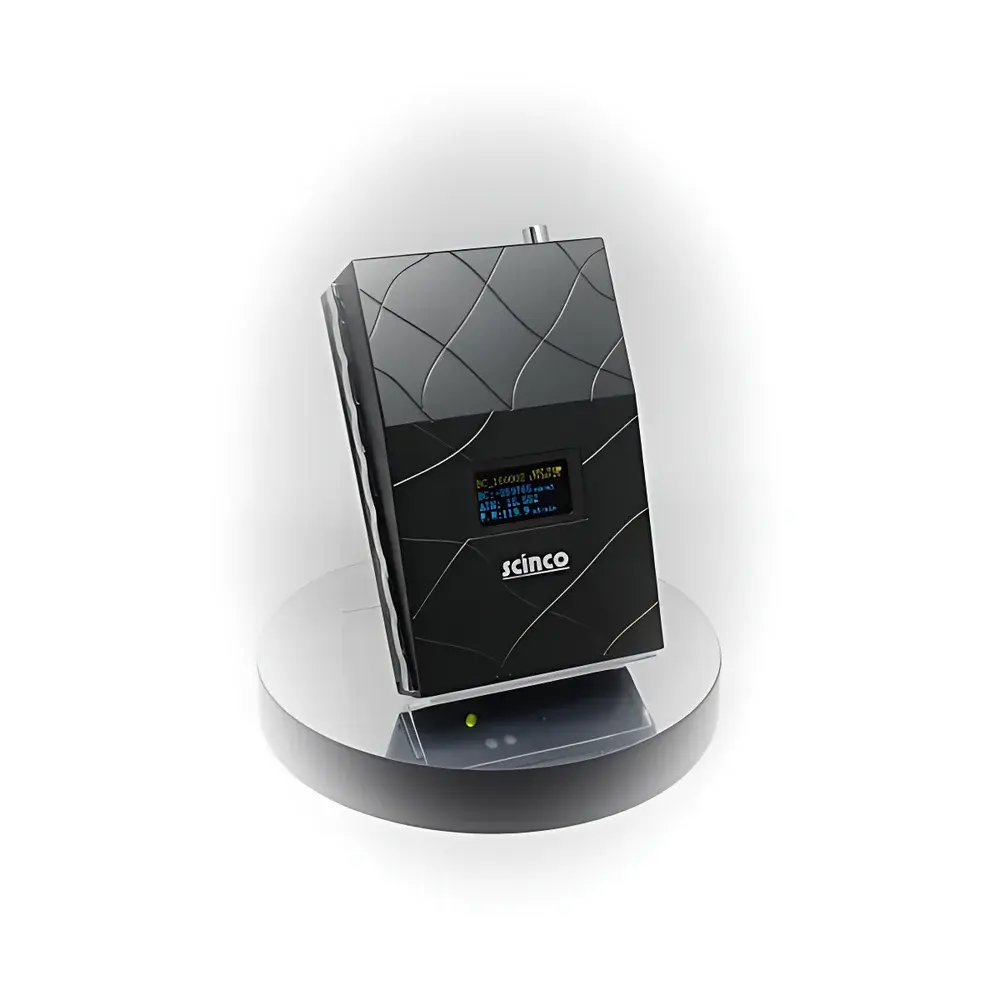
SCINCO SCAB Portable Black Carbon Monitor
| Brand | SCINCO |
|---|---|
| Origin | South Korea |
| Manufacturer Type | Authorized Distributor |
| Product Category | Imported Instrument |
| Model | SCAB |
| Instrument Type | Aerosol Black Carbon Measurement System |
| Measurement Principle | Real-time Optical Absorption (Filter-Based Transmission Attenuation) |
| Detection Target | Elemental Carbon (EC) / Black Carbon (BC) Mass Concentration in Ambient Air |
| Unit | µg/m³ |
| Portability | Hand-carried, Battery-Operated Field Deployment |
Overview
The SCINCO SCAB Portable Black Carbon Monitor is a field-deployable, filter-based optical absorption instrument engineered for real-time quantification of elemental carbon (EC), commonly referred to as black carbon (BC), in ambient aerosols. It operates on the principle of light attenuation measurement—specifically, the reduction in transmitted light intensity across a quartz fiber filter as BC deposits accumulate during active air sampling. This method conforms to the widely accepted photometric standard for BC determination, aligning with protocols referenced in EPA OTM-39, IMPROVE_A, and EMEP/EEA air pollution monitoring guidelines. Unlike thermal-optical methods requiring laboratory analysis, the SCAB delivers continuous, second-by-second BC mass concentration data (µg/m³) with no consumables beyond the filter tape, enabling rapid deployment in remote or mobile settings without infrastructure dependency.
Key Features
- Real-time BC mass concentration output at 1–60 second temporal resolution, configurable via onboard interface
- Integrated rechargeable lithium-ion battery supporting ≥8 hours of continuous operation under standard flow conditions (16.7 L/min)
- Compact, ruggedized housing (IP54-rated) designed for outdoor environmental use, including vehicular mounting and pedestrian surveys
- Onboard data logging with internal SD card storage (up to 32 GB), retaining timestamped absorption coefficient (σabs), flow rate, temperature, pressure, and calculated BC concentration
- Automatic flow control and pressure compensation to maintain volumetric accuracy across altitude and ambient temperature variations (−10 °C to 45 °C operating range)
- Calibration traceable to NIST-traceable optical standards; optional factory calibration verification report available upon request
Sample Compatibility & Compliance
The SCAB accepts standard 47-mm quartz fiber filters and supports both continuous and time-integrated sampling modes. It is compatible with multi-hour to multi-day deployments typical in urban background, traffic corridor, and biomass-burning plume studies. Data output complies with ISO 12103-1 (test dust specifications for filter validation) and adheres to the optical absorption methodology described in ASTM D6520–22 (Standard Practice for Determination of Black Carbon in Atmospheric Particulate Matter). While not a certified reference method per EU Directive 2008/50/EC Annex VI, it serves as a validated indicative method for BC trend analysis and source apportionment when deployed alongside co-located reference-grade instruments. All firmware and data handling meet GLP-aligned audit trail requirements, with user-accessible timestamps, operator ID fields, and uneditable raw absorption logs.
Software & Data Management
Data retrieval is performed via USB-C connection or removable SD card. SCINCO provides the BCView desktop application (Windows 10/11), which enables batch processing of absorption time series, application of site-specific calibration slopes (e.g., based on co-located thermal-optical EC measurements), and generation of compliant CSV and PDF summary reports. The software supports metadata tagging (location GPS coordinates, sampling duration, filter ID), automatic unit conversion (σabs → µg/m³ using user-defined mass absorption cross-section, MAC = 7.5 ± 1.0 m²/g recommended for urban BC), and export to common environmental databases (e.g., EBAS, AERONET-OC). No cloud dependency or subscription model is required—data ownership remains fully local.
Applications
- Epidemiological cohort studies requiring high-temporal-resolution BC exposure assessment near residences, schools, or hospitals
- Mobile monitoring campaigns aboard research vehicles or bicycles to map spatial heterogeneity of combustion-derived particulate emissions
- Source characterization of diesel exhaust, residential wood burning, and agricultural waste incineration through short-term intensive sampling
- Long-term trend analysis at regional background stations where low-maintenance, autonomous operation is critical
- Validation of satellite-based aerosol optical depth (AOD) retrievals and climate model BC emission inventories
FAQ
What is the detection limit for BC mass concentration?
The typical 1-minute averaging limit of detection (LoD) is 0.15 µg/m³ under standard conditions (16.7 L/min, 633 nm laser, clean filter baseline), dependent on filter loading duration and ambient humidity.
Does the SCAB require periodic recalibration in the field?
No routine field recalibration is required. Zero checks are performed automatically before each sampling cycle using a clean filter segment; span verification is recommended annually using a calibrated optical attenuator or co-location with a reference instrument.
Can the SCAB operate unattended for extended periods?
Yes—when powered by an external 12 V DC supply and equipped with a weatherproof enclosure, it supports unattended operation for up to 30 days with scheduled filter advancement and internal clock synchronization.
Is the instrument compliant with FDA 21 CFR Part 11 or similar regulatory data integrity requirements?
While not designed for clinical or pharmaceutical use, its audit-ready data structure—including immutable raw absorption logs, operator authentication fields, and electronic signature support in BCView—meets core ALCOA+ principles applicable to environmental regulatory submissions.







