
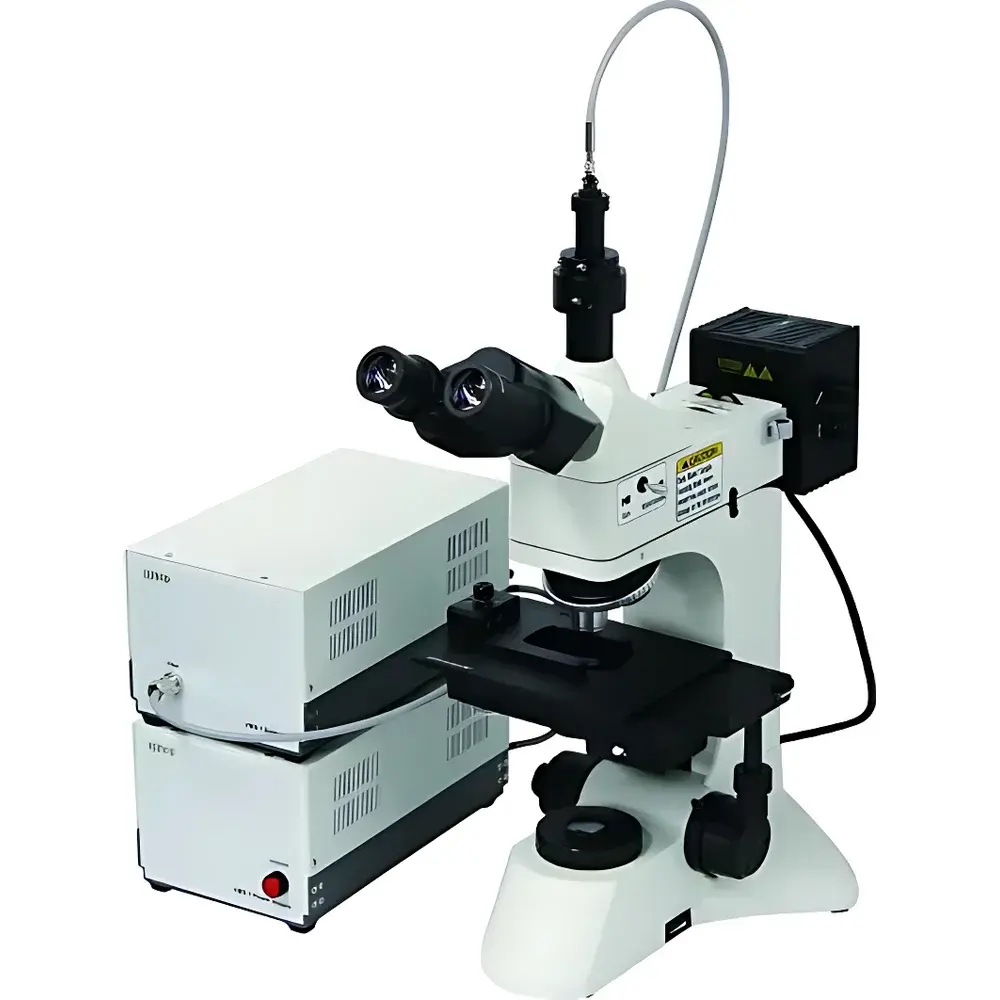
SCINCO VMS-1S UV-Vis Spectrophotometer for Mobile Display Panel Inspection
| Brand | SCINCO |
|---|---|
| Origin | South Korea |
| Model | VMS-1S |
| Optical Configuration | Single-beam |
| Detector | 1024-element photodiode array (PDA) |
| Wavelength Range | 400–1000 nm |
| Wavelength Accuracy | ±1.5 nm |
| Wavelength Repeatability | ±0.2 nm |
| Scan Speed | 1 s per spectrum |
| Light Source | Tungsten halogen lamp |
| Sample Stage | Mechanical dual-layer XY stage (210 × 140 mm footprint |
| Eyepiece | Wide-field WF10× (20 mm field diameter) |
| Objective Lens | 5× |
| Measurement Modes | Transmittance and reflectance of small-area optical features (e.g., IR cut filters, camera aperture windows) |
Overview
The SCINCO VMS-1S is a purpose-engineered UV-Vis spectrophotometer optimized for high-throughput, micro-area optical characterization of display-integrated functional elements—particularly infrared (IR) cut filter apertures on smartphone and tablet front panels. Unlike general-purpose benchtop spectrophotometers, the VMS-1S integrates a precision optical microscope with a single-beam, PDA-based spectroscopic detection system to enable spatially resolved transmittance and reflectance measurements at sub-millimeter scale. Its optical architecture follows classical Beer–Lambert principles, with spectral acquisition based on dispersed light incident on a fixed 1024-pixel photodiode array, eliminating mechanical wavelength scanning and thereby ensuring exceptional temporal stability and shot-to-shot reproducibility. Designed for integration into QC labs and R&D cleanrooms, the instrument delivers traceable photometric data compliant with ISO 9001-controlled measurement processes and supports alignment-critical workflows through its coaxial viewing path and motorized XY stage.
Key Features
- Compact monolithic chassis with minimal footprint (≤0.03 m²), engineered for space-constrained production line environments and metrology workstations.
- High-density 1024-element photodiode array detector delivering signal-to-noise ratio (SNR) >300:1 (at 550 nm, 1 s integration), critical for low-light transmission analysis of narrow IR-cut apertures.
- Dual-mode optical head supporting both transmittance (through-panel) and reflectance (surface-normal) configurations without hardware reconfiguration.
- Sub-0.3 nm wavelength repeatability enables long-term monitoring of spectral edge shifts in IR filter coatings—key for detecting thermal degradation or batch-to-batch coating variation.
- Full-spectrum acquisition completed in ≤1 second, facilitating inline sampling rates up to 60 measurements per minute under automated trigger control.
- Mechanical dual-layer XY translation stage with 75 × 50 mm travel range and 1 µm resolution positioning, calibrated to NIST-traceable standards and compatible with custom fixture mounting.
Sample Compatibility & Compliance
The VMS-1S accommodates rigid flat substrates up to 200 × 150 mm and thicknesses from 0.3 mm to 8 mm—including Gorilla Glass®, chemically strengthened aluminosilicate, and laminated OLED cover windows. Its 5× objective lens and WF10× eyepiece provide real-time visual targeting of features as small as 150 µm in diameter, such as camera sensor cutouts and proximity sensor windows. All optical paths are sealed against particulate ingress, meeting ISO Class 5 cleanroom compatibility requirements. Data integrity conforms to FDA 21 CFR Part 11 guidelines via optional audit-trail-enabled software, and spectral calibration protocols align with ASTM E308 (computing colorimetric quantities) and ISO 13655 (spectral measurement of graphic technology materials).
Software & Data Management
The included SpectraView Pro software provides instrument control, real-time spectral visualization, and batched report generation in PDF/CSV formats. It supports user-defined pass/fail thresholds for peak transmittance (%T @ 850 nm), cutoff slope (Δ%T/Δλ between 750–900 nm), and spectral uniformity across multi-point grid scans. Raw spectral data is stored in vendor-neutral .jdx format, enabling interoperability with third-party analysis tools (e.g., MATLAB, Python SciPy). The software architecture includes role-based access control, electronic signature capability, and full metadata logging—including operator ID, timestamp, stage coordinates, and lamp usage hours—to satisfy GLP and IATF 16949 documentation requirements.
Applications
- Quantitative verification of IR transmission efficiency in camera aperture windows during final assembly QA.
- Monitoring spectral drift of anti-reflective and IR-cut multilayer coatings following thermal cycling or humidity exposure testing.
- Comparative analysis of optical uniformity across large-area displays using programmable 5 × 5 or 10 × 10 grid mapping routines.
- Supporting material qualification for new cover glass suppliers by measuring spectral interference patterns induced by thin-film stress.
- Root-cause analysis of yield loss in proximity sensor modules via correlation of local %T deviation with known defect locations identified by AOI systems.
FAQ
What sample preparation is required prior to measurement?
No coating, cleaving, or mounting is necessary. Samples are placed directly on the stage; only surface cleanliness (ISO 14644 Class 5 wipe protocol) must be verified.
Can the VMS-1S measure curved or flexible displays?
It is validated exclusively for planar, rigid substrates. Curved AMOLED panels require custom fixturing and are outside the scope of factory calibration.
Is NIST-traceable wavelength calibration provided with the instrument?
Yes—a certified holmium oxide and didymium glass reference set is included, with calibration certificate valid for 12 months from shipment.
Does the system support external triggering from PLC or vision inspection systems?
Yes, via opto-isolated TTL input (5 V logic) and RS-232/USB-C serial interface for synchronized start/stop and position reporting.
What maintenance is required for long-term wavelength stability?
Annual lamp replacement and biannual PDA dark-current recalibration are recommended; no optical alignment tools or technician service calls are needed under normal operation.




