SDL Atlas D400IR ECO Infrared Dyeing Tester
| Brand | SDL Atlas |
|---|---|
| Origin | United Kingdom |
| Manufacturer Type | Original Equipment Manufacturer (OEM) |
| Import Status | Imported |
| Model | D400IR |
| Pricing | Available Upon Request |
Overview
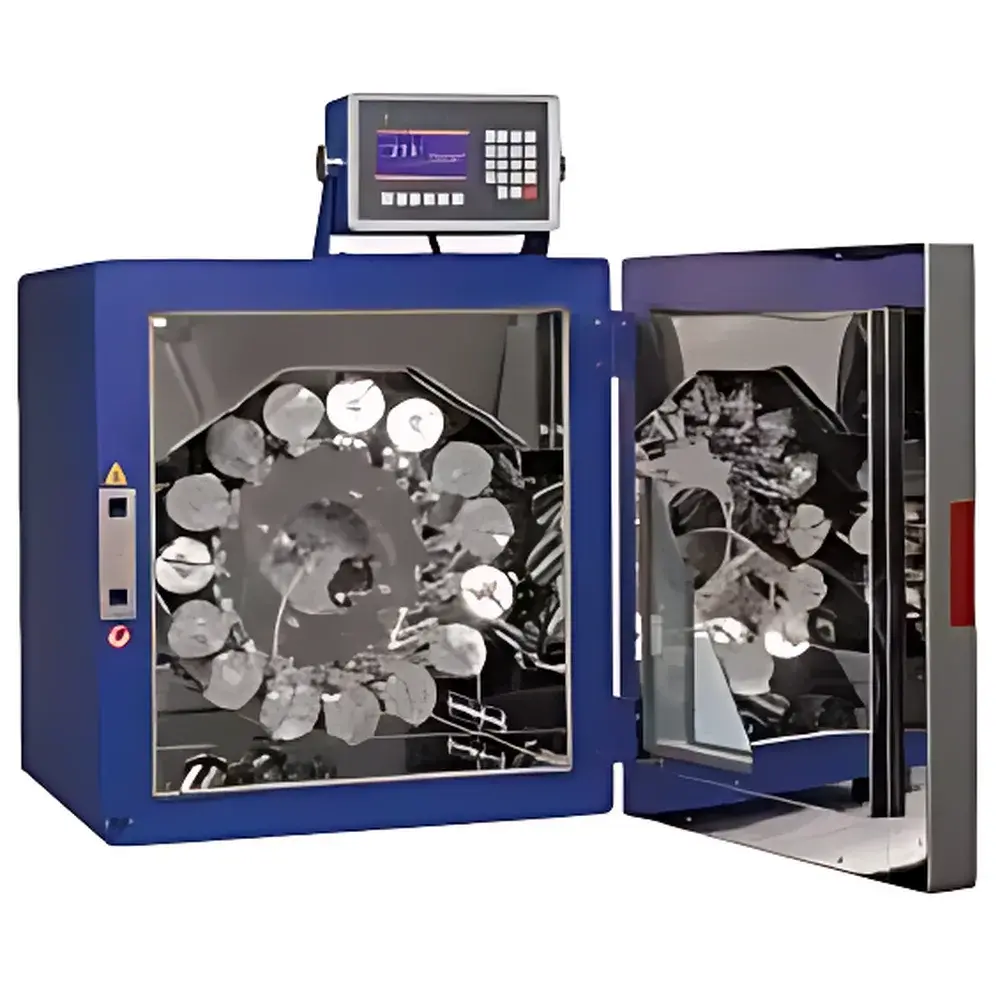
The SDL Atlas D400IR ECO Infrared Dyeing Tester is a precision-engineered laboratory-scale dyeing system designed for reproducible, low-liquor-ratio (LLR) dyeing trials in textile R&D and quality control environments. Unlike conventional dyeing equipment relying on oil or glycol bath heating, the D400IR employs focused near-infrared (NIR) radiation to heat dye solutions directly within individual reaction vessels—eliminating thermal transfer media contamination and reducing maintenance overhead. The system operates on the principle of selective photothermal absorption: NIR energy (wavelength range ~780–1400 nm) penetrates the liquid phase and is absorbed by water, dyes, and auxiliaries, enabling rapid, uniform heating without convective lag. Integrated rotational motion of the 20-position carousel ensures homogeneous mixing and minimizes sedimentation or localized overheating. Each vessel is fitted with a calibrated PT-100 platinum resistance thermometer inserted directly into the dye liquor, delivering real-time, vessel-specific temperature feedback with ±0.3 °C accuracy across the full operational range (ambient to 130 °C). This architecture supports both exhaustion and migration dyeing protocols for reactive, disperse, acid, and direct dyes on natural (cotton, wool, silk) and synthetic (polyester, nylon, acrylic) substrates.
Key Features
- Infrared heating system—no ethylene glycol or thermal oil required; eliminates cross-contamination risk and simplifies cleaning protocols
- 20-position rotating carousel with pressure-rated, borosilicate glass dyeing cups (tested to 6 bar at 150 °C)
- Direct-in-liquid PT-100 temperature sensing per vessel, enabling independent thermal profiling and closed-loop PID control
- Multi-step programmable controller with intuitive touchscreen interface; supports up to 99 sequential steps (ramp/hold/cool) with user-defined dwell times and rate limits
- Low liquor ratio capability (typically 1:5 to 1:20), reducing chemical consumption, wastewater volume, and energy demand by up to 40% versus conventional lab dyeing units
- Integrated safety interlocks including overtemperature cutoff, lid-open detection, and motor stall protection compliant with IEC 61000-6-2 and EN 61000-6-4
Sample Compatibility & Compliance
The D400IR accommodates a broad spectrum of textile substrates—including woven/knitted fabrics, yarns, fibers, and nonwovens—without requiring substrate-specific fixtures. Sample holders are standardized to accept ISO 105-C06-compliant fabric swatches (10 × 10 cm) or ASTM D2259-17-compatible yarn skeins. Vessel geometry ensures consistent mechanical agitation across fiber types, minimizing differential dye uptake due to hydrodynamic variability. The system meets ISO 105-X12 (fastness to washing), ISO 105-P01 (dyeing reproducibility), and AATCC Test Method 61 requirements when operated under validated protocols. Full audit trail functionality—including operator ID, timestamped parameter logs, and electronic signature support—is available via optional software integration aligned with FDA 21 CFR Part 11 and GLP/GMP documentation standards.
Software & Data Management
The D400IR operates natively with SDL Atlas’ proprietary DyeLab™ Control Suite (v4.2+), which provides remote monitoring, method library management, and automated report generation in PDF/CSV formats. All temperature profiles, step transitions, and alarm events are time-stamped and stored locally on an industrial-grade SD card (16 GB, FAT32 formatted) with write-protection options. Data export supports LIMS integration via OPC UA or Modbus TCP protocols. Firmware updates are performed via secure HTTPS endpoint with SHA-256 signature verification. Electronic records comply with ALCOA+ principles (Attributable, Legible, Contemporaneous, Original, Accurate, Complete, Consistent, Enduring, Available) for regulatory submissions.
Applications
- Development and optimization of low-impact dyeing recipes for polyester using high-temperature disperse dyes (up to 130 °C)
- Reactive dye exhaustion studies on cellulosic fibers under controlled pH and salt addition sequences
- Comparative fastness evaluation across dye classes (e.g., azo vs. phthalocyanine) under identical thermal histories
- Validation of eco-friendly auxiliaries (bio-based dispersants, enzymatic scouring agents) in small-batch trials
- Training and proficiency testing for textile laboratory personnel in standardized dyeing methodology (ISO 105-C06, ISO 105-E01)
- Supporting OEKO-TEX® Standard 100 and ZDHC MRSL conformance testing through traceable, repeatable process execution
FAQ
What is the maximum operating temperature and pressure rating of the dyeing cups?
Each cup is certified to operate continuously at 130 °C and withstand transient pressures up to 6 bar at 150 °C per EN ISO 12100 mechanical safety validation.
Can the D400IR be integrated into an existing LIMS or ERP environment?
Yes—via optional OPC UA server module supporting read/write access to all real-time process variables and historical datasets.
Is calibration traceable to national standards?
Temperature sensors are factory-calibrated against NPL-traceable reference standards (UKAS accredited); annual recalibration services include certificate of conformity with uncertainty budget.
Does the system support automatic reagent dosing?
Not natively; however, third-party peristaltic pump modules can be synchronized via digital I/O triggers programmed in DyeLab™.
What maintenance intervals are recommended?
Daily visual inspection of cup seals and IR emitter alignment; quarterly verification of PT-100 sensor drift (<±0.2 °C); biannual optical cleaning of quartz IR windows using IPA and lint-free wipes.