
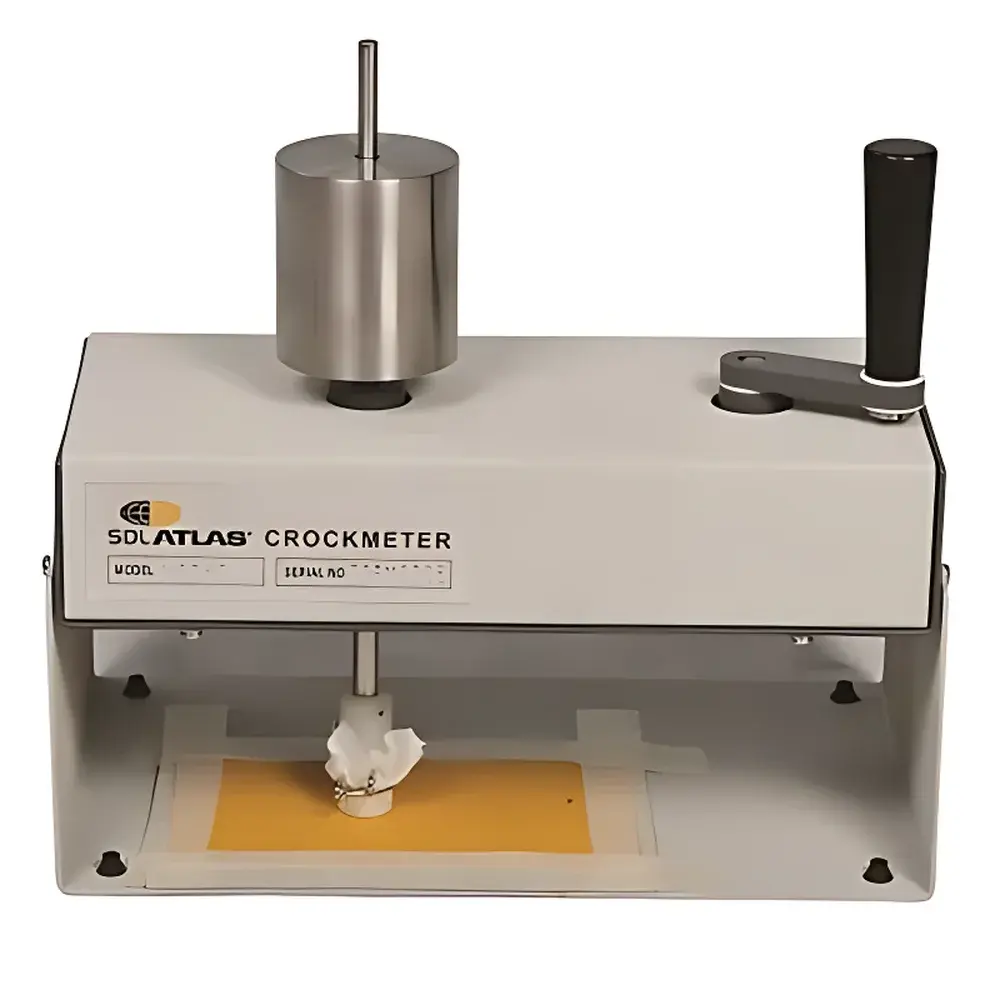
SDL Atlas M238E Rotary Crockmeter
| Brand | SDL Atlas |
|---|---|
| Origin | Guangdong, China |
| Manufacturer Type | Manufacturer |
| Country of Origin | China |
| Model | M238E |
| Price Range | USD 7,000 – 14,000 |
| Test Head Diameter | 16 mm |
| Applied Load | 1134 g |
| Motion Profile | Clockwise 1.125 revolutions followed by counterclockwise return stroke |
| Actuation | Manual rotary handle |
Overview
The SDL Atlas M238E Rotary Crockmeter is a precision-engineered instrument designed specifically for evaluating dry and wet color fastness to rubbing (crocking) in textile materials, particularly printed, dyed, and coated fabrics. It operates on the standardized rotary friction principle defined in ISO 105-X12, AATCC Test Method 8, and GB/T 3920—applying controlled mechanical shear stress via a rotating cylindrical test head against a standardized white cotton or multifiber fabric. The device replicates real-world abrasion conditions encountered during garment handling, laundering, and end-use wear, enabling objective quantification of color transfer under reproducible load and motion parameters. Its robust mechanical architecture ensures long-term dimensional stability and consistent force application—critical for inter-laboratory comparability and regulatory compliance.
Key Features
- Fixed-load rotary actuation delivering precisely 1134 g (±10 g) normal force via calibrated mass system—fully compliant with ISO and AATCC load specifications.
- 16 mm diameter polished stainless-steel test head with concentric groove geometry, ensuring uniform contact area and minimizing edge effects during rubbing.
- Repeatable bidirectional motion sequence: 1.125 clockwise rotations followed by immediate counterclockwise return—mimicking natural fabric-to-fabric contact dynamics without slippage or dwell time.
- Ergonomic manual rotary handle with tactile feedback and positive stop mechanism, eliminating operator-induced variability in stroke initiation and termination.
- Modular base plate compatible with standard AATCC and ISO multifiber test cloths (MFT), as well as user-supplied white cotton swatches (100% bleached, 10 × 10 cm).
- Non-electronic, purely mechanical design—no calibration drift from sensors or firmware; maintenance limited to periodic cleaning and visual inspection per ASTM E29.
Sample Compatibility & Compliance
The M238E accommodates flat textile specimens up to 150 × 150 mm, secured via spring-loaded clamping frame with adjustable tension to prevent lateral movement during testing. It supports both dry-state evaluation and wet-state assessment using specimens conditioned to specified moisture content (e.g., AATCC 20A equilibrium at 65% RH / 21°C). All test protocols align with internationally recognized standards: ISO 105-X12 (rotary crockmeter method), AATCC TM8 (Crockmeter Test), GB/T 3920 (Textiles — Tests for colour fastness — Colour fastness to rubbing), and JIS L 0849 Type II. The instrument’s mechanical traceability enables full audit readiness for GLP environments and third-party certification labs requiring documented metrological chain-of-custody.
Software & Data Management
As a fully mechanical, non-digital instrument, the M238E does not incorporate embedded software or data logging functionality. This design choice prioritizes operational simplicity, long-term reliability, and immunity to cybersecurity vulnerabilities or firmware obsolescence. Test results are recorded manually in laboratory notebooks or LIMS-compatible spreadsheets following standardized reporting templates (e.g., AATCC Evaluation Procedure 1). For laboratories operating under FDA 21 CFR Part 11 or ISO/IEC 17025 requirements, handwritten records must be contemporaneous, signed, and archived with specimen identification, environmental conditions (temperature/humidity), operator ID, and reference standard lot numbers. Optional accessories—including calibrated load verification kits and certified reference crocking charts—are available to support internal quality audits.
Applications
- Quality control of digital textile prints, reactive-dyed cottons, pigment-coated synthetics, and thermoset finishes prior to shipment.
- R&D screening of novel dye systems, nano-pigment dispersions, and crosslinking agents for improved rub fastness performance.
- Supplier qualification testing in global apparel supply chains where compliance with brand-specific color fastness thresholds (e.g., ZDHC MRSL Level 3) is mandatory.
- Failure analysis of crocking-related customer complaints—correlating lab results with field wear patterns using standardized grey scales (ISO 105-A02/A03).
- Validation of post-finishing treatments such as silicone softeners, cationic fixatives, or plasma surface modification.
FAQ
Does the M238E require electrical power or compressed air?
No—it is entirely manual and mechanically self-contained, requiring no external utilities.
Can it be used for wet crocking tests?
Yes; specimens are pre-moistened to 100% saturation or conditioned per AATCC TM8 procedure before mounting.
Is calibration certification provided with the instrument?
SDL Atlas supplies a factory-verified load certificate traceable to NIM (China National Institute of Metrology); annual verification against certified weights is recommended.
What consumables are required for routine operation?
Standardized multifiber test cloth (MFT), white cotton crocking cloth, grey scale for staining assessment (ISO 105-A02), and distilled water for wet testing.
How does the M238E differ from linear crockmeters?
Unlike reciprocating linear devices (e.g., AATCC TM116), the rotary design applies torsional shear more representative of rotational garment contact, yielding higher sensitivity for structured prints and pile fabrics.





