
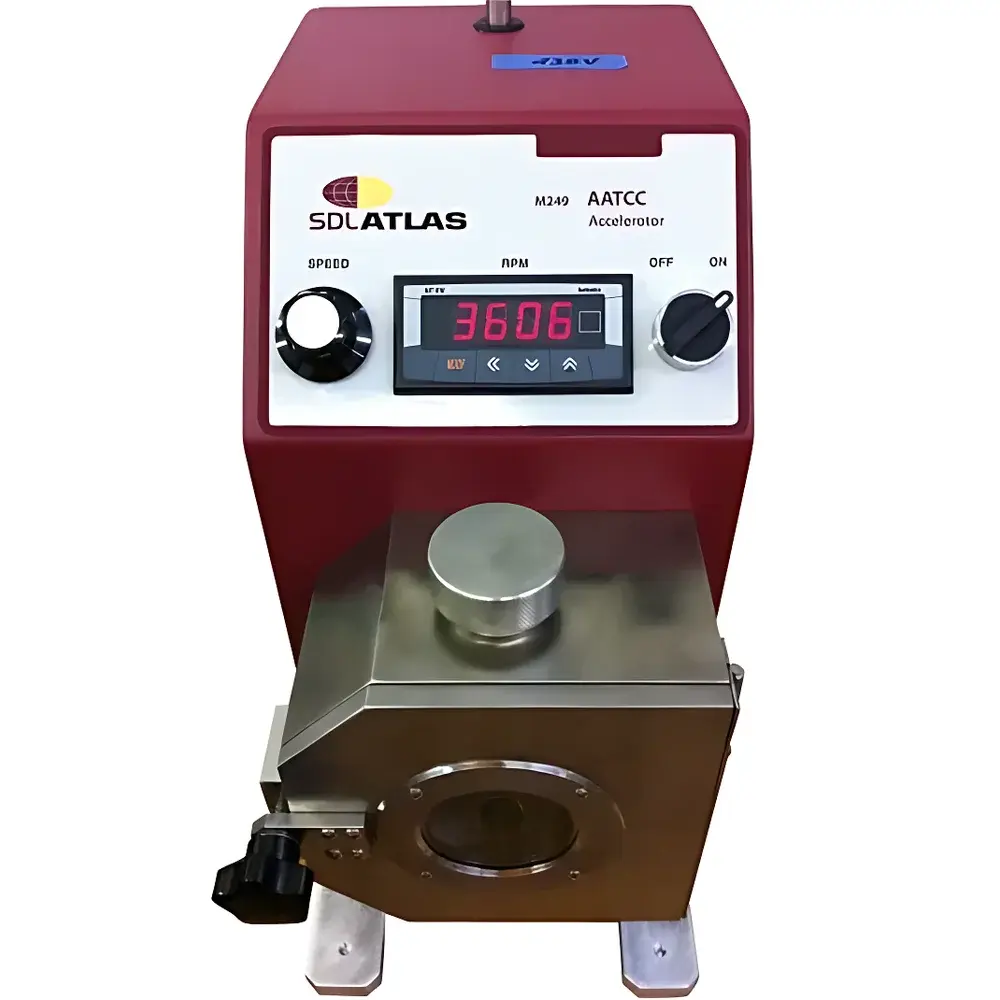
SDL Atlas M249 AATCC Accelerated Abrasion Tester
| Brand | SDL Atlas |
|---|---|
| Origin | Guangdong, China |
| Manufacturer Type | Manufacturer |
| Country of Origin | China |
| Model | M249 |
| Price Range | USD 14,000 – 70,000 |
Overview
The SDL Atlas M249 AATCC Accelerated Abrasion Tester is a precision-engineered instrument designed to evaluate the dry and wet abrasion resistance of flexible sheet materials—including textiles, nonwovens, paper, leather, and thin plastic films—under standardized, reproducible mechanical stress. It operates on the principle of controlled tumbling abrasion, where test specimens are subjected to continuous, uniform rotational motion inside a cylindrical test chamber lined with standardized abradant material. The motion is generated by a precisely balanced impeller (rotor) immersed in the specimen chamber, inducing a consistent tumbling action that simulates real-world wear mechanisms such as flexing, rubbing, and surface attrition. Unlike flat-bed or reciprocating abrasion testers, the M249 replicates multi-directional, volumetric wear patterns critical for assessing durability in end-use applications like apparel, upholstery, technical fabrics, and packaging substrates. Its design strictly adheres to the mechanical and dimensional requirements specified in AATCC Test Method 93 (Accelerated Abrasion Resistance of Textiles) and ASTM D3884 (Standard Guide for Abrasion Resistance of Textile Fabrics), ensuring compatibility with internationally recognized performance evaluation protocols.
Key Features
- Programmable digital controller enabling precise setting and monitoring of rotation speed (typically 60–120 rpm), test duration (0–999 minutes), and cycle count
- Robust stainless-steel cylindrical test chamber with removable, standardized abradant liner—compatible with AATCC-approved abrasive papers (e.g., #1000 grit silicon carbide paper) and ASTM-specified woven wool felts
- Self-centering impeller rotor engineered for balanced dynamic loading, minimizing vibration and ensuring uniform specimen agitation across all load conditions
- Dual-mode operation supporting both dry-abrasion and wet-abrasion testing via optional liquid retention trays and calibrated moisture application kits
- Integrated safety interlock system that halts operation upon chamber lid opening, compliant with IEC 61000-6-2 electromagnetic compatibility and EN 61010-1 laboratory equipment safety standards
- Modular construction facilitating rapid cleaning, liner replacement, and calibration verification without disassembly of drive components
Sample Compatibility & Compliance
The M249 accommodates specimens up to 100 mm × 100 mm (4 in × 4 in) in planar dimension and up to 5 mm in thickness, including laminated composites and coated substrates. It supports standardized specimen mounting using AATCC-supplied clamping rings and tensioning fixtures to eliminate slippage during high-speed tumbling. All abradant materials—including rotors and liners—are supplied exclusively by certified AATCC-accredited vendors to guarantee traceable conformity with AATCC TM93 Annex A specifications. The instrument meets the dimensional, rotational tolerance, and torque consistency criteria required for GLP-compliant color fastness and durability testing laboratories. While not an ISO/IEC 17025-accredited device itself, its operational parameters are fully documented and auditable for inclusion in laboratory quality management systems aligned with ISO/IEC 17025:2017 Clause 6.4 (Equipment) and Clause 7.2 (Method Validation).
Software & Data Management
The M249 operates as a standalone hardware platform with embedded firmware; no proprietary PC software is required for basic operation. However, it features an RS-232 serial interface (optional USB-to-serial adapter available) enabling integration into LIMS or custom QA data logging environments. All test parameters—including start time, elapsed duration, speed setpoint, and stop reason—are timestamped and stored in non-volatile memory for up to 1,000 test records. Exported logs comply with FDA 21 CFR Part 11 audit trail requirements when paired with validated third-party data acquisition software supporting electronic signatures and user access controls. Calibration certificates for impeller balance and rotational speed verification are issued per ISO/IEC 17025-accredited service providers upon request.
Applications
- Evaluation of pilling resistance in knitted and woven apparel fabrics per AATCC TM152
- Assessment of coating adhesion and substrate integrity in synthetic leathers and laminated textiles
- Comparative abrasion ranking of medical-grade nonwovens used in surgical gowns and drapes (ASTM F1670/F1671 surrogate testing)
- Quality control of printing durability on paper-based labels and flexible packaging films
- Pre-screening of textile reinforcements for automotive interior trim and aerospace cabin linings
FAQ
Does the M249 comply with AATCC TM93 and ASTM D3884?
Yes—the mechanical configuration, rotor geometry, chamber dimensions, and rotational tolerances conform to the mandatory requirements of both standards.
Are abradant liners and rotors supplied with the instrument?
No—abradant materials must be procured separately from AATCC-authorized suppliers to ensure traceable certification and batch-specific performance validation.
Can the M249 perform wet abrasion tests?
Yes, with optional moisture retention trays and calibrated water application accessories, enabling controlled wet-state abrasion per AATCC TM116 procedures.
Is routine calibration required?
Annual speed verification and impeller balance validation are recommended; full calibration services are available through SDL Atlas-certified field engineers.
What maintenance is needed between tests?
Chamber cleaning with lint-free cloths and visual inspection of liner wear after every 10 test cycles; rotor shaft lubrication is required only once per 500 operating hours.





