
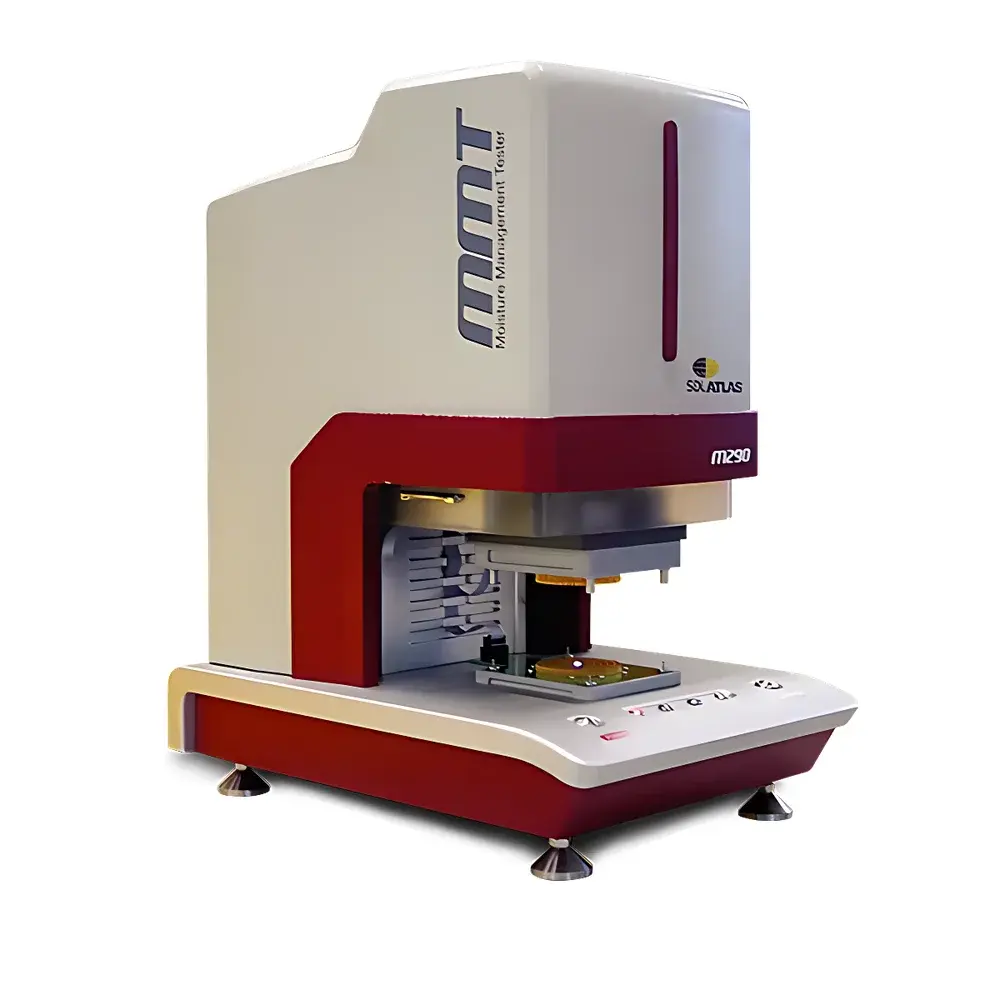
SDL Atlas MMT Liquid Moisture Management Tester
| Brand | SDL Atlas |
|---|---|
| Origin | Shenzhen, China |
| Manufacturer Type | Manufacturer |
| Origin Category | Domestic (China) |
| Model | MMT |
| Price Range | USD 14,000 – 42,000 |
| Compliance Standards | AATCC 195, GB/T 21655.2 |
| Test Duration | ≤ 120 s |
| Measurement Principle | Electrical Resistance Mapping of Dynamic Liquid Transport |
| Sensor Options | Standard Isotropic Sensor / Directional 8-Channel Anisotropic Sensor |
| Sample Mounting | Horizontal, Centered via LED Alignment Guide |
| Optional Accessory | Adjustable Elastic Fabric Clamp (0–50% elongation) |
Overview
The SDL Atlas MMT Liquid Moisture Management Tester is an engineered instrument designed for objective, quantitative assessment of dynamic liquid transport behavior in technical and functional textiles. It operates on the principle of real-time electrical resistance mapping: when a standardized synthetic sweat solution (0.08% NaCl in deionized water) is applied to the fabric surface, localized changes in conductivity—corresponding to moisture penetration, lateral spreading, and vertical wicking—are captured by an array of precision electrodes embedded in top and bottom sensor plates. The system computes six core performance metrics within a maximum 120-second test cycle, including overall moisture management capacity (OMMC), accumulative one-way transport capability (AOTC), wetting time and absorption rate for both top and bottom surfaces, maximum wetted radius, and liquid diffusion speed. This methodology aligns with internationally recognized test protocols—specifically AATCC Test Method 195 and GB/T 21655.2—and supports traceable, repeatable evaluation under controlled environmental conditions (23 ± 2°C, 50 ± 5% RH).
Key Features
- Automated dual-sensor positioning: Motor-driven upper sensor plate and semi-transparent protective hood deploy automatically before and after testing, ensuring consistent electrode-to-fabric contact pressure and protecting specimens from ambient airflow interference.
- Real-time visual monitoring: The optically clear hood enables direct observation of liquid front propagation without compromising measurement integrity or operator safety.
- Dual-sensor modularity: Users select between the standard isotropic sensor (for AATCC 195/GB/T 21655.2 compliance) or the directional 8-channel anisotropic sensor, which resolves radial moisture migration patterns across orthogonal and diagonal axes—critical for evaluating engineered gradient fabrics and asymmetric laminates.
- Open-frame mechanical architecture: Facilitates rapid sample loading, accessory interchange (e.g., elastic clamps), and routine sensor cleaning; no tools required for sensor removal or reinstallation.
- Centering assistance: Integrated LED alignment guide ensures precise specimen placement at the sensor centroid, minimizing positional variance and enhancing inter-laboratory reproducibility.
- Calibration verification kit: Includes certified reference fabrics with documented OMMC and AOTC values, enabling daily system performance validation per ISO/IEC 17025 internal quality control requirements.
Sample Compatibility & Compliance
The MMT accommodates flat, non-rigid textile specimens measuring 100 mm × 100 mm (minimum), including knits, wovens, nonwovens, laminates, and coated fabrics. Its horizontal mounting configuration eliminates gravitational bias inherent in vertical wicking tests. For stretchable substrates—such as sportswear membranes or compression garments—an optional elastic fabric clamp allows controlled uniaxial extension up to 50%, with mechanical scale indicators ensuring repeatable strain application prior to transfer into the test zone. All reported metrics comply with the statistical reporting conventions defined in AATCC 195 (2023 edition) and GB/T 21655.2–2019. Data outputs meet GLP documentation standards, with timestamped raw resistance curves, derived parameter tables, and pass/fail classification against user-defined thresholds.
Software & Data Management
The MMT Control Software (v4.2+) provides multilingual interface support (English, Spanish, Turkish, Simplified Chinese) and enforces audit-trail functionality compliant with FDA 21 CFR Part 11 requirements. Each test session generates a secure, tamper-evident PDF report containing metadata (operator ID, ambient conditions, calibration status), normalized resistance plots, spatial heatmaps of moisture distribution, and final parameter values with uncertainty estimates. Export options include CSV for statistical process control (SPC) integration and XML for LIMS interoperability. Software updates are delivered via encrypted firmware packages with SHA-256 checksum verification.
Applications
- Functional apparel development: Quantifying moisture diversion efficiency in next-to-skin layers of athletic wear, military uniforms, and medical compression textiles.
- Quality assurance in high-volume production: Batch screening of hydrophilic/hydrophobic finish uniformity across dye lots and supplier deliveries.
- R&D of smart textiles: Characterizing stimulus-responsive coatings (e.g., thermochromic or pH-sensitive finishes) under dynamic hydration states.
- Regulatory submission support: Generating data packages for OEKO-TEX® STANDARD 100 Class II certification and bluesign® system audits requiring objective moisture management evidence.
- Academic research: Investigating capillary-driven transport mechanisms in bio-inspired fibrous architectures and nanofiber-based filtration media.
FAQ
What standards does the MMT validate against?
The instrument implements AATCC Test Method 195 and GB/T 21655.2 as primary normative references; full compliance documentation is provided with each system.
Can the MMT test three-dimensional or quilted fabrics?
Yes—provided the specimen remains planar under the sensor plates and does not exceed 10 mm thickness; compression force is limited to 1.2 kPa to avoid structural deformation.
Is external environmental control required?
Testing must be conducted in a conditioned laboratory meeting ISO 139 specifications (23 ± 2°C, 50 ± 5% RH); the MMT itself does not regulate ambient conditions.
How often should the verification fabric be used?
Daily use is recommended before the first test of each shift, with results logged in the system’s QC register to satisfy ISO/IEC 17025 Clause 7.7.1.
Does the directional sensor require separate calibration?
No—the directional sensor shares the same calibration matrix as the standard sensor; orientation-specific algorithms are applied during post-processing, not hardware adjustment.





