
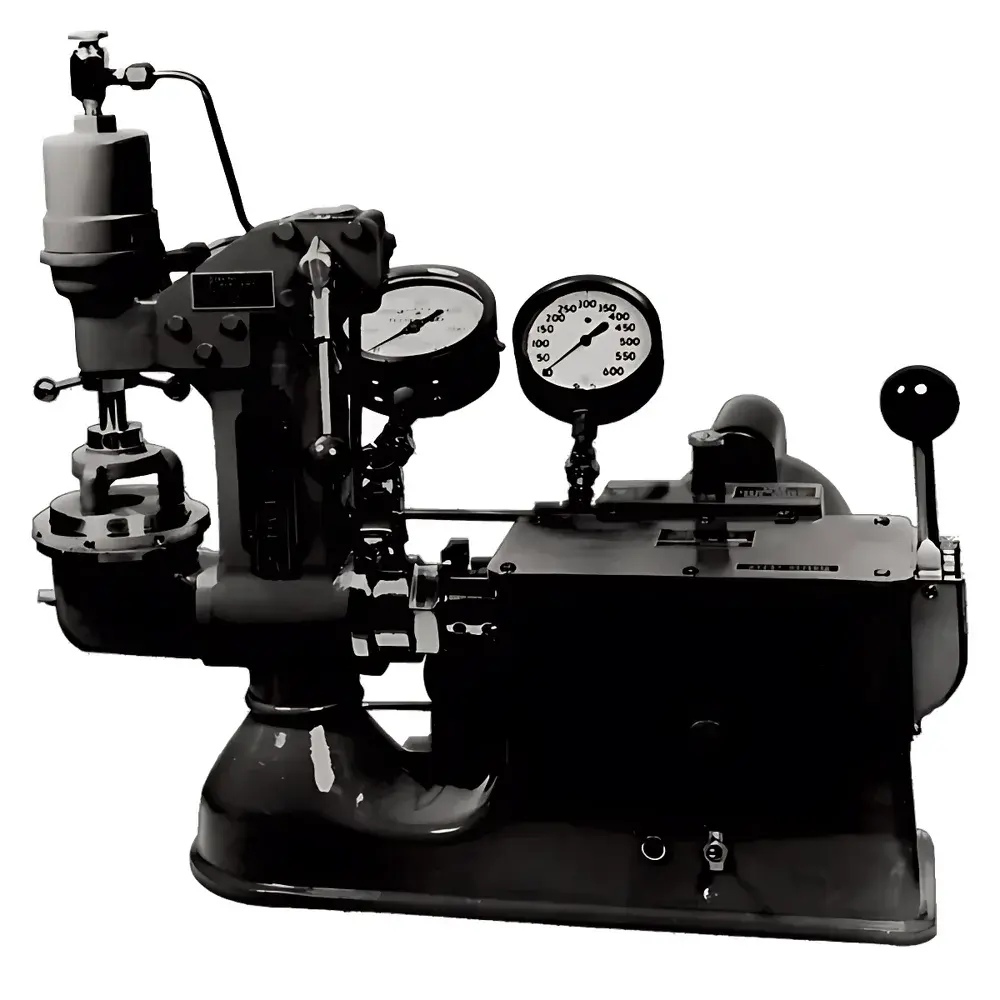
SDL Atlas Mullen Model AH Burst Tester
| Brand | SDL Atlas |
|---|---|
| Origin | USA |
| Manufacturer Type | Manufacturer |
| Origin Category | Imported |
| Model | Model AH |
| Pricing | Upon Request |
Overview
The SDL Atlas Mullen Model AH Burst Tester is a precision-engineered hydraulic burst strength testing instrument designed to measure the resistance of planar materials to rupture under uniformly distributed, perpendicular hydraulic pressure. Operating on the classical Mullen principle—where a diaphragm-supported, expanding rubber membrane applies controlled hydraulic force against a clamped specimen—the Model AH delivers reproducible, standardized burst strength values in pounds per square inch (PSI). With a maximum test pressure of 1500 PSI, it is validated for high-strength substrates including corrugated fiberboard, linerboard, heavy-duty textiles, nonwovens, coated papers, and composite packaging laminates. Its robust mechanical architecture and calibrated hydraulic actuation system ensure compliance with foundational physical testing methodologies used across global quality assurance laboratories.
Key Features
- Hydraulic burst testing platform with full-scale capacity of 1500 PSI, enabling evaluation of both standard and high-strength industrial materials.
- Dual-purpose hydraulic clamping system engineered to apply uniform, adjustable clamping pressure—critical for preserving structural integrity of corrugated board flutes during testing.
- Manually regulated hydraulic pressure control for precise, repeatable application of force without reliance on electronic servo systems.
- Integrated analog pressure gauge with fine-resolution scale for real-time visual monitoring and manual endpoint determination.
- Stainless-steel test chamber and hardened steel clamping rings for long-term dimensional stability and corrosion resistance.
- Compliant with core mechanical design principles underlying TAPPI T 403 om-22 (Bursting Strength of Paper and Paperboard) and ASTM D774 / D3786 (Bursting Strength of Textiles and Woven/Nonwoven Fabrics).
Sample Compatibility & Compliance
The Model AH accommodates flat, flexible sheet materials up to 150 mm (6 in) in diameter, including corrugated medium, solid bleached sulfate (SBS), kraft linerboard, technical textiles, geotextiles, filtration membranes, and metallized foils. Its clamping geometry and diaphragm displacement profile are optimized to minimize edge effects and ensure uniform stress distribution across the test area. The instrument satisfies essential requirements for GLP-compliant environments when operated within documented SOPs, and its mechanical traceability supports audit readiness for ISO/IEC 17025-accredited laboratories. While not digitally networked, its analog operation ensures immunity to software validation burdens associated with 21 CFR Part 11 compliance—making it suitable for facilities maintaining legacy QA workflows aligned with TAPPI, ASTM, and ISO 2965 standards.
Software & Data Management
The Mullen Model AH is a fully manual, analog-operated instrument with no embedded microprocessor, firmware, or digital data output. All measurements are recorded visually from the calibrated pressure gauge and transcribed manually into laboratory notebooks or LIMS-compatible spreadsheets. This architecture eliminates dependencies on software validation, cybersecurity protocols, or electronic signature infrastructure—providing inherent suitability for regulated environments where simplicity, mechanical traceability, and operational transparency are prioritized over automated reporting. Users may integrate the instrument into broader digital QA ecosystems via external pressure transducers (optional retrofit) or camera-based gauge reading systems compliant with internal validation protocols.
Applications
- Quality control of corrugated shipping containers and point-of-purchase displays in packaging manufacturing.
- Evaluation of wet/dry burst strength in technical textiles used in protective apparel, military uniforms, and medical barrier fabrics.
- Validation of nonwoven integrity in filtration media, battery separators, and hygiene product substrates.
- Comparative analysis of coating adhesion and substrate cohesion in laminated paperboard and metallized packaging films.
- Root-cause investigation of delamination, fiber tear propagation, and hydrostatic resistance failure modes in multi-layer composites.
- Supporting R&D activities requiring high-fidelity mechanical rupture data independent of sensor drift or algorithmic interpolation.
FAQ
What standards does the Mullen Model AH comply with?
It is mechanically aligned with TAPPI T 403 om-22, ASTM D774 (paperboard), ASTM D3786 (textiles), and ISO 2965, though final compliance requires verification against current edition specifications and lab-specific calibration procedures.
Can the Model AH test wet specimens?
Yes—its stainless-steel construction and sealed hydraulic system support conditioned or saturated specimens, provided moisture does not compromise clamping integrity or gauge readability.
Is operator training required?
Yes—consistent results depend on proper specimen centering, clamp torque consistency, and controlled pressure ramp rate; SDL Atlas provides documented SOP templates and on-site technician orientation.
Does the instrument require annual recalibration?
Per ISO/IEC 17025 and TAPPI guidelines, the analog pressure gauge must be verified annually against NIST-traceable deadweight testers, and clamping ring wear inspected at scheduled maintenance intervals.
Where is the Model AH manufactured post-acquisition?
All production, final assembly, and distribution of Mullen-branded instruments—including the Model AH—are now conducted at SDL Atlas’s ISO 9001-certified facility in Rock Hill, South Carolina, USA.






