
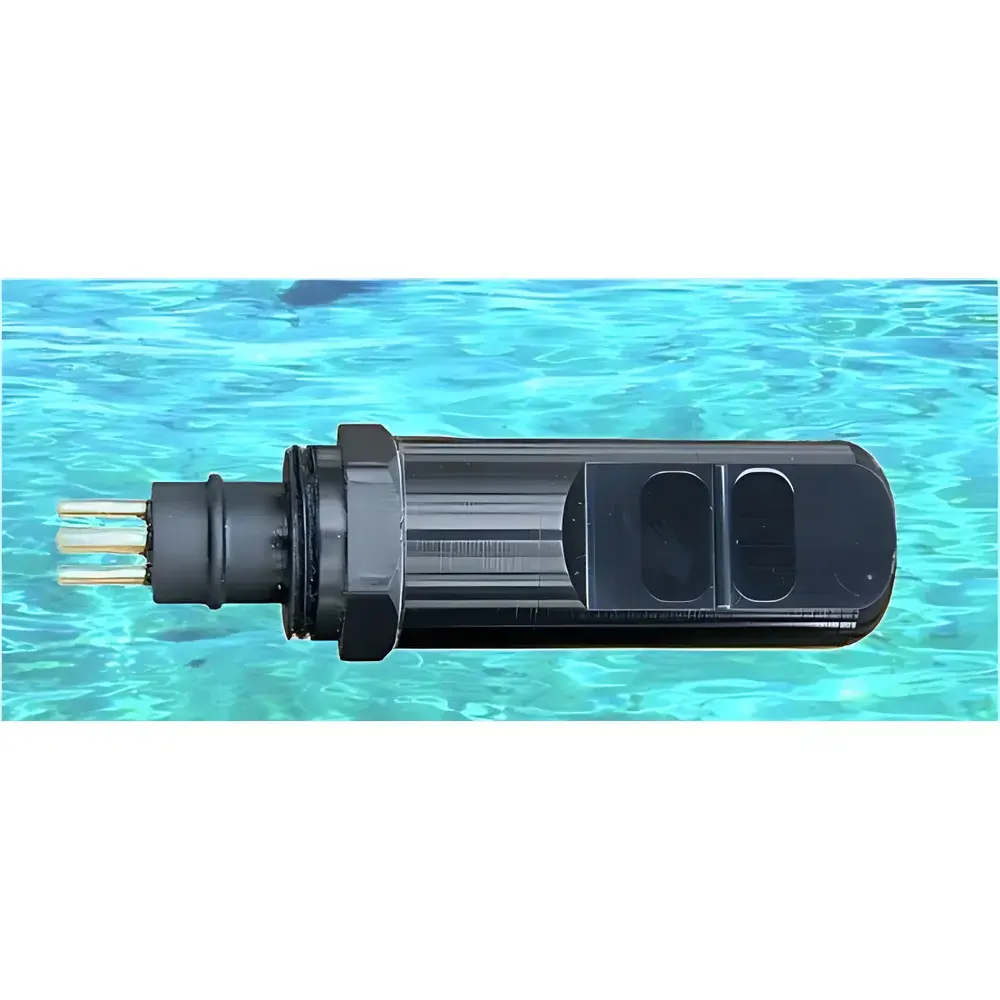
Seapoint STM Turbidity Sensor
| Origin | USA |
|---|---|
| Manufacturer Type | Distributor |
| Origin Category | Imported |
| Model | STM |
| Price Range | USD 1,400–2,800 (est.) |
| Product Type | In-line / Submersible Sensor |
| Measurement Range | 0–4000 FTU |
| Resolution | 0.1 FTU |
| Operating Temperature | 0–65 °C |
| Accuracy | < ±2% FS (0–1250 FTU) |
Overview
The Seapoint STM Turbidity Sensor is an engineered submersible optical sensor designed for continuous, high-stability in-situ measurement of turbidity in natural and engineered water systems. Based on the principle of near-infrared (880 nm) forward-scattered light detection, the STM quantifies suspended particulate matter by measuring the intensity of light scattered at a fixed angular geometry within a tightly constrained optical sensing zone (<5 cm radial distance from the sensor face). This design minimizes interference from ambient light, wall reflections, and sediment resuspension artifacts—critical for benthic profiling, riverine monitoring, and long-term moored deployments. Unlike benchtop nephelometers or laboratory-grade turbidimeters, the STM operates as a true process-grade transducer: it delivers a linear, analog 0–5 VDC output proportional to turbidity (FTU), with four user-selectable gain ranges enabling optimal signal-to-noise ratio across orders of magnitude—from clear oligotrophic waters (sub-1 FTU) to highly turbid estuarine or dredge plume environments (up to 4000 FTU). Its 6000-meter depth rating, low power consumption (3.5 mA avg.), and passive temperature and aging compensation ensure metrological integrity under extended field conditions without manual recalibration.
Key Features
- Four programmable gain ranges (1X, 5X, 20X, 100X) for adaptive resolution and dynamic range optimization
- Optically confined sensing volume (<5 cm radius) to suppress boundary effects and enable near-bottom measurements
- Integrated thermal and photodiode aging compensation—no external zero/span adjustment required
- Low-offset analog output: zero-point drift < ±1 mV; no hardware trimming needed during installation
- Robust housing: ABS thermoplastic body with epoxy-sealed underwater connector (AG-306/206 push-style)
- Submersible rating: IP68, 6000 m seawater depth (19,685 ft), validated per ISO 22820:2020 hydrostatic pressure testing
- Low-power operation: 7–20 VDC input, 3.5 mA typical, compatible with solar-powered data loggers and telemetry systems
- Response time constant: 0.1 s (10–90% step response); RMS noise < 1 mV
- Interchangeable mechanical interface: compatible with Seapoint’s fluorometer mounting brackets and cable harnesses
Sample Compatibility & Compliance
The STM is optimized for aqueous media including freshwater, seawater, wastewater effluent, and sediment-laden slurries. It complies with ASTM D7315-22 (Standard Test Method for Determination of Turbidity in Water Using a Nephelometric Turbidimeter) for field-deployable turbidity instrumentation. While not a certified reference standard, its 880 nm LED source and fixed-angle scattering geometry align with EPA Method 180.1 and ISO 7027-1:2016 principles for instrumental turbidity measurement. The sensor meets CE marking requirements for electromagnetic compatibility (EN 61326-1) and environmental protection (RoHS 3, REACH). Its materials are NSF/ANSI 61-compliant for potable water contact applications. No calibration traceability to NIST SRM is provided; users are advised to perform periodic verification using formazin or AMCO AEPA standards per site-specific QA/QC protocols.
Software & Data Management
The STM operates as a standalone analog transducer—no embedded firmware or onboard data storage. Its 0–5 VDC output is directly compatible with industry-standard data acquisition systems (e.g., Campbell Scientific CR series, Onset HOBO, YSI EXO platforms) and SCADA I/O modules. When integrated into networked environmental monitoring systems, the sensor supports time-synchronized logging with metadata tagging (depth, temperature, GPS position). For regulatory reporting, raw voltage outputs can be converted to FTU using factory-provided gain coefficients and linearization polynomials (valid up to 1250 FTU; nonlinear correction tables supplied for 1250–4000 FTU range). Audit trails, calibration history, and sensor health diagnostics must be managed externally via host system software compliant with FDA 21 CFR Part 11 (if used in GLP/GMP-regulated water quality surveillance).
Applications
- Real-time sediment transport tracking in rivers, deltas, and coastal zones
- Long-term oceanographic profiling (CTD-integrated or moored buoy deployments)
- Wastewater treatment plant influent/effluent monitoring per ISO 24510
- Drinking water intake protection and reservoir clarity assessment
- Environmental impact assessment of dredging, construction, or mining operations
- Validation of remote sensing algorithms (e.g., MODIS, Sentinel-3 OLCI) through in-situ ground truthing
- Autonomous underwater vehicle (AUV) and glider-based water column characterization
FAQ
What is the recommended calibration frequency for the STM in continuous deployment?
Calibration verification is advised every 3–6 months in stable environments; monthly in high-turbidity or biofouling-prone sites. Use traceable formazin standards (e.g., StablCal) and follow ASTM D6708 for interlaboratory precision validation.
Can the STM be deployed in ice-covered freshwater lakes?
Yes—its operating temperature range (0–65 °C) accommodates sub-zero surface conditions when installed below the freeze line; however, ice abrasion on the optical window requires optional quartz guard coating (part #STM-QC).
Is the 0–4000 FTU range fully linear?
Linearity deviation is < ±2% FS up to 1250 FTU and < ±5% FS up to 1600 FTU. Above 750 FTU, output follows a documented polynomial correction curve supplied in the technical manual.
Does the sensor require optical window cleaning during deployment?
Biofouling mitigation is user-managed; no built-in wiper or ultrasonic cleaner. Field-tested antifouling coatings (e.g., silicone-based hydrophobic layers) extend maintenance intervals to >90 days in eutrophic waters.
How is range selection implemented electrically?
Range switching is accomplished via two TTL-compatible digital control lines (VSEL1/VSEL2), allowing hardware or microcontroller-based gain selection without interrupting analog output continuity.



