
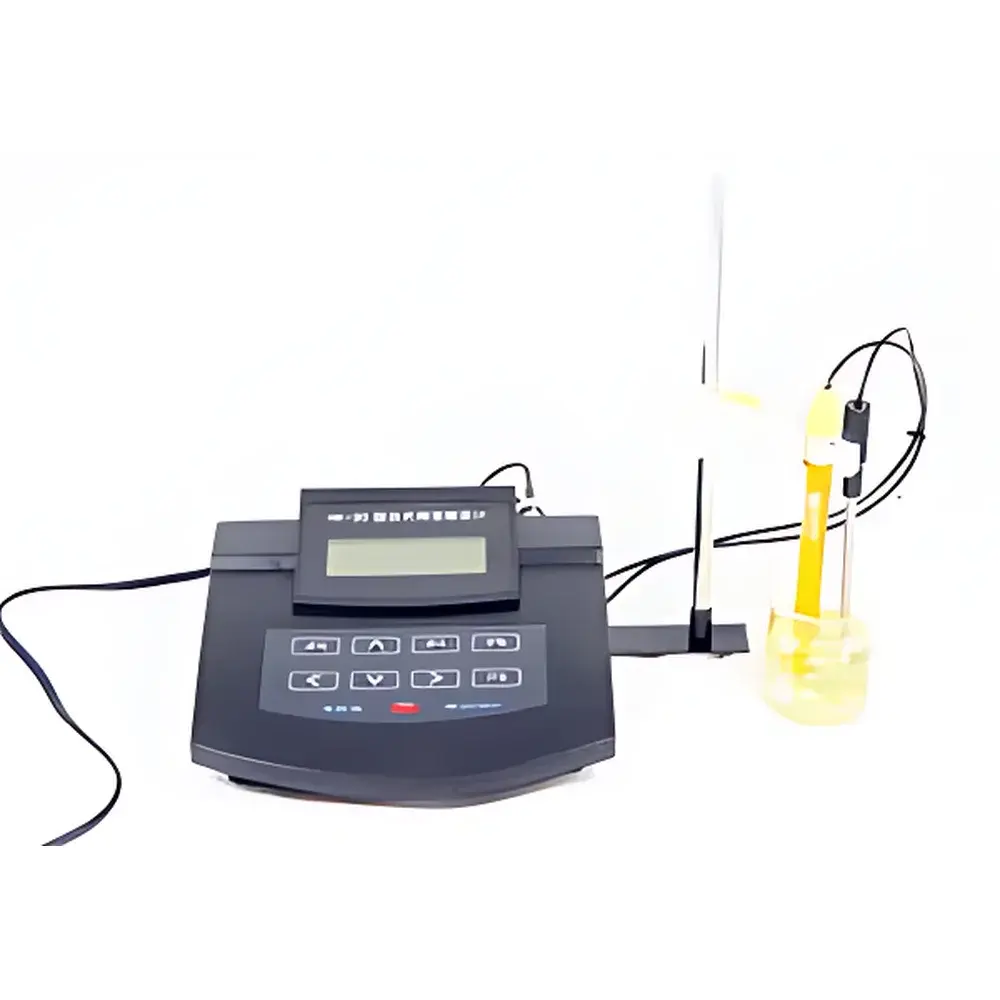
SENHK-3C Desktop Precision pH Meter
| Origin | Beijing, China |
|---|---|
| Manufacturer Type | Authorized Distributor |
| Origin Category | Domestic (China) |
| Model | SENHK-3C |
| Pricing | Available Upon Request |
| Display | 192×64 dot-matrix LCD (English/Chinese selectable) |
| pH Range | 0.00–14.00 |
| pH Resolution | 0.01 |
| pH Accuracy | ±0.02 |
| Input Impedance | ≥10¹² Ω |
| Response Time | ≤60 s to 90% of final value at 25 °C |
| Temperature Sensor | Pt1000 |
| Temp. Range | 0.0–99.9 °C |
| Temp. Accuracy | ±0.5 °C |
| Temp. Resolution | 0.1 °C |
| Temp. Compensation | 0.1–60.0 °C (manual or automatic) |
| Sample Temp. Range | 5–60 °C |
| Operating Ambient | 5–45 °C, ≤90% RH (non-condensing) |
| Storage Temp. | −25–55 °C (electrode excluded |
| Power Supply | 198–242 VAC, 50 Hz ±1 Hz |
| Power Consumption | ≤3 VA |
| Dimensions (L×W×H) | 200 × 210 × 65 mm |
| Weight | 2.0 kg |
Overview
The SENHK-3C Desktop Precision pH Meter is a laboratory-grade electrochemical instrument engineered for high-reproducibility pH measurement in quality control, academic research, and routine chemical analysis environments. Based on potentiometric principle—measuring the potential difference between a pH-sensitive glass electrode and a stable reference electrode—the instrument delivers traceable, NIST-compatible results when calibrated against certified buffer standards. Its design adheres to fundamental electrochemical metrology requirements, including ultra-high input impedance (>10¹² Ω) to minimize loading errors on high-impedance glass electrodes, and temperature-compensated slope calculation per the Nernst equation. The integrated Pt1000 temperature sensor enables accurate automatic temperature compensation (ATC), critical for maintaining measurement integrity across variable sample conditions. Built for daily reliability rather than occasional use, the SENHK-3C operates within ISO/IEC 17025-aligned environmental tolerances and supports documentation practices compatible with GLP and GMP workflows.
Key Features
- Embedded microcontroller architecture with real-time stability detection—automatically flags stable readings based on rate-of-change thresholds, reducing subjective endpoint judgment.
- High-contrast 192×64 dot-matrix LCD with user-selectable English or Chinese interface—optimized for readability under varied ambient lighting in lab and production settings.
- Integrated ATC via Pt1000 sensor with ±0.5 °C accuracy—enables precise slope correction from 0.1 to 60.0 °C, supporting both manual and automatic modes.
- Robust mechanical construction: black reinforced polymer housing, surface-mount PCB assembly, and sealed membrane keypad—designed for long-term durability and resistance to chemical splashes.
- Multi-point calibration support (1–3 points) using standard buffers (pH 4.01, 6.86, 9.18)—with on-screen guidance, slope % display, and offset diagnostics for electrode health assessment.
- Low power consumption (≤3 VA) and wide-input AC supply (198–242 VAC, 50 Hz)—ensures stable operation in fluctuating utility environments common in regional laboratories.
Sample Compatibility & Compliance
The SENHK-3C is validated for aqueous solutions with conductivity ≥20 µS/cm and total dissolved solids (TDS) < 10,000 ppm. It is not recommended for non-aqueous, highly viscous, or protein-rich samples without electrode-specific conditioning protocols. The included 201-C combination pH electrode features a low-resistance glass membrane and Ag/AgCl reference system with double-junction design—minimizing contamination in samples containing sulfides, heavy metals, or proteins. All components comply with IEC 61010-1:2010 safety standards for electrical equipment for measurement, control, and laboratory use. While the instrument itself does not carry CE or UKCA marking, its electrical design meets essential requirements for Class II protected equipment in controlled laboratory spaces. Buffer sets conform to ISO 3696 Grade 3 water purity and include traceable pH certification per ISO 6779.
Software & Data Management
The SENHK-3C operates as a standalone benchtop meter with no proprietary software dependency. All calibration data, measurement history, and system settings are retained in non-volatile memory—even during power loss. Timestamped readings are not generated internally; however, users may manually log entries in accordance with ALCOA+ principles (Attributable, Legible, Contemporaneous, Original, Accurate, Complete, Consistent, Enduring, Available) when employed in regulated environments. For audit readiness, laboratories may integrate the device into electronic lab notebooks (ELNs) or LIMS via documented SOPs specifying calibration frequency (e.g., pre-use and post-series), electrode maintenance logs, and buffer lot traceability. The unit supports 21 CFR Part 11 compliance only when used in conjunction with external validated systems that enforce electronic signatures, audit trails, and role-based access controls.
Applications
- Quality assurance of pharmaceutical excipients and final dosage forms per USP and EP 2.2.3.
- pH monitoring in municipal and industrial wastewater treatment processes—aligned with ASTM D1293 and ISO 10523.
- Calibration verification of inline pH sensors in bioreactor and fermentation systems.
- Teaching laboratories for undergraduate electrochemistry experiments—including Nernst equation validation and buffer capacity analysis.
- Food and beverage QC labs performing titratable acidity correlation studies (e.g., AOAC 973.41).
FAQ
What calibration buffers are required for routine use?
The instrument ships with traceable pH 4.01, 6.86, and 9.18 buffers (25 °C). Calibration should be performed at least daily or before each analytical series, using freshly opened or properly stored buffer solutions.
Can the SENHK-3C measure ORP (redox potential)?
No—this model is dedicated exclusively to pH measurement. ORP capability requires a separate mV mode and compatible redox electrode, which the SENHK-3C does not support.
Is the 201-C electrode suitable for measuring pH in soil slurries?
Yes—with appropriate sample preparation: 1:5 soil-to-deionized water ratio, agitation, settling, and measurement of the supernatant within 30 minutes. Electrode cleaning with 0.1 M HCl followed by rinsing is recommended after each soil analysis.
How often should the ATC temperature sensor be verified?
Verification against a NIST-traceable thermometer is advised quarterly or whenever discrepancies >0.3 °C are observed during simultaneous dual-temperature measurements.
Does the unit support GLP-compliant record keeping?
It provides the foundational metrological performance required for GLP, but full compliance depends on procedural controls—such as written SOPs, calibration logs, and analyst training records—not embedded firmware features.





