
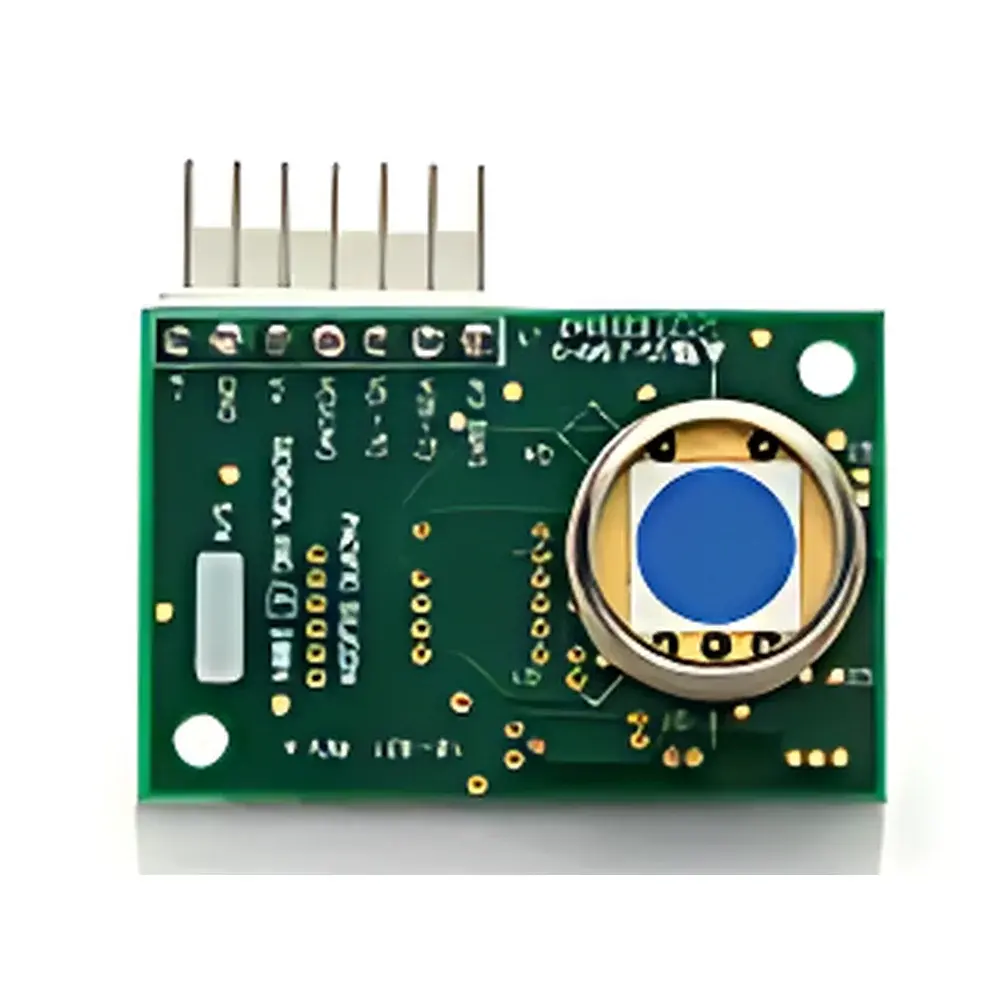
First Sensor 64AA0.24-9 Photodiode Module with Integrated Amplification and Temperature Compensation
| Brand | First Sensor |
|---|---|
| Origin | Germany |
| Model | 64AA0.04-9 |
| Type | APD Array Evaluation Module for LIDAR Applications |
| Bandwidth | 125 MHz |
| Package | Shielded OEM Module with PCB Integration |
| Compliance | RoHS, CE, ISO 9001 Certified Manufacturing |
| Supply Voltage | ±15 V DC |
| Operating Temperature Range | −10 °C to +60 °C |
| Output Interface | SMA coaxial (analog voltage) |
| HV Bias Control | Integrated ultra-low-noise high-voltage source (±500 V, <7.5 mV ripple) |
Overview
The First Sensor 64AA0.04-9 is a fully integrated photodiode module engineered for high-speed, low-noise optical detection in demanding LIDAR, time-of-flight (ToF), and scientific measurement systems. Unlike bare photodiodes or discrete APD chips, this module incorporates a custom-designed transimpedance amplifier (TIA), active temperature compensation circuitry, and an ultra-stable high-voltage bias supply—enabling immediate system integration without external signal conditioning. Its core sensing element is a 4-channel avalanche photodiode (APD) array optimized for 905 nm laser emission, operating in linear mode with gain stability across ambient thermal gradients. The device leverages First Sensor’s proprietary silicon-on-insulator (SOI) APD architecture, delivering high quantum efficiency (>75% at 905 nm), low dark current (<2 nA at −20 °C), and sub-nanosecond rise time. Designed for OEM deployment, the module adheres to industrial-grade mechanical tolerances and EMC shielding standards per IEC 61000-6-3/4.
Key Features
- Integrated 4-element APD array with matched responsivity and gain uniformity (±3% inter-channel deviation)
- On-board transimpedance amplifier with 125 MHz small-signal bandwidth and 50 Ω output impedance
- Dual-stage temperature compensation: analog front-end drift correction + digital feedback loop (via optional I²C interface)
- Embedded high-voltage power supply: ±500 V output, <7.5 mV peak-to-peak ripple, programmable via external DAC input
- Hermetically sealed ceramic package with integrated RF shielding and SMA-female analog output connector
- Compliant with automotive-grade reliability testing (AEC-Q102 Level G, 1000 h HTOL at 85 °C/85% RH)
- Factory-calibrated gain and offset; calibration coefficients stored in on-module EEPROM (I²C accessible)
Sample Compatibility & Compliance
The 64AA0.04-9 is compatible with pulsed laser sources operating at 905 nm (FWHM ≤ 5 nm), including edge-emitting laser diodes (EELs) and VCSEL arrays used in automotive LIDAR and industrial distance mapping. It supports pulse widths from 1 ns to 100 ns and repetition rates up to 2 MHz. The module meets key regulatory and quality frameworks required for instrumentation deployed in regulated environments: RoHS 2011/65/EU, CE marking under Directive 2014/30/EU (EMC) and 2014/35/EU (LVD), and manufacturing traceability aligned with ISO 9001:2015. For applications requiring audit-ready documentation, full calibration reports—including spectral responsivity curves, linearity error maps (≤±0.5% FS), and thermal drift profiles—are available upon request. While not intrinsically certified for medical or aerospace use, the module’s design basis conforms to foundational requirements of IEC 61000-4-2 (ESD immunity) and MIL-STD-883H Method 1010.8 (thermal shock).
Software & Data Management
No proprietary software is bundled; however, the module is fully compatible with standard data acquisition platforms including National Instruments DAQmx, Keysight PathWave, and MATLAB Data Acquisition Toolbox. Analog output signals are DC-coupled and optimized for digitization at ≥1 GS/s sampling rates. Optional firmware upgrade enables I²C-based configuration of HV bias level, TIA gain stage (×10⁴ to ×10⁶ V/A), and internal temperature monitoring (±0.5 °C accuracy). All configuration parameters persist through power cycles. For GLP/GMP-aligned laboratories, First Sensor provides traceable calibration certificates compliant with ISO/IEC 17025:2017, including uncertainty budgets derived from NIST-traceable reference detectors. Audit trails for calibration events and firmware revisions can be exported as CSV or XML for integration into LIMS or electronic lab notebooks.
Applications
- Automotive and robotics LIDAR receivers (solid-state and scanning architectures)
- Time-resolved fluorescence lifetime imaging (FLIM) in biophotonics research
- High-resolution optical beam position and centroid tracking in adaptive optics systems
- Low-light photon counting in Raman spectroscopy and single-molecule detection setups
- Industrial laser alignment and weld seam monitoring under high-EMI conditions
- Atmospheric backscatter profiling using eye-safe 905 nm pulsed lasers
FAQ
Is the 64AA0.04-9 suitable for continuous-wave (CW) operation?
Yes—it supports both pulsed and CW detection modes. In CW mode, the TIA’s DC coupling and low-frequency noise floor (<1 pA/√Hz at 1 kHz) enable stable analog output for intensity monitoring applications.
Can multiple modules be synchronized for multi-channel acquisition?
Yes. The module features a dedicated trigger input (LVDS-compatible) and sync output pin, enabling hardware-level timing alignment across up to 16 units with jitter <50 ps RMS.
Does it require external cooling?
No active cooling is required within its specified operating range (−10 °C to +60 °C). The integrated temperature compensation maintains gain stability to within ±0.02%/°C over this interval.
What is the maximum optical input power before saturation?
Saturation occurs at ≈1.2 µW per channel (for 10 ns pulses at 100 kHz PRF), corresponding to ≈2.5 × 10⁵ photons/pulse at 905 nm. Linear dynamic range exceeds 80 dB.
Are custom calibration or mechanical modifications available?
Yes. First Sensor offers OEM customization including aperture masking, fiber-pigtailed variants (FC/PC or SMA905), and application-specific calibration against user-provided light sources under NDA.







