
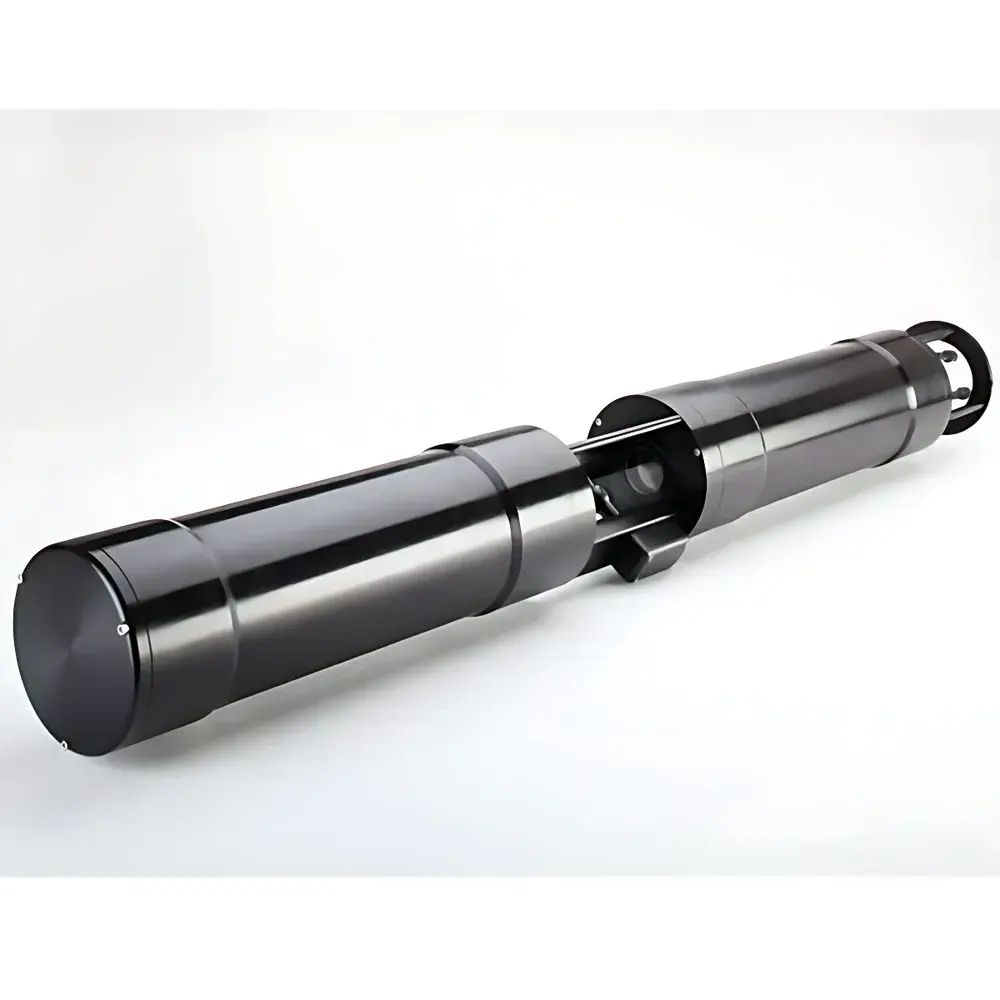
Sequoia LISST-VSF In Situ Volume Scattering Function and Polarization Analyzer
| Brand | Sequoia |
|---|---|
| Origin | USA |
| Model | LISST-VSF |
| Measurement Parameters | VSF (P11), Degree of Linear Polarization (DoLP, P12), Sphericity (P22), Beam Transmission, Depth, Temperature |
| Angular Range | 0.1°–15° (log-spaced, 32 channels) & 15°–150° (1° resolution) |
| Temperature Range | −5 to 50 °C (0.1 °C resolution) |
| Depth Range | 0–50 m (0.08 m resolution) |
| Beam Attenuation Coefficient | 0.1–20 m⁻¹ |
| Sampling Time per Full VSF + DoLP Set | ~4 s |
| Power Supply | 12–15 VDC, 700 mA operating |
| Data Interface | RS-232 (9600/115200 bps) |
| Internal Storage | 128 GB (≈24,000 full measurements) |
| Dimensions (Φ × L) | 12.7 × 95.7 cm (with handle) |
| Weight (air) | 13.1 kg |
| Max Operating Depth | 50 m |
Overview
The Sequoia LISST-VSF is a field-deployable, submersible optical instrument engineered for high-fidelity in situ measurement of the volume scattering function (VSF), denoted as Mueller matrix element P11, alongside the degree of linear polarization (P12, or DoLP) and sphericity-related parameter P22. It operates on the principle of controlled laser illumination (496 nm) combined with angularly resolved, polarization-sensitive detection—enabling quantitative characterization of light scattering by suspended particles across marine, estuarine, and freshwater environments. Unlike conventional scanning systems that rotate a single detector or restrict observation to a fixed sector, the LISST-VSF employs Sequoia’s patented Roving Eyeball™ optical architecture: a motorized, azimuthally rotating collimated receiver whose line-of-sight remains orthogonal to the optical window. As the “eyeball” rotates, it sequentially intercepts scattered photons from distinct angular segments of the incident laser beam, thereby reconstructing the full VSF over 15°–150° with 1° angular resolution. Simultaneously, a concentric silicon photodiode ring captures forward-scattered light from 0.1° to 15° using 32 logarithmically spaced channels—ensuring seamless integration of small-angle and wide-angle scattering data into a single, physically consistent VSF profile.
Key Features
- Simultaneous acquisition of P11 (VSF), P12 (DoLP), and P22 (sphericity proxy) via dual-polarization modulation and dual-PMT detection
- Roving Eyeball™ optics enabling 1°-resolution angular sampling from 15° to 150° without mechanical repositioning of the instrument body
- Logarithmic small-angle detection (0.1°–15°, 32 channels) optimized for accurate extrapolation of total scattering coefficient b and backscattering ratio bb/b
- Laser power dimming control automatically attenuates output during strong forward-scatter conditions (15°–40°), extending dynamic range beyond 6 orders of magnitude in VSF
- High-frequency laser modulation (chopping) suppresses ambient solar irradiance, permitting daytime deployment in surface waters without signal contamination
- Automatic gain control (AGC) on photomultiplier tubes maintains optimal signal-to-noise ratio across variable turbidity regimes
- Integrated CTD sensors provide co-located temperature (±0.1 °C) and depth (±0.08 m) metadata synchronized with each scattering measurement
- Onboard 128 GB non-volatile storage supports unattended operation for >24,000 full VSF+DoLP profiles
Sample Compatibility & Compliance
The LISST-VSF is designed for direct immersion in natural aquatic matrices—including seawater, brackish estuaries, glacial runoff, and eutrophic lakes—without sample extraction or filtration. Its pressure-rated housing (50 m max depth) and corrosion-resistant titanium/housing materials ensure long-term operational integrity under field conditions. The instrument complies with ISO 17025-aligned calibration traceability protocols; factory calibration includes absolute radiometric responsivity (A/W) verification for both PMTs and ring detector channels. All polarization measurements adhere to the Mueller matrix formalism defined in ASTM E2758–19 (Standard Practice for Polarimetric Measurements of Scattering Media). Data logging meets GLP-compliant audit trail requirements when used with Sequoia’s validated firmware v3.2+, supporting time-stamped, checksummed records suitable for regulatory reporting and peer-reviewed publication.
Software & Data Management
Data retrieval and configuration are managed via Sequoia’s cross-platform LISST-View software (Windows/macOS/Linux), which provides real-time telemetry display, spectral visualization of VSF/DoLP angular distributions, and export to netCDF-4 or ASCII formats compliant with NASA’s Ocean Color Web standards. Raw measurements include full Mueller matrix reconstruction coefficients, calibrated photon counts per channel, dark-current subtraction flags, and diagnostic logs (e.g., PMT saturation events, laser power stability metrics). Firmware updates support remote configuration of sampling intervals, laser polarization sequencing, and AGC thresholds. For integration into larger observatory networks, the RS-232 interface supports Modbus RTU protocol mapping, enabling compatibility with Nortek, Sea-Bird, or WHOI-designed data acquisition systems. All stored datasets include embedded metadata conforming to CF (Climate and Forecast) conventions, facilitating ingestion into IOOS and EMODnet repositories.
Applications
- Validation of Mie and T-matrix scattering models against in situ VSF and DoLP profiles across particle size distributions (e.g., polystyrene microspheres, diatom aggregates, mineral clays)
- Quantification of bubble-mediated scattering in wind-mixed surface layers, informing air-sea gas exchange and underwater optical wireless communication (OWC) channel modeling
- Derivation of inherent optical properties (IOPs)—including scattering coefficient b, backscattering coefficient bb, and absorption-corrected phase functions—for radiative transfer model initialization
- Discrimination of microplastic morphology via angle-resolved polarized scattering signatures, supporting identification of fiber vs. fragment populations
- Development and validation of multivariate algorithms linking VSF shape parameters (e.g., asymmetry factor g, backscatter fraction) to particulate organic carbon (POC) concentration
- Characterization of submicron colloidal fractions contributing to near-forward scattering peaks, critical for correcting satellite-derived remote sensing reflectance (Rrs) at blue-green wavelengths
- Field-based assessment of multiple scattering contributions in optically complex waters, enabling refinement of inverse scattering solvers used in bio-optical inversion schemes
FAQ
What is the minimum detectable VSF value and its uncertainty at 90°?
The LISST-VSF achieves a noise-equivalent VSF of ≤1.2×10⁻⁵ m⁻¹ sr⁻¹ at 90° under typical coastal conditions, with relative uncertainty ±4.7% (k=2) based on repeated calibrations using NIST-traceable neutral density filters.
Can the instrument operate autonomously on a mooring or AUV?
Yes—its low-power DC input (12–15 V), RS-232 command set, and internal storage enable integration with standard oceanographic platforms; Sequoia provides mounting brackets and synchronization pulse I/O for coordinated profiling.
How is polarization calibration performed and maintained?
Factory calibration uses a precision rotating half-wave plate and polarizer assembly; users can verify alignment annually using the built-in reference scatterer (polystyrene suspension) and Sequoia’s Polarization Validation Utility.
Is the 0.1°–15° ring detector sensitive to stray light from the laser source?
No—the detector geometry incorporates an annular baffle and multi-stage light traps; combined with laser chopping and synchronous lock-in detection, ambient and specular artifacts are suppressed to <0.3% of full-scale signal.
Does the firmware support user-defined measurement sequences?
Yes—via ASCII command scripting, users may define variable-duration dwell times per polarization state, custom angular step patterns, and conditional triggers based on depth or temperature thresholds.







