
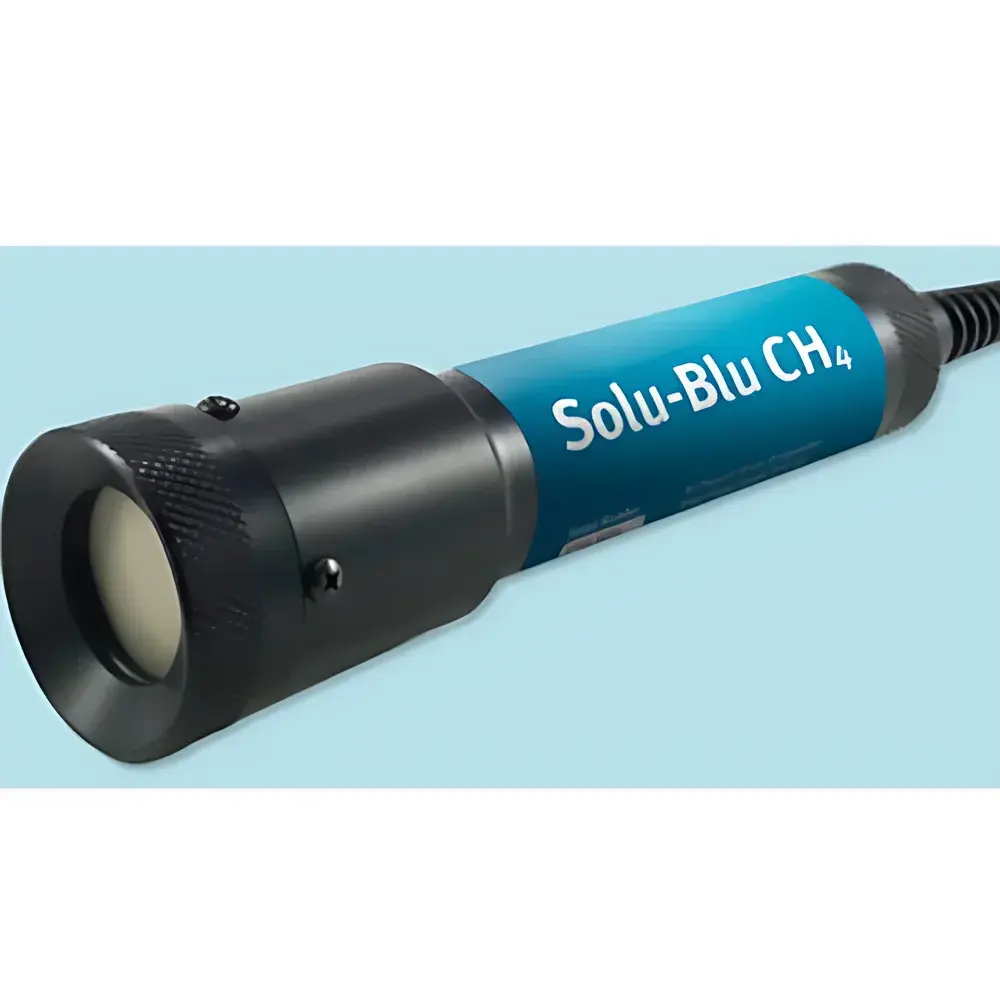
Pro-Oceanus Solu-Blu CH4 Shallow-Water Methane Analyzer
| Brand | Pro-Oceanus |
|---|---|
| Origin | Canada |
| Model | Solu-Blu CH4 |
| Measurement Principle | Membrane Inlet Non-Dispersive Infrared (NDIR) |
| CH₄ Range | 0–30 mg/L (switchable to 0–3 mg/L and 0–300 µg/L) |
| TDGP Range | 0–2 bar |
| Accuracy | ±3% of full scale (pCH₄), ±0.1% FS (TDGP) |
| Response Time (t₆₃) | 10 min |
| Resolution | 0.1% of full scale |
| Operating Depth | 0–50 m |
| Temperature Range | 0–35 °C |
| Power Input | 7–24 VDC |
| Power Consumption | 90 mW (RS-232 + 0–5 V), 300–600 mW (RS-232 + 4–20 mA) |
| Output | RS-232 (ASCII), 0–5 V analog, or 4–20 mA analog |
| Sampling Interval | Configurable down to 2 s |
| Dimensions | 19.68 cm (L, sensor only), 25.68 cm (L with connector) |
| Weight | 0.47 kg |
| Housing Material | Acetal (POM) |
| Standard Cable | 3 m integrated |
Overview
The Pro-Oceanus Solu-Blu CH4 Shallow-Water Methane Analyzer is a submersible, membrane inlet-based dissolved methane sensor engineered for continuous, high-fidelity monitoring in low-to-moderate depth aquatic environments. It operates on the principle of membrane inlet non-dispersive infrared (NDIR) spectroscopy: dissolved CH₄ molecules permeate a selective hydrophobic polymer membrane, equilibrate within a diffusion chamber, and are quantified by an optical NDIR detector calibrated to absorbance at 3.3 µm. This physical measurement method eliminates dependence on chemical reagents, catalytic surfaces, or carrier gases—ensuring long-term operational integrity in biologically active waters. Designed specifically for deployment in coastal zones, inland lakes, aquaculture ponds, and shallow groundwater systems (0–50 m), the Solu-Blu CH4 delivers stable, trace-level CH₄ concentration data (0–30 mg/L, with user-selectable lower ranges) without drift-induced recalibration cycles. Its acetal housing provides corrosion resistance and mechanical robustness under sustained immersion, while its low-power architecture supports autonomous operation on battery, solar, or mains-powered data loggers.
Key Features
- Membrane inlet NDIR detection: Reagent-free, zero consumables, no cross-sensitivity to CO₂, H₂S, or VOCs under standard freshwater/marine matrices
- Automatic zero-point stabilization: Onboard thermal and pressure-compensated baseline correction ensures measurement continuity across diurnal temperature shifts and tidal pressure gradients
- Biological fouling resilience: The inert, smooth acetal housing and optimized membrane geometry minimize biofilm adhesion; validated for >6-month unattended deployment in eutrophic lakes and estuarine sediments
- Low-power, plug-and-play electronics: Draws ≤60 mA peak current; powers on autonomously at system boot—no host PC or external initialization required
- Multi-format analog/digital output: Simultaneous RS-232 (ASCII protocol), 0–5 V, and 4–20 mA outputs enable seamless integration with Campbell Scientific, Onset HOBO, or custom SCADA architectures
- Configurable sampling interval: Adjustable from 2 seconds to hourly intervals via serial command set—optimized for both rapid process monitoring and long-term trend analysis
Sample Compatibility & Compliance
The Solu-Blu CH4 is validated for use in natural freshwater, brackish, and marine matrices with salinities up to 35 PSU and turbidity <100 NTU. It meets ISO 15682:2021 (Water quality — Determination of dissolved methane — Membrane inlet gas chromatography and infrared detection) performance benchmarks for precision (RSD <2.5% over 24 h at 500 µg/L) and long-term stability (drift <0.5% per month). While not certified for regulatory reporting under EPA Method 1664 or ASTM D7217, its output is traceable to NIST-traceable CH₄ standards and suitable for GLP-aligned environmental research, baseline characterization, and emissions inventory development. The device complies with IEC 60529 IP68 rating for continuous submersion and conforms to RoHS 3 and REACH Annex XVII material restrictions.
Software & Data Management
Data acquisition is supported through Pro-Oceanus’ open ASCII command protocol—enabling direct parsing into Python (Pandas), MATLAB, or R workflows without proprietary drivers. The instrument logs timestamped CH₄ concentration (µg/L or mg/L), partial pressure (µatm), total dissolved gas pressure (bar), and internal temperature (°C) in real time. Optional firmware upgrades support Modbus RTU over RS-485 for industrial telemetry networks. All configuration parameters—including range selection, averaging window, and output scaling—are stored in non-volatile memory and survive power loss. Audit trails for calibration events (if manually initiated) and firmware revisions are retained internally and retrievable via serial query—supporting documentation requirements under ISO/IEC 17025 and FDA 21 CFR Part 11 when paired with compliant data acquisition software.
Applications
- Baseline characterization of dissolved CH₄ prior to hydraulic fracturing operations in shallow aquifers
- Long-term monitoring of CH₄ ebullition and diffusive flux in reservoirs, wetlands, and aquaculture effluent channels
- Real-time tracking of anaerobic digestion efficiency in wastewater treatment lagoons and covered bioreactors
- Quantification of landfill leachate plume migration in adjacent surface waters
- Field validation of air–water gas exchange models using concurrent pCH₄ and wind speed/turbulence data
- Process control in controlled-environment aquaculture systems where CH₄ accumulation signals organic loading imbalances
FAQ
Does the Solu-Blu CH4 require calibration gas or liquid standards?
No. It relies on factory-calibrated NDIR optics and automatic zero referencing. Field verification may be performed using certified aqueous CH₄ standards (e.g., NIST SRM 2230), but routine gas-phase calibration is unnecessary.
Can it operate continuously at 50 m depth?
Yes—its acetal housing and pressure-compensated membrane assembly are rated for static pressures up to 6 bar (equivalent to ~50 m seawater), with validated performance across the full 0–35 °C operating range.
How does it handle variable salinity or DOC-rich water?
The hydrophobic membrane excludes ions and macromolecules; salinity effects on permeability are compensated algorithmically using concurrent TDGP and temperature inputs.
Is the 3 m cable field-replaceable?
Yes—the pigtail connector follows M12 x 1.0 IP68 standard; extension cables with matching connectors are available as accessories.
What is the recommended maintenance interval?
Visual inspection every 3 months in high-fouling environments; membrane replacement every 12–18 months depending on exposure history—no routine cleaning or recalibration required.







