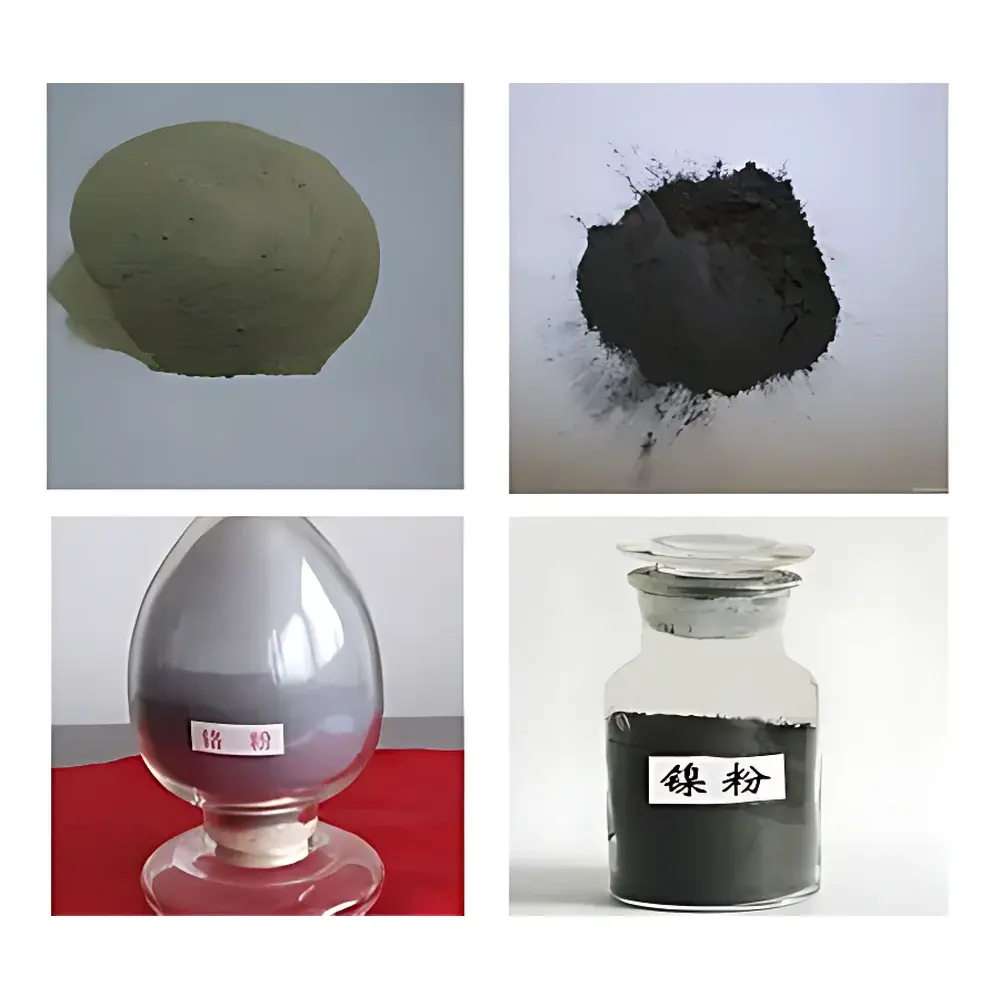
A-Z Series High-Purity Metal Powders (Al, Ag, Cu, Fe, Ti, W, Zn, Ni, Co, Cr, Bi, Er, In, Mo, Nb, Ta, V, Sn, etc.)
| Brand | Hefei Kejing |
|---|---|
| Origin | Anhui, China |
| Manufacturer Type | Authorized Distributor |
| Product Origin | Domestic (China) |
| Model | A-Z Series Metal Powders |
| Pricing | Available Upon Request |
| Purity | 99.9% (3N) to 99.99% (4N) |
| Particle Size | Nanoscale (1–80 nm) and Micron-Scale (100–300 mesh) |
| Material Range | Aluminum, Silver, Copper, Iron, Titanium, Tungsten, Zinc, Nickel, Cobalt, Chromium, Bismuth, Erbium, Indium, Molybdenum, Niobium, Tantalum, Vanadium, Tin, and others |
Overview
The A-Z Series High-Purity Metal Powders are a comprehensive portfolio of elemental metal powders engineered for advanced materials research, thin-film deposition, additive manufacturing feedstock development, catalyst synthesis, and functional nanomaterial formulation. Designed to meet stringent requirements in academic laboratories, national research institutes, and industrial R&D centers, this series encompasses over 18 distinct metallic elements—including Al, Ag, Cu, Fe, Ti, W, Zn, Ni, Co, Cr, Bi, Er, In, Mo, Nb, Ta, V, and Sn—each available in rigorously controlled purity grades (3N to 4N) and precisely characterized particle size distributions. Unlike generic commodity powders, the A-Z Series is processed under inert atmosphere handling protocols to minimize surface oxidation, ensuring batch-to-batch consistency and reproducibility critical for quantitative physical property studies and process validation.
Key Features
- Multi-Grade Purity Options: Select between 99.9% (3N) and 99.99% (4N) purity levels—certified via ICP-MS and GDMS trace element analysis—to align with application-specific impurity tolerance thresholds (e.g., semiconductor-grade precursors vs. catalytic supports).
- Bimodal Particle Architecture: Offers two complementary size formats: ultrafine nanoscale powders (1–80 nm primary particle size, verified by TEM and XRD line-broadening analysis) and micron-scale powders (100–300 mesh, sieve-verified per ASTM E11), enabling direct comparison of size-dependent phenomena such as sintering kinetics or surface reactivity.
- Elemental Coverage & Traceability: Full coverage from light metals (Al) to refractory metals (W, Ta, Nb, Mo) and rare earths (Er), each lot supplied with a Certificate of Analysis (CoA) listing residual impurities (e.g., O, C, N, Fe, Si), specific surface area (BET), and moisture content (Karl Fischer titration).
- Inert Packaging & Handling: All nanoscale variants are sealed under argon in double-layered, static-dissipative aluminum-laminated pouches; micron-grade powders are packed in vacuum-sealed HDPE containers with oxygen/moisture barrier liners to preserve stoichiometric integrity during storage and transport.
- Regulatory-Ready Documentation: CoAs comply with ISO/IEC 17025-accredited testing methodologies; documentation supports GLP-compliant reporting and can be adapted for FDA 21 CFR Part 11-aligned electronic record systems upon request.
Sample Compatibility & Compliance
The A-Z Series is routinely employed in applications governed by international standards including ASTM B822 (particle size distribution by laser diffraction), ASTM E2906 (metal powder flowability characterization), ISO 13320 (laser diffraction particle sizing), and USP (particulate matter in injectables—relevant for biocompatibility screening). Each material variant is compatible with standard metallurgical sample preparation workflows (cold pressing, spark plasma sintering, electron beam melting) and analytical platforms including SEM-EDS, XRD, TGA-DSC, and XPS. Powder morphology (spherical vs. irregular) and surface oxide layer thickness (<2 nm for Ag, Cu, Al nanoscale grades) are documented per lot to support interface engineering in heterostructure fabrication.
Software & Data Management
While the A-Z Series itself is a physical reference material portfolio—not an instrument—the associated digital documentation ecosystem supports seamless integration into laboratory information management systems (LIMS). Batch-specific CoAs are delivered in machine-readable PDF/A-1b format with embedded metadata (product ID, lot number, purity grade, particle size mode, test date, analyst ID). Upon institutional request, structured data exports (CSV/JSON) containing full impurity profiles and certified parameters can be provided for automated ingestion into ELN platforms (e.g., LabArchives, Benchling) or statistical process control (SPC) dashboards. All documentation adheres to ALCOA+ principles (Attributable, Legible, Contemporaneous, Original, Accurate, Complete, Consistent, Enduring, Available) to satisfy audit readiness requirements under ISO 9001, ISO 13485, and GMP environments.
Applications
- Development of high-conductivity Cu/Ag nanopaste inks for printed electronics and flexible circuitry
- Synthesis of bimetallic catalysts (e.g., Pt–Ni, Pd–Co) via co-reduction using controlled-nucleation metal precursors
- Feedstock qualification for laser powder bed fusion (LPBF) of Ti-6Al-4V and Ni-based superalloys
- Preparation of magnetorheological fluids utilizing Fe, Co, and Ni microparticles with defined saturation magnetization
- Model systems for fundamental studies of grain boundary diffusion, Ostwald ripening, and Kirkendall effect in nanoscale metals
- Reference standards in inter-laboratory round-robin studies for powder rheometry (FT4, Freeman Technology) and BET surface area calibration
FAQ
Are particle size distributions provided for each lot?
Yes—nanoscale lots include D10/D50/D90 values derived from dynamic light scattering (DLS) and TEM image analysis; micron-grade lots report sieve analysis results per ASTM E11 with cumulative mass retention curves.
Can custom particle size fractions or surface modifications (e.g., PVP coating) be requested?
Custom processing—including size fractionation by centrifugal sedimentation (ISO 13321) and ligand grafting (e.g., oleic acid, citrate, PVP)—is available under NDA for qualified R&D partners.
Is there stability data for long-term storage?
Accelerated aging studies (40 °C / 75% RH for 6 months) confirm no measurable agglomeration or oxidation for nanoscale Al, Cu, and Ag powders when stored per recommended protocols; full stability reports available upon request.
Do you provide ISO 17025-accredited test reports?
Third-party accredited testing (e.g., SGS, Bureau Veritas) for purity, particle size, and surface area can be arranged at additional cost; internal CoAs follow ISO/IEC 17025-aligned procedures.
What shipping conditions apply to nanoscale variants?
All nanoscale powders ship in UN-certified, argon-purged containers compliant with IMDG Code Class 4.1 (flammable solids); air freight documentation includes SDS per GHS Rev.10 and IATA Dangerous Goods Regulations Annex 18.