
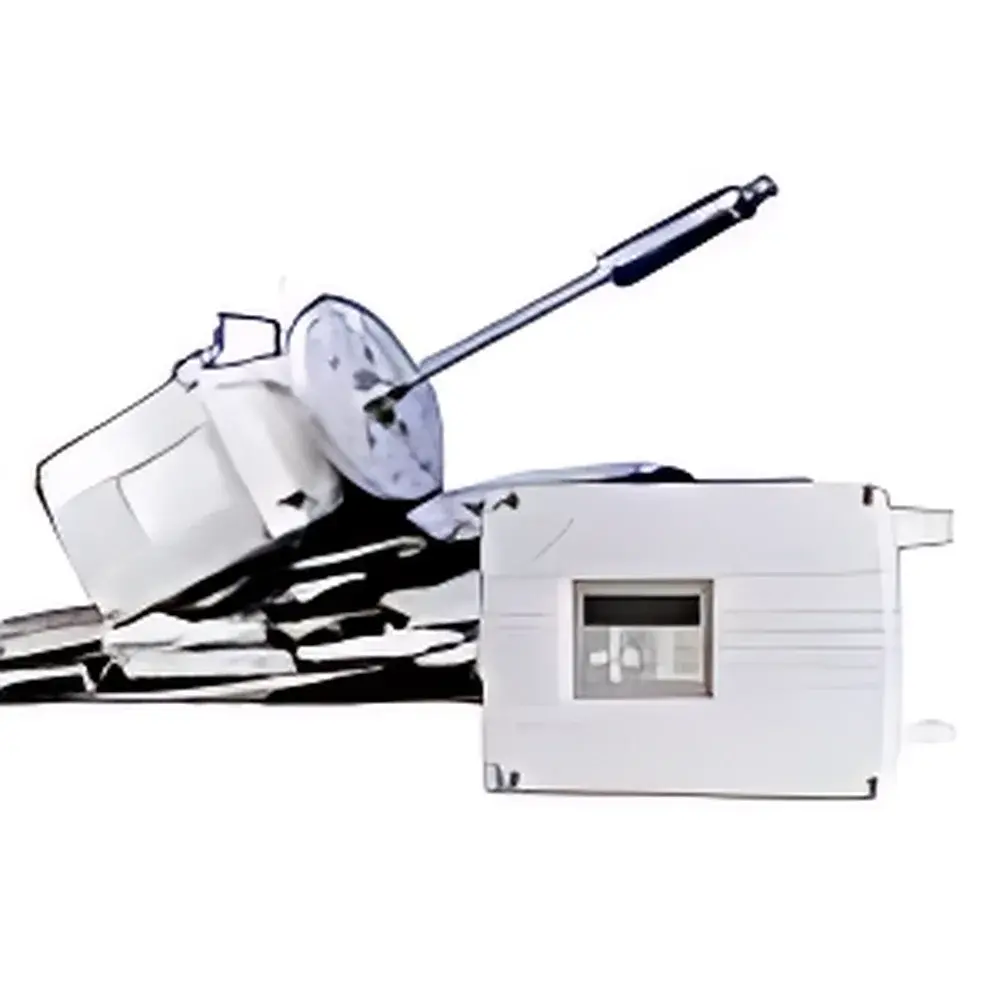
SERVOTOUGH Fluegas 2700 Continuous Emission Monitoring System (CEMS) for Oxygen and Combustible Gases
| Brand | SERVOMEX |
|---|---|
| Origin | United Kingdom |
| Model | 2700 |
| Instrument Type | Continuous Emission Monitoring System (CEMS) |
| Measurands | O₂ and combustible gases (e.g., CH₄, H₂, CO) |
| Measurement Principle | Zirconia electrochemical cell (O₂), thick-film catalytic thermal conductivity (Tfx) sensor (combustibles) |
| Operating Temperature | up to 1750 °C (3182 °F) |
| Accuracy | low indication error |
| Repeatability | high |
| Response Time | fast |
| Stability | high |
| Display | backlit LCD |
| Calibration | automatic on-site self-calibration |
| Certification | ATEX Category 3, FM Class I, Division 2, Group A–D |
| Flange Standard | ANSI 4″ 150 lb (with optional adapters) |
| Probe Materials | stainless steel / high-temperature alloy / ceramic |
| Optional | high-dust filtration, thermal isolation flange, probe retention assembly, insulated disc |
Overview
The SERVOTOUGH Fluegas 2700 is a rugged, industrial-grade Continuous Emission Monitoring System (CEMS) engineered for real-time, in-situ measurement of oxygen (O₂) and combustible gas concentrations—including methane (CH₄), hydrogen (H₂), and carbon monoxide (CO)—in hot, aggressive flue gas streams. Designed specifically for power generation, cement kilns, waste-to-energy plants, and heavy process industries, the system operates directly in ducts and stacks without extractive sampling, eliminating transport delays and condensation artifacts. Its dual-sensor architecture integrates SERVOMEX’s proprietary zirconia-based electrochemical O₂ cell—known for exceptional long-term stability and minimal drift—and the patented Thick-Film Catalytic (Tfx) thermal conductivity sensor for combustibles. Unlike conventional “leak detection” or binary alarm sensors, the Tfx cell delivers quantitative, linear concentration data across wide dynamic ranges (0–500 ppm to 0–6000 ppm), enabling precise stoichiometric combustion control. The system’s ability to function continuously at temperatures up to 1750 °C (3182 °F) eliminates the need for external dilution or cooling systems, reducing maintenance points and improving measurement fidelity under transient load conditions.
Key Features
- True in-situ measurement with no sample extraction, conditioning, or transport lines
- Zirconia O₂ sensor with >5-year typical service life and <±0.1% O₂ full-scale accuracy over extended operation
- Tfx catalytic thermal sensor for combustibles—provides calibrated ppm-level output, not just presence/absence
- Integrated self-calibration routine executed via front-panel interface or remote command; requires only certified span gas and zero air
- ATEX Category 3 and FM Class I, Division 2, Groups A–D certified control unit for hazardous area installation (Zone 2 / Class I, Div. 2)
- Modular probe design with configurable thermal management: insulated disc, high-temp isolation flange, probe retention assembly, or hybrid configurations
- Probe material options include 316 stainless steel (≤800 °C), Inconel 600 (≤1200 °C), and alumina ceramic (≤1750 °C); all compatible with optional sintered metal or ceramic particulate filters for high-dust environments
- Backlit graphical LCD with intuitive menu navigation, real-time trend display, and diagnostic status indicators
Sample Compatibility & Compliance
The Fluegas 2700 is validated for use in dry or moderately wet flue gases containing particulates, SO₂, NOₓ, and alkali vapors typical of coal-, oil-, biomass-, and refuse-derived fuel combustion. It complies with EN 15267-3 (QAL1 certification framework for CEMS), supports compliance with EU Industrial Emissions Directive (IED) and US EPA Performance Specification 3 (PS-3) for O₂ monitoring. While not itself a certified QAL1 analyzer, its design enables integration into QAL1-validated CEMS architectures when paired with certified data acquisition and reporting systems. Sensor outputs meet IEC 61508 SIL 2 functional safety requirements for combustion optimization loops. All firmware and configuration logs maintain audit trails aligned with GLP/GMP documentation expectations, and optional analog/digital outputs support 21 CFR Part 11-compliant data handling when interfaced with validated DCS/SCADA platforms.
Software & Data Management
The embedded controller supports Modbus RTU (RS-485), 4–20 mA analog outputs (isolated, HART-enabled), and optional Ethernet/IP or Profibus DP-V1 interfaces. Local configuration and diagnostics are managed through the onboard LCD interface with password-protected access levels (operator, engineer, administrator). Remote monitoring and parameter adjustment are possible via Modbus register mapping or optional web server module (HTTPS, TLS 1.2). All calibration events, fault logs, sensor health metrics (e.g., cell impedance, thermal offset drift), and raw signal timestamps are stored internally for ≥30 days and exportable via USB or serial dump. Configuration files are version-controlled and checksum-verified to prevent unauthorized or corrupted uploads.
Applications
- Boiler and furnace combustion optimization in thermal power plants
- Real-time excess air ratio (λ) control in cement rotary kilns and precalciners
- Waste incineration process monitoring for dioxin precursor suppression
- Hydrogen-rich syngas monitoring in gasification and reforming units
- Emergency combustible leak detection and quantification in flare gas recovery systems
- Commissioning and performance testing of SCR/SNCR de-NOₓ systems where O₂ trim is critical
FAQ
Can the Fluegas 2700 measure both O₂ and combustibles simultaneously?
Yes—the dual-sensor probe performs concurrent, independent measurements with synchronized sampling and temperature compensation.
Is calibration traceable to NIST or UKAS standards?
Calibration gases used during field verification must be certified to ISO 6141 or ISO 6145; the instrument itself does not hold traceability but accepts certified reference materials per EN 14181.
What maintenance intervals are recommended for high-dust applications?
With integrated sintered filter, visual inspection every 90 days and filter cleaning/replacement every 6–12 months is typical; sensor replacement intervals exceed 3 years under continuous operation.
Does the system support redundant sensor configurations?
No—redundancy requires two separate Fluegas 2700 units configured in voting logic via external DCS; the hardware does not natively support dual-channel internal redundancy.
Can the Tfx sensor distinguish between different combustible species?
No—it measures total thermal conductivity change proportional to combined combustible concentration; speciation requires GC or FTIR integration.
Related Products







