
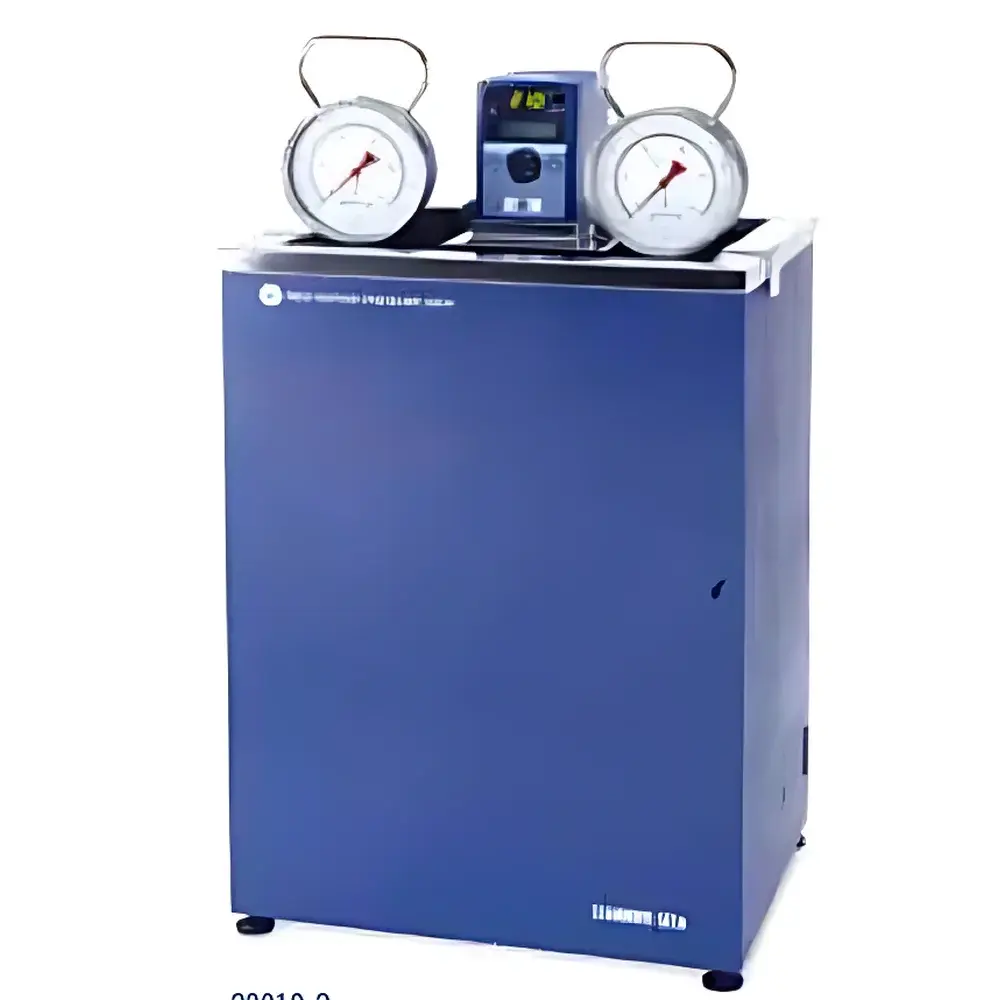
SETA Model 22210-3 Reid Vapor Pressure (RVP) Bath
| Brand | SETA |
|---|---|
| Origin | United Kingdom |
| Model | 22210-3 |
| Temperature Range | 5°C to 90°C (ambient referenced) |
| Temperature Uniformity | ±0.1°C at 37.8°C |
| Bath Volume | 80 L |
| Capacity | Up to six RVP test bombs |
| Power Supply | 220/240 V, 50/60 Hz |
| Power Consumption | 2.2 kW |
| Dimensions (W × D × H) | 77 × 55 × 51 cm |
| Weight | 70 kg |
Overview
The SETA Model 22210-3 Reid Vapor Pressure (RVP) Bath is a precision-engineered thermal immersion system designed exclusively for standardized determination of vapor pressure in petroleum products—particularly gasoline, naphthas, and volatile distillates—according to globally recognized test methods. It operates on the principle of controlled isothermal equilibration between liquid and vapor phases within a sealed, calibrated RVP test bomb (also known as a “vapor pressure bomb” or “RVP bomb”), following the fundamental thermodynamic equilibrium defined in ASTM D323 and ISO 3007. The bath maintains a highly stable and uniform temperature environment across its 80 L water reservoir, enabling reproducible saturation conditions required for accurate RVP measurement. Unlike ambient-air ovens or non-circulated heating blocks, this unit employs forced convection and digital PID temperature regulation to ensure minimal spatial and temporal deviation—critical for compliance with stringent regulatory and quality control requirements in refinery laboratories, independent testing facilities, and fuel certification bodies.
Key Features
- Simultaneous capacity for up to six standard RVP test bombs—optimized for high-throughput routine analysis without compromising thermal integrity.
- Digital microprocessor-based temperature controller with real-time display, adjustable setpoint resolution of 0.1°C, and auto-tuning capability for rapid stabilization.
- Thermal uniformity maintained at ±0.1°C at the reference temperature of 37.8°C (100°F), meeting the tightest tolerance specified in ASTM D323 Procedure A and ISO 3007 Annex B.
- Integrated safety interlocks including low-water-level detection and overtemperature cutoff (set at 95°C), preventing dry-run operation and thermal runaway.
- Corrosion-resistant stainless-steel water tank with insulated housing and splash guard, engineered for long-term reliability in high-humidity laboratory environments.
- Compliance-ready design: CE-marked, RoHS-compliant, and compatible with GLP/GMP documentation workflows through external data logging interfaces (e.g., 4–20 mA or RS-232 outputs upon optional configuration).
Sample Compatibility & Compliance
The SETA 22210-3 supports all standard RVP test bombs conforming to ASTM D323, ISO 3007, and IP 69 dimensional and material specifications—including both copper-alloy and stainless-steel variants used for gasoline, reformulated fuels, oxygenated blends, and light distillates. Its operational temperature range (5°C to 90°C) accommodates not only standard RVP testing at 37.8°C but also extended applications such as vapor pressure testing of liquefied petroleum gas (LPG) per NF M41-010 and JIS K2258, where elevated equilibration temperatures are mandated. The unit satisfies essential regulatory alignment requirements for laboratories subject to ISO/IEC 17025 accreditation, U.S. EPA fuel certification programs, and EU EN 12 (observational) protocols. All thermal performance validations are traceable to NPL (UK) or NIST-traceable reference standards.
Software & Data Management
While the 22210-3 operates as a standalone analog/digital benchtop instrument, it integrates seamlessly into modern laboratory informatics ecosystems. Optional analog output modules enable connection to LIMS or SCADA systems for automated timestamped temperature logging. When paired with validated third-party data acquisition software (e.g., LabVIEW-based custom scripts or METTLER TOLEDO LabX), the bath supports audit-trail generation compliant with FDA 21 CFR Part 11 requirements—including user authentication, electronic signatures, and immutable record retention. Firmware updates are delivered via secure USB interface, with version history and calibration event logs stored internally for internal QA review.
Applications
- Routine RVP testing of motor gasoline, aviation gasoline, and ethanol-blended fuels in refinery QC labs.
- Regulatory submission testing for EPA Tier 3, CARB, and EU Fuel Quality Directive (2009/30/EC) compliance.
- Research and development of low-RVP reformulated fuels targeting summer volatility reduction.
- Third-party verification of vapor pressure claims for fuel trading and custody transfer documentation.
- Method validation studies requiring multi-bomb parallelism and inter-laboratory reproducibility assessment under ISO 5725 guidelines.
FAQ
What test methods does the SETA 22210-3 support?
It is fully compatible with ASTM D323 (Procedures A, C, and D), ASTM D1267, ASTM D4953 (Procedure A), IP 69 (Procedures A, C, D), IP 402 (observational), IP 410, BS 2000 Parts 69/402/410, ISO 3007, ISO 4256, EN 12 (observational), FTM 791-1201, NF M07-007, NF M41-010 (for LPG), and JIS K2258.
Is the bath suitable for LPG vapor pressure testing?
Yes—its extended temperature range up to 90°C and robust thermal stability meet the operational requirements of NF M41-010 and JIS K2258 for liquefied petroleum gas analysis.
Does the unit include calibration documentation?
Each unit ships with a factory calibration certificate traceable to UKAS-accredited standards; users may perform periodic verification using NIST-traceable PT100 probes and certified reference thermometers.
Can the bath be operated continuously?
Yes—the 2.2 kW heating system and reinforced thermal insulation support uninterrupted 24/7 operation under normal laboratory conditions, provided ambient ventilation meets ISO 14644 Class 8 air cleanliness guidelines.
What maintenance is required?
Routine maintenance includes bi-weekly water level checks, quarterly descaling (using citric acid solution), annual verification of safety interlocks, and biannual recalibration of the digital controller against primary standards.





