
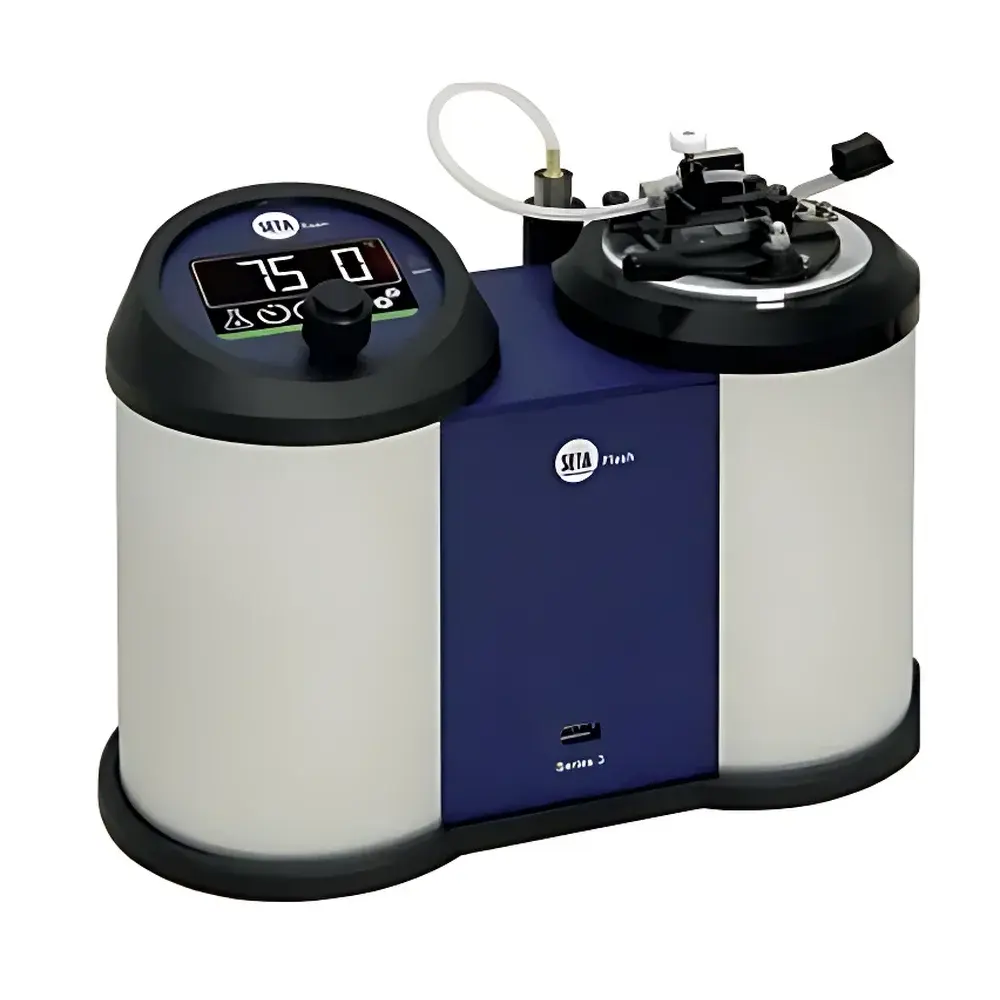
SETAFLASH Series 3 Miniature Rapid Equilibrium Flash Point Tester
| Brand | SETA |
|---|---|
| Origin | United Kingdom |
| Model | SETAFLASH Series 3 |
| Detection Method | Closed-Cup |
| Temperature Range | 0 °C to 300 °C |
| Ignition Mode | Electric or Gas Ignition |
| Compliance Standards | ISO 3679 |
| Sample Volume | 2 mL (for samples with expected flash point ≤100 °C), 4 mL (for >100 °C) |
| Cooling Time | ≤4 min (from 80 °C to 20 °C, optional) |
| Test Duration | 1–99 min |
| Interface Options | RS232, USB, LAN |
| Power | 200 W / 300 W |
| Voltage | 100–250 V AC, 50/60 Hz |
| Cup Materials | Anodized Aluminum, Corrosion-Resistant Stainless Steel |
Overview
The SETAFLASH Series 3 Miniature Rapid Equilibrium Flash Point Tester is a precision-engineered closed-cup instrument designed for rapid, reproducible flash point determination across petroleum, chemical, pharmaceutical, and specialty materials industries. It operates on the rapid equilibrium method—where sample temperature is incrementally raised in controlled steps while vapor concentration above the liquid surface is continuously monitored until the lower flammability limit is reached under standardized ignition conditions. This principle ensures compliance with internationally recognized test protocols including ISO 3679 (rapid equilibrium), ISO 3680 (observed flash point), ASTM D3828 (mini-method), and EPA Method 1020 B. Unlike traditional Pensky-Martens or Tag apparatuses, the Series 3 employs a compact thermal chamber and optimized vapor sampling geometry to reduce thermal inertia and accelerate equilibration—enabling flash point results in as little as 1–3 minutes for low-boiling solvents, without compromising measurement traceability or repeatability.
Key Features
- Rapid equilibrium methodology with programmable heating ramp profiles (0.5–10 °C/min) and real-time vapor-phase monitoring
- Dual ignition options: electronically triggered spark ignition (IEC 60079-0 compliant) or adjustable gas flame ignition (propane or butane)
- Thermally isolated aluminum or corrosion-resistant stainless steel sample cups—designed for minimal carryover and compatibility with aggressive solvents, high-viscosity oils, and reactive formulations
- Integrated Peltier-assisted rapid cooling module (optional), achieving ≥60 °C/min cooling rate from 80 °C to ambient in ≤4 minutes
- Wide operational temperature range (0 °C to 300 °C) with ±0.1 °C digital PID control and NIST-traceable Pt100 sensor calibration
- Low sample consumption: only 2 mL required for samples with anticipated flash point ≤100 °C; 4 mL for higher-temperature applications
- Full safety architecture: automatic gas shutoff, flame detection interlock, overtemperature cutoff, and explosion-proof enclosure design (ATEX Category 2G, IECEx certified)
- Portable benchtop form factor (320 × 320 × 280 mm; <12 kg) suitable for both laboratory and field deployment—including refinery process labs and transport safety inspection sites
Sample Compatibility & Compliance
The SETAFLASH Series 3 accommodates diverse sample matrices without modification: volatile organic compounds (e.g., acetone, ethanol, MTBE), mid-distillates (jet fuel, diesel), heavy hydrocarbons (lubricating oils, bitumen emulsions), polymer solutions, coatings, fragrances, and water-miscible formulations. Its closed-cup configuration and precise vapor space control meet stringent requirements for Class I–IV hazardous material classification per UN GHS and OSHA HCS. All test methods implemented are fully aligned with regulatory frameworks governing transportation (IMDG Code, IATA DGR), storage (NFPA 30), and occupational exposure (ACGIH TLVs). Instrument validation documentation supports GLP-compliant operation, and audit-ready electronic records comply with FDA 21 CFR Part 11 when paired with validated software packages.
Software & Data Management
Control and data acquisition are managed via SETALink™ PC software (Windows 10/11 compatible), supporting method-driven workflows, multi-user access control, and encrypted result archiving. The software enables full traceability—including operator ID, environmental conditions (ambient T/RH), calibration history, and raw thermal/vapor signal logs. Export formats include CSV, PDF reports (with digital signature support), and XML for LIMS integration. Optional networked deployment allows centralized fleet management across multiple instruments using secure HTTPS-based remote monitoring. All firmware updates maintain backward compatibility with legacy method libraries and retain full revision history per ISO/IEC 17025 Clause 5.9.2.
Applications
- Petroleum refining: Routine flash point verification of aviation turbine fuel (Jet A/A-1 per ASTM D1655 Annex B), naphtha cuts, and reformulated gasoline blends
- Chemical manufacturing: Hazard classification of intermediates, monomers, and solvent recovery streams per CLP Regulation (EC) No 1272/2008
- Coatings & inks: Flash point assessment of acrylic resins, alkyd varnishes, and UV-curable formulations under ISO 3679 and IP 523
- Pharmaceutical excipients: Flammability screening of propylene glycol, PEGs, and ethanol-based sanitizers per USP & EP monographs
- Environmental testing: Screening of contaminated soils and aqueous extracts per EPA SW-846 Method 1020 B and ASTM D7236
- Regulatory submission: Generation of auditable test reports accepted by ECHA, Health Canada, and APVMA for SDS authoring and transport classification
FAQ
What distinguishes rapid equilibrium flash point testing from traditional Pensky-Martens methods?
Rapid equilibrium eliminates prolonged soaking periods by dynamically balancing vapor pressure at each temperature step—reducing test duration by up to 70% while maintaining equivalence to reference methods under ISO and ASTM guidelines.
Can the instrument handle high-viscosity samples such as bitumen or gear oil?
Yes—using the stainless steel cup option and extended equilibration time settings (up to 99 minutes), the Series 3 reliably measures flash points of viscous materials per ISO 9038 and ASTM D7236.
Is method validation support available for regulated environments?
SETA provides IQ/OQ/PQ protocols, metrological traceability certificates, and 21 CFR Part 11 readiness documentation upon request.
How is temperature calibration verified during routine use?
Built-in self-diagnostic routines perform daily sensor linearity checks against internal reference junctions; external calibration is performed using certified NIST-traceable thermometers per ISO/IEC 17025.
Does the system support unattended batch testing?
When integrated with optional autosampler modules (e.g., SETA AutoLoad™), up to 12 samples can be processed sequentially with automated cup cleaning and purge cycles.





