
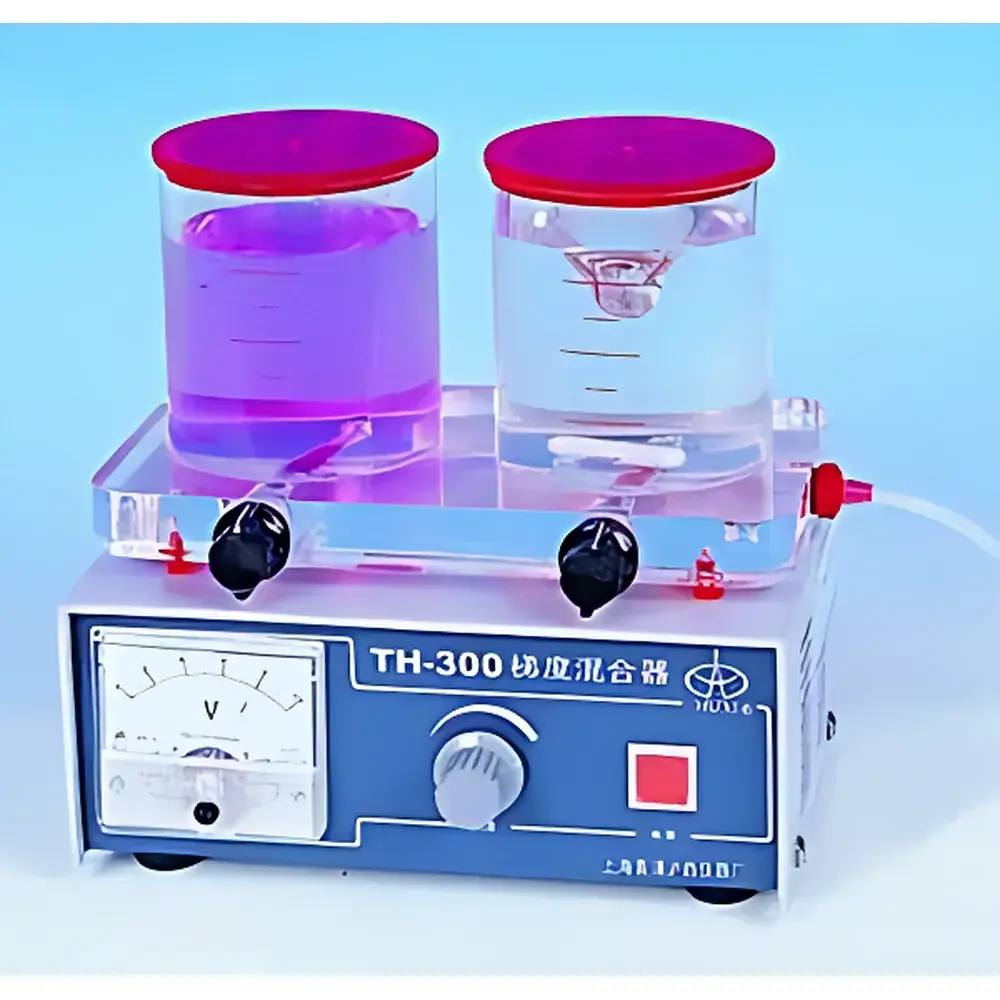
Shanghai TH-300 Gradient Mixer / Liquid-Liquid Blending System
| Origin | Shanghai, China |
|---|---|
| Manufacturer Type | Authorized Distributor |
| Origin Category | Domestic (PRC) |
| Model | TH-300 |
| Price | USD 195 (approx. ¥1,380) |
| Gradient Volume Capacity | 600 mL |
| Gradient Profile | Linear Only |
| Dimensions (W×D×H) | 211 × 160 × 250 mm |
Overview
The Shanghai TH-300 Gradient Mixer is a precision-engineered liquid-phase blending system designed for controlled, reproducible linear gradient generation in chromatographic sample preparation, buffer exchange, and analytical method development workflows. Operating on the principle of dual-reservoir volumetric displacement with synchronized peristaltic or gravity-fed flow control, the TH-300 maintains dynamic level equilibrium between concentrated and diluted solution reservoirs—ensuring consistent hydrostatic pressure across both channels. This equilibrium-based architecture eliminates pulsation-induced variability and enables stable, continuous output at user-defined flow rates. Unlike digitally controlled gradient pumps, the TH-300 implements mechanical gradient formation via calibrated cam-driven syringe displacement or adjustable valve resistance, delivering robust, low-maintenance operation suitable for routine QC labs and teaching laboratories where deterministic analog control is preferred over complex software integration.
Key Features
- Mechanically stabilized dual-chamber design ensures real-time liquid level synchronization between reservoir A (stock solution) and reservoir B (diluent), minimizing concentration drift during extended gradient runs.
- Continuously adjustable flow rate control via calibrated needle valve or stepped gear-driven piston actuation—enabling fine-tuned output from 0.5 to 15 mL/min (dependent on tubing ID and fluid viscosity).
- Linear gradient generation only: optimized for applications requiring monotonic, time-proportional composition change—e.g., ion-exchange column equilibration, SDS-PAGE sample dilution series, or solvent strength ramping in preparative HPLC scouting.
- Compact footprint (211 × 160 × 250 mm) with chemical-resistant housing compatible with common aqueous buffers, organic solvents (e.g., acetonitrile, methanol), and mild acidic/basic solutions (pH 2–12).
- No electrical power requirement for core mixing function—operates passively via gravity or optional low-voltage DC motor drive (accessory), supporting use in explosion-proof or EMI-sensitive environments.
Sample Compatibility & Compliance
The TH-300 accommodates standard laboratory glassware including 500–1000 mL graduated cylinders or screw-cap reagent bottles (neck diameter ≤ 45 mm). Tubing compatibility includes Tygon® R-3603, PharMed® BPT, and PTFE-lined silicone—supporting USP Class VI and FDA-compliant fluid paths. While not certified to ISO/IEC 17025 or ASTM D7777 (for automated gradient analyzers), the device meets general laboratory equipment requirements under ISO 9001:2015 for manufacturing traceability and dimensional conformity. Its analog operation inherently satisfies GLP documentation needs where electronic audit trails are not mandated; users may record manual settings (valve position, timing, reservoir volumes) in bound lab notebooks per 21 CFR Part 11 Annex A guidelines.
Software & Data Management
The TH-300 operates without embedded firmware or proprietary software—eliminating cybersecurity risks, driver conflicts, or OS compatibility constraints. All operational parameters (initial volume ratio, flow rate setting, total gradient duration) are documented manually or integrated into LIMS via standardized SOP templates. For labs requiring digital logging, third-party USB data loggers (e.g., Omega OM-DAQPRO-5300) can monitor outlet pressure or flow via inline sensors—outputting CSV-compatible timestamps for post-run correlation with chromatogram baselines. No cloud connectivity, remote access, or firmware updates are supported or intended.
Applications
- Preparatory gradient formation for FPLC and fast protein liquid chromatography systems prior to column loading.
- Buffer gradient dialysis in membrane-based protein purification workflows.
- Controlled dilution series generation for calibration curve construction in UV-Vis spectrophotometry and ELISA assay validation.
- Teaching laboratory demonstrations of diffusion kinetics, osmotic pressure equilibration, and first-order mixing dynamics.
- Low-cost alternative to high-pressure gradient modules in educational HPLC training systems where flow precision > ±5% is acceptable.
FAQ
Does the TH-300 support exponential or concave/convex gradient profiles?
No. The TH-300 is mechanically constrained to linear gradients only, as achieved through constant-speed displacement of equal-volume reservoir pistons or fixed-orifice flow restriction. Nonlinear profiles require programmable dual-pump systems (e.g., Shimadzu LC-30AD or Waters Alliance e2695).
What tubing sizes are recommended for optimal flow stability?
Internal diameters of 1.6 mm (1/16″) or 2.4 mm (3/32″) silicone or fluoropolymer tubing are validated for flow rates between 2–10 mL/min. Smaller IDs increase backpressure sensitivity; larger IDs reduce resolution below 1 mL/min.
Can the TH-300 be used with viscous solutions such as glycerol-water mixtures?
Yes—up to 40% (v/v) glycerol at 25°C. Viscosity > 15 cP requires pre-warming reservoirs to 30–35°C and using wider-bore tubing (≥3.2 mm ID) to maintain laminar flow and prevent air entrapment.
Is calibration certification included with shipment?
No factory calibration certificate is provided. Users should verify gradient linearity using conductivity probes or refractometry at three points (start/mid/end) per ICH Q2(R2) verification principles before first use.
What maintenance intervals are recommended for long-term reliability?
Valve seats and tubing should be inspected every 200 operating hours; replace silicone tubing quarterly under continuous use. Cam mechanisms require light mineral oil lubrication biannually per ISO 13485 preventive maintenance guidance.
Related Products



