
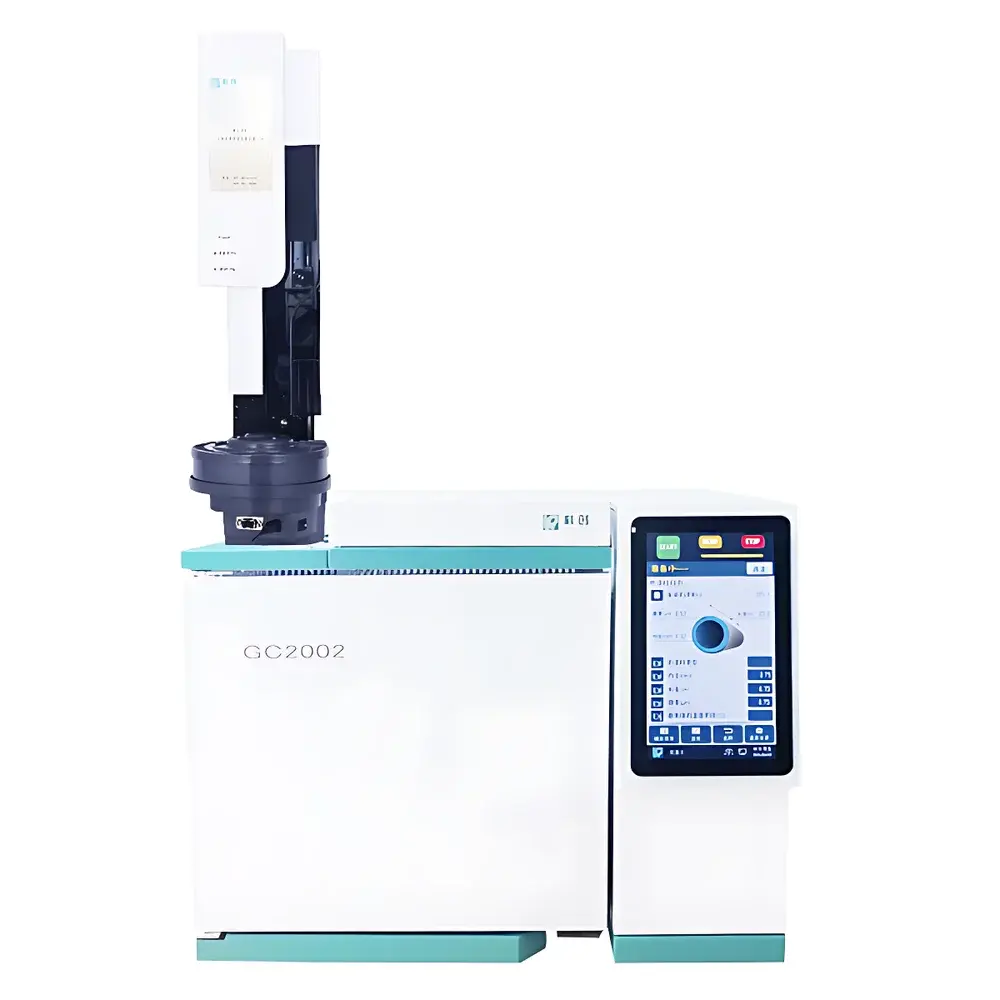
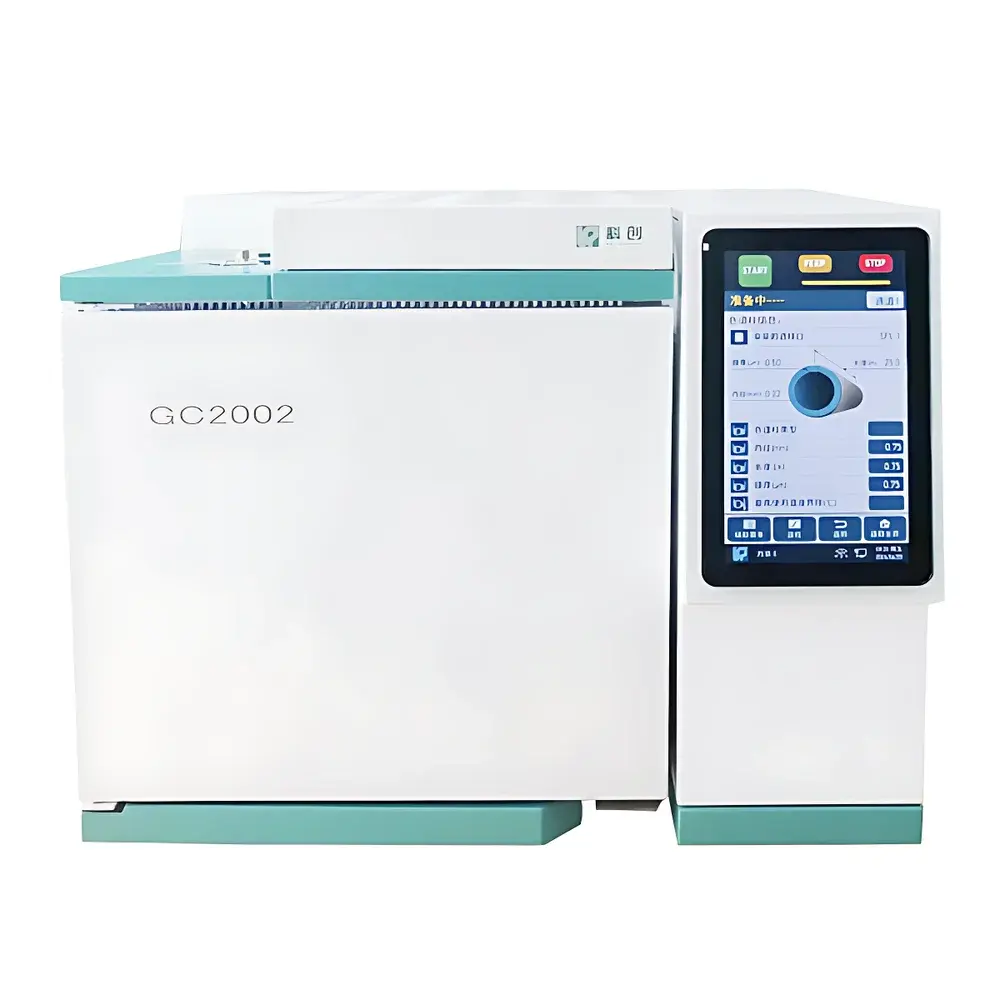
Shanghai Kechuang GC2002 Network-Enabled Gas Chromatograph with 10-inch Color Touchscreen
| Brand | Kechuang |
|---|---|
| Origin | Shanghai, China |
| Manufacturer Type | OEM Manufacturer |
| Product Category | Domestic Laboratory Gas Chromatograph |
| Model | GC2002 (High-End Intelligent Network GC) |
| Instrument Type | Laboratory Gas Chromatograph |
| Application Field | Petrochemical Industry |
| Temperature Control Range | Ambient + 5°C to 450°C |
| Maximum Ramp Rate | >120°C/min |
| Cooling Time | <5 min (from 300°C to 50°C) |
| Carrier Gas Flow Range & Control | 0–1200 mL/min |
| Carrier Gas Pressure Range & Control | 0–970 kPa |
| Injector Max Operating Temperature | 400°C |
| Injector Pressure Set Range | 0–970 kPa |
| Injector Total Flow Set Range | 0–1200 mL/min |
| Temperature Control Precision | ±0.01°C |
| EPC/EFC Pressure Accuracy | 0.001 psi |
| EPC/EFC Flow Accuracy | 0.001 mL/min |
| Programmed Temperature Steps | Up to 16 stages (expandable to unlimited) |
| Retention Time Repeatability (RSD) | <0.008% |
| Peak Area Repeatability (RSD) | <1.0% |
| Detector Options | TCD, FID, ECD, FPD |
Overview
The Shanghai Kechuang GC2002 is a high-performance, network-enabled laboratory gas chromatograph engineered for precision, reproducibility, and operational autonomy in regulated petrochemical analysis environments. Built on a robust dual-column oven architecture with independent temperature control, it employs capillary or packed column separation coupled with universal detection modalities—including thermal conductivity (TCD), flame ionization (FID), electron capture (ECD), and flame photometric (FPD) detectors—to resolve complex hydrocarbon mixtures, sulfur compounds, halogenated organics, and trace contaminants. Its core analytical principle relies on differential partitioning of volatile analytes between a mobile phase (inert carrier gas) and a stationary phase (column coating), with retention time serving as the primary qualitative identifier and peak area/height as the quantitative metric under calibrated conditions. The instrument integrates real-time digital signal acquisition via RJ45 Ethernet interface, enabling deterministic data transmission without analog degradation and full remote supervision across distributed lab networks.
Key Features
- 10-channel independent temperature control system, including dual programmable column ovens with resolution of 0.01°C and stability of ±0.01°C over ambient +5°C to 450°C;
- Integrated electronic pressure and flow control (EPC/EFC) with 0.001 psi pressure accuracy and 0.001 mL/min flow accuracy; supports constant-pressure, constant-flow, and up to 8-step programmed pressure/flow ramps;
- 10-inch high-resolution color touchscreen HMI with embedded spectral baseline visualization, real-time chromatogram display, and local instrument control—no external PC required for basic operation;
- Modular detector architecture: interchangeable TCD (detection limit ≥3500 mV·mL/mg), FID (≤3.0×10⁻¹² g/s on n-hexadecane), ECD (≤10 fg/mL on γ-HCH), and FPD (≤1 pg/s P, ≤10 pg/s S); all equipped with wide-range amplifiers to prevent solvent peak saturation;
- Column oven cooling accelerated by motorized rear door actuation; achieves <5 min cooldown from 350°C to 50°C, minimizing cycle time between injections;
- Native Ethernet connectivity (RJ45) with embedded chromatography workstation firmware; supports centralized management of up to 253 units on a single subnet with audit-ready event logging;
- Self-diagnostic firmware with real-time fault mapping, overtemperature cutoff on any controlled zone, and environmental drift compensation (±0.1°C oven deviation per 10°C ambient shift);
- Comprehensive external event timing engine: 8 programmable TTL-triggered inputs for autosampler synchronization, valve switching, or detector modulation.
Sample Compatibility & Compliance
The GC2002 accommodates standard 1/8″ or 1/4″ packed columns and fused-silica capillaries up to 100 m in length. It is routinely deployed in ASTM D2425 (hydrocarbon type analysis), ASTM D5186 (aromatics in diesel), ISO 6416 (gasoline hydrocarbon distribution), and GB/T 17623 (dissolved gas analysis in transformer oil) workflows. Its EPC/EFC architecture meets GLP/GMP requirements for method traceability, while the embedded event log and detector signal timestamping support FDA 21 CFR Part 11 compliance when paired with validated third-party CDS software. Optional hydrogen leak detection and variable-frequency column oven drive further enhance safety and energy efficiency in continuous-operation settings.
Software & Data Management
The GC2002 ships with Kechuang’s proprietary GC Navigator™ reverse-control software, deployable on Windows-based workstations. It provides full bidirectional communication: users define methods (injection parameters, oven programs, detector settings, integration rules) locally or remotely, and the instrument executes them with deterministic timing. Signal acquisition supports simultaneous multi-detector channel routing—any two detectors can be dynamically assigned to the same processing channel for comparative quantitation. All raw data are stored in vendor-neutral .CDF format (compatible with OpenChrom, Chromeleon, and AIA-compliant platforms). Audit trails record operator ID, method version, calibration history, and hardware status changes with immutable timestamps—essential for regulatory submissions and internal QA reviews.
Applications
Primary deployment domains include refinery process stream monitoring (C1–C5 hydrocarbons, olefin/paraffin ratios), fuel additive profiling (MTBE, ethanol, oxygenates), environmental VOC screening (EPA Method 8021B), petrochemical catalyst effluent analysis (benzene/toluene/xylene isomers), and transformer oil DGA (dissolved gas analysis per IEC 60599). Its high ramp rate (>120°C/min) and sub-0.008% retention time repeatability make it suitable for fast GC applications requiring rapid throughput without sacrificing resolution. Dual oven capability enables heart-cutting MDGC configurations for co-elution resolution in heavy-end fractions.
FAQ
Is the GC2002 compatible with mass spectrometry interfaces?
Yes—the instrument includes a standardized MS transfer line port on the column oven rear panel, supporting direct coupling to quadrupole or single-quadrupole GC-MS systems with appropriate vacuum interlock signaling.
Can the EPC/EFC system manage multiple carrier gases simultaneously?
Yes—up to 24 independently controlled gas channels are supported, allowing N2, H2, He, and Ar to be routed to different inlets or detectors with individual pressure/flow programming.
What level of cybersecurity is implemented for network operation?
The embedded TCP/IP stack supports VLAN segmentation, MAC address filtering, and HTTPS-based configuration access. Firmware updates require signed binaries; no default credentials are shipped.
Does the system support 21 CFR Part 11-compliant electronic signatures?
The base firmware does not include electronic signature functionality; however, when integrated with validated third-party chromatography data systems (e.g., Thermo Fisher Chromeleon, Agilent OpenLab CDS), full Part 11 compliance—including role-based access, audit trail export, and digital signature enforcement—is achievable.
What maintenance intervals are recommended for optimal performance?
Carrier gas filters should be replaced every 6 months; inlet liners and septa every 100–200 injections; detector components (FID jets, ECD cells) annually or per usage intensity. Column conditioning protocols are detector-specific and documented in the GC Navigator™ method library.
Related Products




