
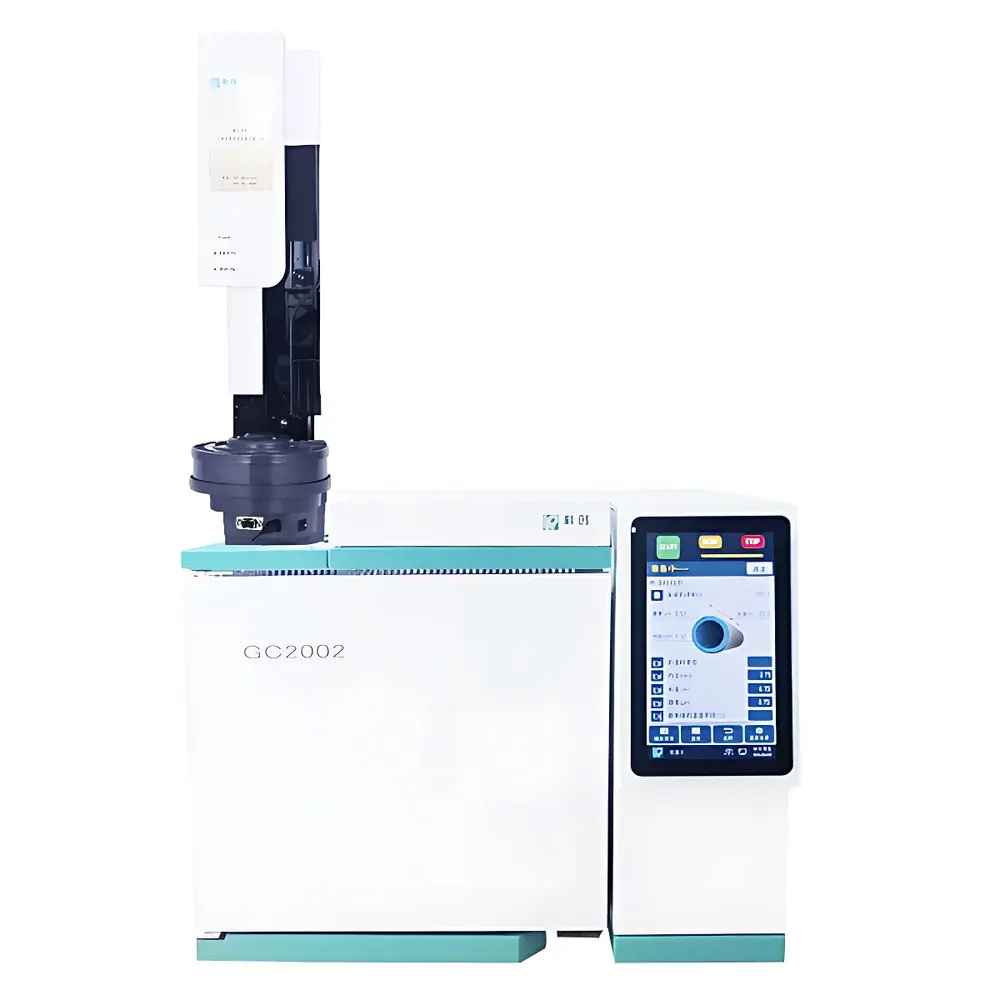
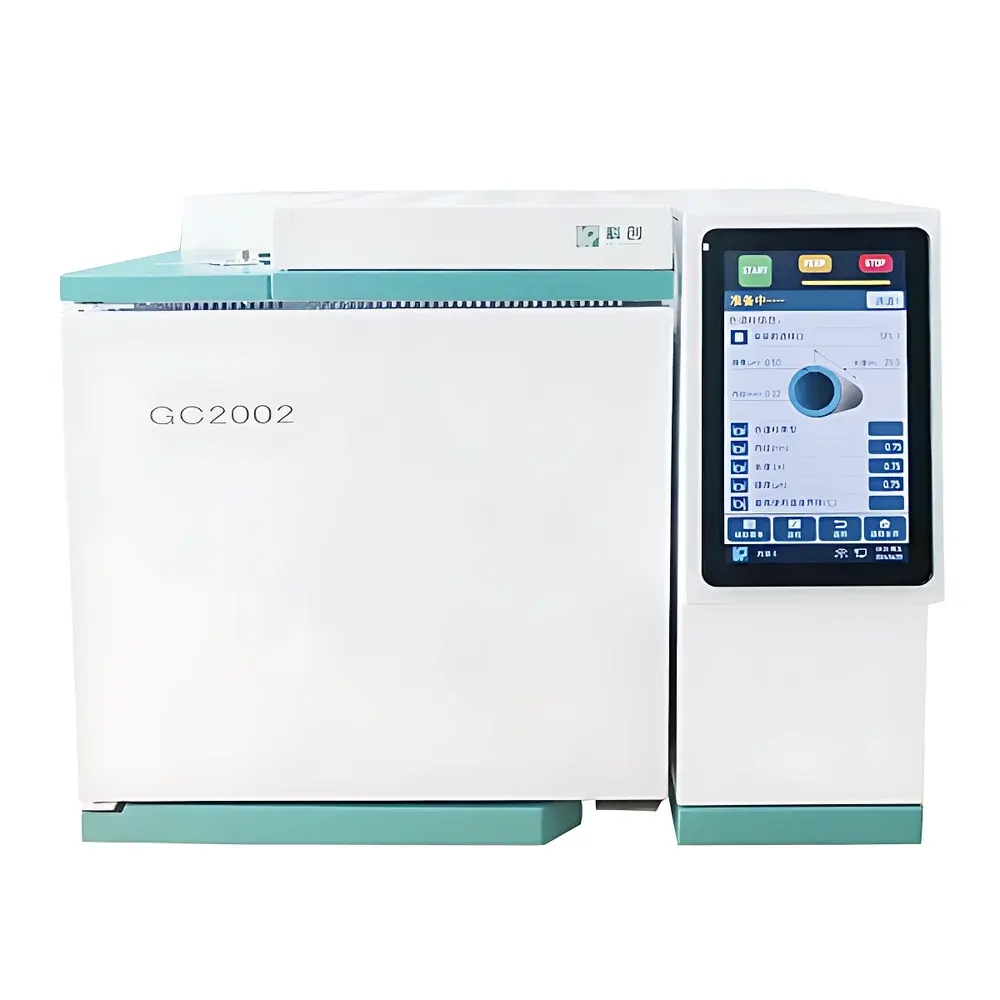
Shanghai Kechuang GC2002N/FF Network-Enabled Gas Chromatograph
| [Brand | Kechuang |
|---|---|
| Origin | Shanghai, China |
| Manufacturer Type | Direct Manufacturer |
| Instrument Type | Laboratory Gas Chromatograph |
| Application Focus | Petrochemical Industry |
| Oven Temperature Range | Ambient + 3 °C to 450 °C |
| Maximum Ramp Rate | 120 °C/min (0.1 °C/min increment) |
| Cooling Rate | 350 °C → 50 °C in ≤5 min (with motorized rear door) |
| Carrier Gas Flow Control Range | 0–1200 mL/min |
| Carrier Gas Pressure Control Range | 0–100 psi |
| Injector Max Temp | 450 °C |
| Injector Pressure Setpoint Range | 0–100 psi |
| Injector Total Flow Setpoint Range | 0–1200 mL/min |
| EPC/EFC Precision | ±0.001 psi (pressure), ±0.001 mL/min (flow) |
| Temperature Stability | ±0.1% of setpoint |
| Retention Time RSD | <0.008% |
| Peak Area RSD | <1.0% |
| Detector Options | TCD, FID, ECD, FPD |
| Column Oven Capacity | 305 × 160 × 278 mm (W×D×H) |
| Dimensions (W×D×H) | 570 × 570 × 506 mm |
| Weight | ≤55 kg |
| Power | ≤3000 W, 220 V ±10%, 50 Hz ±5%] |
Overview
The Shanghai Kechuang GC2002N/FF is a network-enabled, laboratory-grade gas chromatograph engineered for high reproducibility and operational robustness in regulated petrochemical analysis environments. Built upon a dual-column oven architecture with independent programmable temperature control, it employs capillary or packed column separation coupled with carrier gas flow modulation via electronic pressure and flow control (EPC/EFC). The system operates on the fundamental principle of differential partitioning of volatile analytes between a mobile phase (inert or reactive carrier gas) and a stationary phase coated inside a fused-silica or stainless-steel column. Separated compounds elute at characteristic retention times and are quantified by one or more selectable detectors—including thermal conductivity (TCD), flame ionization (FID), electron capture (ECD), and flame photometric (FPD)—each meeting defined sensitivity and linearity benchmarks per ASTM D3606, ISO 15502, and USP . Its embedded 10-inch capacitive touchscreen and integrated mainboard-based chromatography workstation enable real-time baseline monitoring, method execution, and local data acquisition without external hardware dependencies.
Key Features
- Dual independently programmable column ovens supporting up to 16 heating ramps (expandable to unlimited steps), each with ±0.1% temperature stability and 0.01 °C display resolution.
- Integrated EPC/EFC system with 24-channel capability, offering constant-pressure, constant-flow, or multi-step programmed pressure/flow profiles (up to 8 stages), with control precision of ±0.001 psi and ±0.001 mL/min.
- RJ45 Ethernet interface enabling native TCP/IP communication; supports centralized control of up to 253 instruments from a single workstation under secure LAN/WAN configurations—compatible with IT infrastructure for remote diagnostics, firmware updates, and audit-log synchronization.
- Motorized rear oven door with active cooling circuit achieves 350 °C → 50 °C equilibration in ≤5 minutes, minimizing cycle time between injections in high-throughput QC labs.
- Self-diagnostic firmware continuously monitors heater status, sensor integrity, gas leaks (optional H2 alarm), and thermal over-limit conditions; automatic shutdown activates if any zone exceeds user-defined thresholds.
- Front-panel touch interface with real-time base-line visualization, method editing, and direct instrument reverse control—eliminating reliance on external PCs during routine operation.
- MS-compatible column oven interface with standardized flange mountings and vacuum-rated seals, facilitating seamless coupling to quadrupole or single-quadrupole mass spectrometers per ASTM E260 and IUPAC recommendations.
Sample Compatibility & Compliance
The GC2002N/FF accommodates standard 0.1–0.53 mm ID fused-silica capillary columns and 1/8″ or 1/4″ stainless-steel packed columns. It supports split/splitless, on-column, and PTV injection modes across a wide polarity and volatility range—from permanent gases (C1–C5) to heavy hydrocarbons (C40+) and organohalogen compounds. All detector modules comply with GLP/GMP documentation requirements: FID meets ASTM D2429 for hydrocarbon quantification; ECD satisfies EPA Method 8081B for organochlorine pesticides; TCD conforms to ISO 6974-2 for natural gas composition. Data integrity adheres to FDA 21 CFR Part 11 principles through electronic signature support, immutable audit trails, and role-based access control within the bundled ChromaLink™ software suite.
Software & Data Management
ChromaLink™ v4.2 is a Windows-native, 64-bit chromatography data system (CDS) fully integrated into the GC2002N/FF’s mainboard firmware. It provides method development tools including retention time locking (RTL), peak deconvolution for co-eluting species, and automated calibration curve generation with weighted least-squares regression. Raw signal acquisition supports simultaneous sampling from two or more detectors on shared or independent channels, with dynamic switching between FID/TCD/ECD signals within a single run sequence. All raw data (.chd binary format) and processed reports (.pdf/.xlsx) are timestamped, digitally signed, and stored with full version history. Export modules include ASTM E1394-compliant ASCII, AIA/ANDI, and CSV formats for LIMS integration. Audit logs record every parameter change, user login/logout, and instrument state transition—retained for ≥18 months per internal storage policy.
Applications
- Petrochemical QA/QC: Hydrocarbon group-type analysis (PIONA), benzene/toluene/xylenes (BTX) profiling, sulfur speciation (mercaptans, sulfides, thiophenes) via FPD.
- Refinery process stream monitoring: C1–C5 light ends by TCD, naphtha distillation fractions by FID, catalyst poisons (Cl, S, N compounds) using ECD or NPD.
- Environmental compliance testing: VOCs in soil headspace (EPA TO-17), chlorinated solvents in groundwater (EPA 8240), and pesticide residues in crude oil matrices.
- Research applications: Reaction kinetics studies under controlled isothermal or gradient conditions; method transfer validation between legacy and modern GC platforms.
- Regulatory submissions: Fully documented method files, system suitability test (SST) reports, and uncertainty budgets compliant with ISO/IEC 17025:2017 Annex A.2.
FAQ
Does the GC2002N/FF support 21 CFR Part 11-compliant electronic signatures?
Yes—ChromaLink™ implements role-based authentication, biometric or token-assisted digital signing, and immutable audit trails covering all analytical data lifecycle events.
Can the instrument operate unattended for extended periods?
Yes—equipped with 8 programmable external event inputs, it supports automated valve switching, fraction collection, and sequential sample injection via optional autosampler interfaces (e.g., ALS-200).
What carrier gases are supported, and how is gas purity managed?
N2, H2, He, and Ar are fully supported. EPC/EFC automatically compensates for inlet pressure fluctuations; we recommend Grade 5.0 (99.999%) gas with inline moisture/oxygen traps per ASTM D7217.
Is column oven lighting included as standard?
Yes—a recessed LED strip is factory-installed for safe column installation and leak-checking under low-ambient light conditions.
How is temperature stability verified during qualification?
Per IQ/OQ protocols, stability is validated using NIST-traceable PT100 sensors and a calibrated reference thermometer across three points (50 °C, 200 °C, 400 °C) over 2 hours, with deviation ≤±0.1 °C.




