
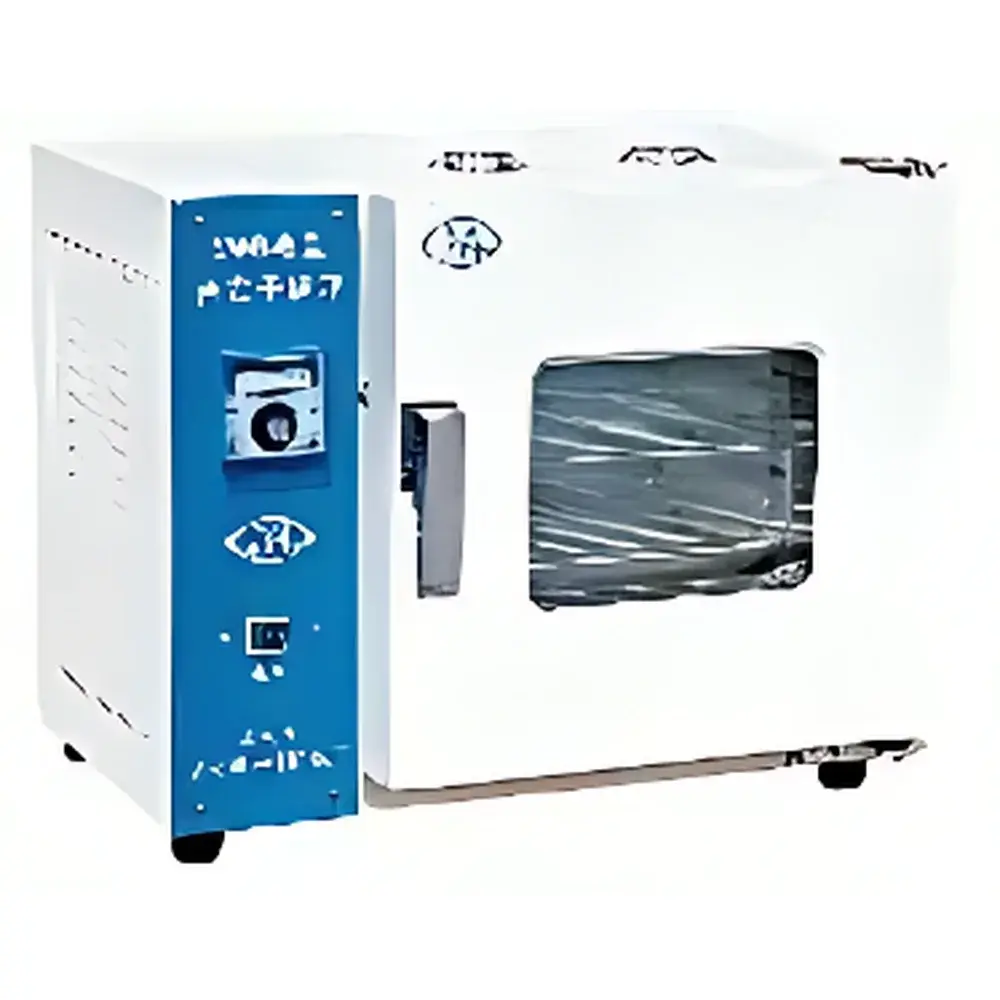
Shanghai-made 101-2EBS Digital Display Forced-Air Laboratory Drying Oven with Stainless Steel Interior Chamber
| Origin | Shanghai, China |
|---|---|
| Manufacturer Type | Authorized Distributor |
| Product Origin | Domestic (PRC) |
| Model | 101-2EBS |
| Rated Power | 2500 W |
| Voltage | 220 V AC |
| Temperature Range | 50–250 °C |
| Interior Chamber Dimensions | 450 × 550 × 550 mm (W × D × H) |
| External Dimensions | 615 × 840 × 755 mm (W × D × H) |
| Interior Material | AISI 304 Stainless Steel |
| Control System | Digital PID Temperature Controller |
| Viewing Window | Tempered Glass with Sealed Frame |
Overview
The 101-2EBS Digital Display Forced-Air Laboratory Drying Oven is an industrial-grade thermal processing instrument engineered for precise, uniform, and repeatable heat treatment in research laboratories, pharmaceutical quality control units, medical device manufacturing facilities, and materials testing environments. It operates on the principle of forced convection—using a centrifugal blower to circulate heated air across the chamber interior—ensuring rapid thermal equilibration and minimal temperature gradients (< ±2.5 °C at setpoint across the working volume per ISO 17025 calibration practices). Designed for continuous-duty operation, the unit delivers stable thermal performance over extended cycles, supporting critical non-destructive processes including moisture loss determination (per ASTM E121-22), polymer curing, glassware sterilization (dry-heat method), wax embedding preparation, and residual solvent removal from coated substrates. Its stainless steel interior (AISI 304) eliminates corrosion risk from acidic vapors or repeated cleaning agents, extending service life and maintaining compliance with GLP and GMP environmental control requirements.
Key Features
- Robust structural architecture: Cold-rolled steel outer casing with electrostatic powder coating—enhancing mechanical durability and resistance to abrasion and chemical exposure.
- High-integrity thermal containment: Double-wall insulation with mineral fiber packing (≥50 mm thickness) minimizes external surface temperature rise and improves energy efficiency.
- Real-time visual monitoring: Reinforced tempered glass observation window integrated into the door assembly, sealed with high-temperature silicone gasketing to preserve chamber integrity during operation.
- Precision digital temperature regulation: Microprocessor-based PID controller with adjustable proportional band, integral time, and derivative action—enabling tight setpoint adherence (±0.5 °C typical stability after 30 min dwell at 150 °C).
- Over-temperature safety protection: Independent mechanical backup thermostat prevents uncontrolled thermal excursion, meeting IEC 61000-4-2 immunity and EN 60519-2 safety standards for heating equipment.
- Optimized airflow design: Rear-mounted axial blower with adjustable speed (three-position switch) ensures laminar, turbulence-free circulation—critical for homogeneous drying of particulate samples and thin-film coatings.
Sample Compatibility & Compliance
The 101-2EBS accommodates a broad spectrum of sample formats—including Petri dishes, crucibles, aluminum weighing pans, glass vials, metal trays, and ceramic boats—without dimensional interference. Its 450 × 550 × 550 mm stainless steel chamber supports batch processing of up to 20 standard 100-mm Petri dishes or 12 × 50-mL glass vials per cycle. The unit complies with key regulatory frameworks governing laboratory thermal instrumentation: it satisfies the thermal uniformity and recovery time criteria outlined in USP for dry-heat sterilization validation, aligns with ISO 14644-1 Class 8 cleanroom-compatible installation guidelines when placed in controlled environments, and meets electrical safety requirements per UL 61010-1 and GB 4793.1–2019. Optional traceable calibration certificates (NIST-traceable RTD probe) are available upon request to support 21 CFR Part 11 audit readiness.
Software & Data Management
While the base configuration features standalone digital PID control, optional RS-485 Modbus RTU interface enables integration with centralized laboratory information management systems (LIMS) or SCADA platforms. Users may log temperature profiles, cycle start/stop timestamps, and alarm events via third-party data acquisition software. The controller supports programmable ramp-soak sequences (up to 8 segments), facilitating complex thermal protocols such as gradient drying of hygroscopic polymers or stepwise desorption studies. All operational parameters—including actual vs. setpoint deviation history—are retained in non-volatile memory for post-cycle review. Audit trail functionality (with user ID tagging and timestamped event logging) can be activated to meet FDA 21 CFR Part 11 electronic record requirements when paired with validated software extensions.
Applications
- Pharmaceutical: Residual moisture analysis of active pharmaceutical ingredients (APIs) per USP , excipient drying prior to tablet compression, and depyrogenation of glass containers.
- Materials Science: Pre-baking of ceramic green bodies, thermal aging of composites, and binder burnout in investment casting molds.
- Food & Agriculture: Moisture content determination in grains and feedstuffs (AOAC 950.46), enzyme inactivation studies, and shelf-life acceleration testing.
- Electronics: Degassing of encapsulants, pre-conditioning of PCB substrates, and solder paste drying prior to reflow profiling.
- Academic Research: Solvent evaporation from nanoparticle dispersions, thermal gravimetric sample preparation, and catalyst support calcination.
FAQ
What is the maximum recommended operating temperature for continuous use?
The 101-2EBS is rated for sustained operation up to 250 °C; however, prolonged use above 200 °C may reduce heater element lifespan and requires verification of sample thermal stability.
Is the stainless steel chamber electropolished or passivated?
The interior uses standard mill-finish AISI 304 stainless steel; electropolishing is available as a custom option for enhanced corrosion resistance in aggressive chemical environments.
Can this oven be used for sterilization applications?
Yes—it supports dry-heat sterilization protocols (e.g., 160 °C for 120 minutes or 170 °C for 60 minutes) compliant with ISO 15883-5 and EU Annex 1 requirements, provided validation is performed using calibrated biological indicators and thermocouple mapping.
Does the unit include a data output port by default?
No—the RS-485 interface is optional and must be specified at time of order; the standard configuration includes only front-panel digital display and manual controls.
What maintenance intervals are recommended for optimal performance?
Blower motor lubrication every 12 months, door gasket inspection quarterly, and annual calibration of the internal PT100 sensor against a NIST-traceable reference standard are advised per ISO/IEC 17025 maintenance protocols.



