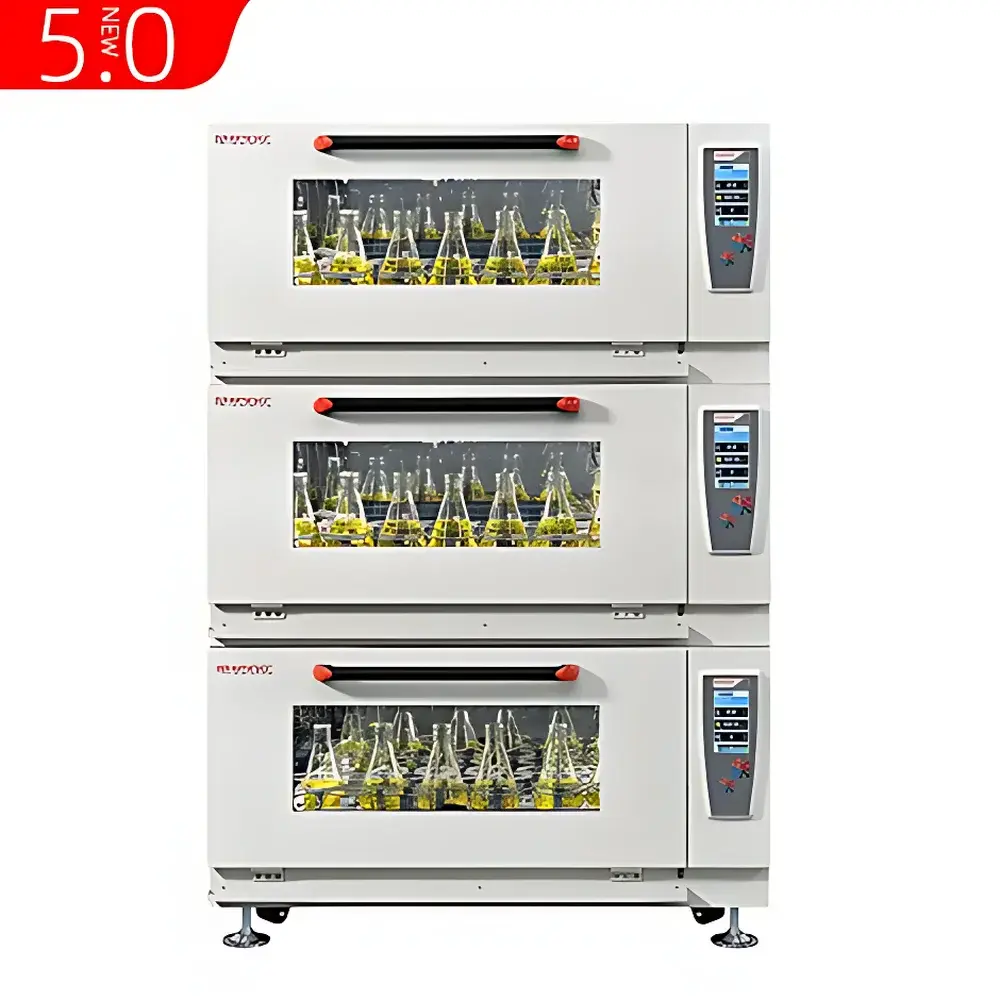
Shanghai Shiping DJS-2017R Plus Stackable Incubated Orbital Shaker
| Brand | Shanghai Shiping |
|---|---|
| Origin | Shanghai, China |
| Manufacturer Type | Direct Manufacturer |
| Instrument Type | Stackable Temperature-Controlled Orbital Shaker |
| Model | DJS-2017R Plus |
| Oscillation Frequency Range | 20–300 rpm |
| Oscillation Amplitude | Φ25 mm (standard), Φ50 mm (optional) |
| Temperature Control Range | 4–60 °C (minimum ambient: −18 °C |
| operational ambient | 5–35 °C) |
| Temperature Uniformity | ≤ ±0.5 °C |
| Temperature Accuracy | ±0.1 °C |
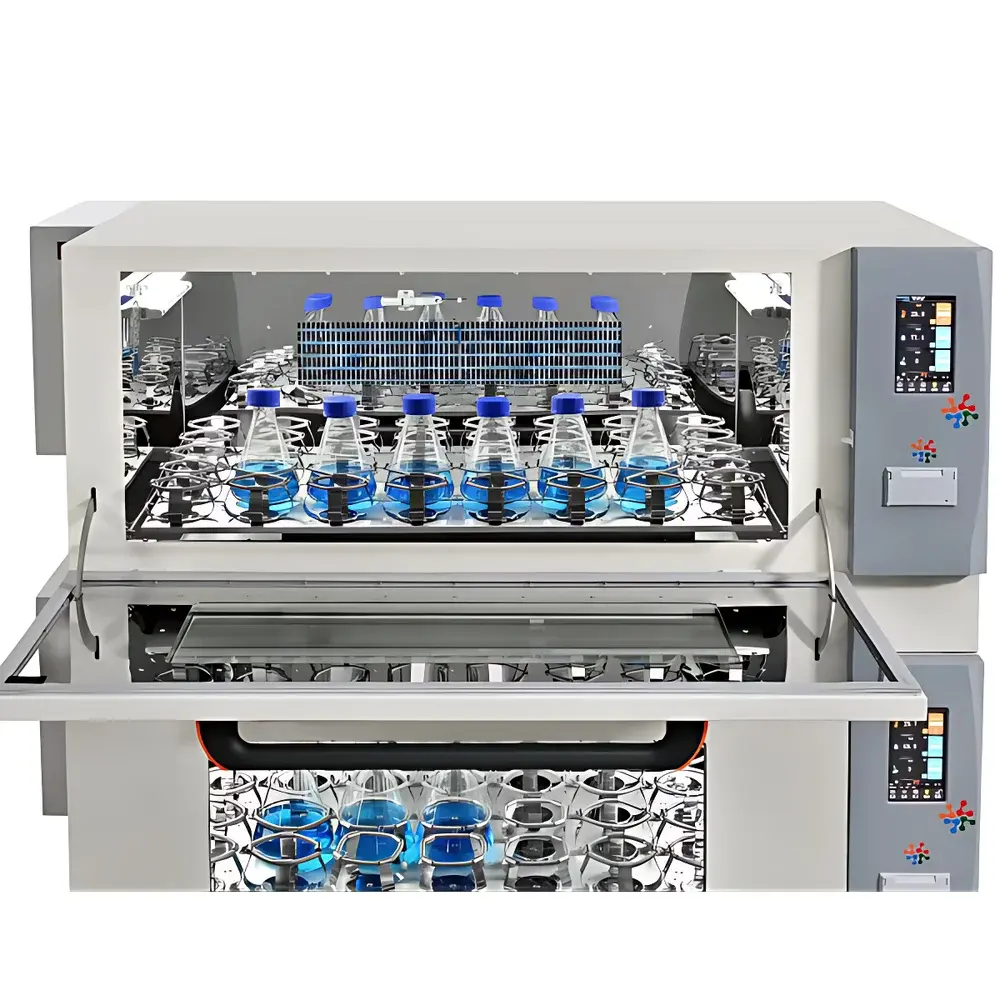
| Shelf Capacity | 1 platform (stackable up to 3 units) |
| Platform Dimensions | 940 × 530 mm |
| Internal Chamber Volume | 354 L |
| Max Load Capacity | 250 mL × 66, or 500 mL × 38, or 1000 mL × 27, or 2000 mL × 15, or 3000 mL × 11, or 5000 mL × 7 |
| Heating Power | 1300 W |
| Refrigeration Power | 195 W |
| Motor Power | 150 W |
| Display | 7-inch true-color capacitive touchscreen |
| Control Algorithm | PID-based environmental scanning microprocessor |
| Programmability | 5 programs × 30 segments |
| Air Circulation | Forced convection |
| Drive Mechanism | Single-axis balanced drive with parallel-linkage dynamic balancing |
| Bearing | Imported double-row precision bearings (rated for ≥100,000 hr service life) |
| Compressor | High-efficiency inverter-driven refrigeration system (R134a, non-ozone-depleting) |
| Chamber Material | AISI 304 stainless steel mirror finish, radius-cornered |
| Platform Material | AISI 304 brushed stainless steel |
| Flask Clamp Material | AISI 304 mirror-finish stainless steel (elasticity: 360°, hardness: 420 HBW) |
| Safety Features | Dual-limit overtemperature/overspeed audiovisual alarm, independent overtemperature cut-off, leakage & overload protection, compressor overload protection, sensor fault detection, door-open auto-stop |
| Compliance Support | Audit trail, user-level access control (3-tier permissions), event logging, power-failure recovery, calibration traceability, 21 CFR Part 11-ready configuration (with optional validation package) |
Overview
The Shanghai Shiping DJS-2017R Plus Stackable Incubated Orbital Shaker is an engineered platform for precise, long-duration cultivation of microbial, mammalian, and hybridoma cultures under tightly controlled thermal and mechanical conditions. It operates on the principle of orbital shaking—generating uniform circular motion at adjustable frequencies—to ensure homogeneous oxygen transfer, suspension stability, and nutrient distribution across liquid-phase bioreactions. Designed for multi-tier laboratory scalability, its modular stackable architecture supports up to three independently controlled units in a single footprint, optimizing floor space without compromising performance integrity. The system integrates refrigeration and heating within a single chamber, enabling operation from sub-ambient (4 °C) to elevated (60 °C) temperatures—critical for applications ranging from psychrophilic bacterial growth to thermophilic enzyme expression studies. Its forced-convection airflow system, combined with high-uniformity temperature control (±0.1 °C accuracy, ≤±0.5 °C uniformity), ensures reproducible environmental conditions compliant with GLP and GMP-aligned workflows.
Key Features
- Single-axis balanced drive mechanism utilizing parallel-linkage dynamic balancing—eliminates mechanical friction, reduces vibration transmission, and delivers stable, low-noise (<55 dB[A]) operation over extended cycles.
- Inverter-driven refrigeration system with R134a refrigerant ensures frost-free evaporator operation, energy savings exceeding 30% versus fixed-speed compressors, and consistent thermal regulation even during 72+ hour continuous runs.
- AISI 304 stainless steel chamber with mirror-finish interior and radius-cornered geometry facilitates complete sterilization, meets ISO 14644-1 Class 5 cleanroom-compatible cleaning protocols, and complies with pharmaceutical-grade hygiene standards.
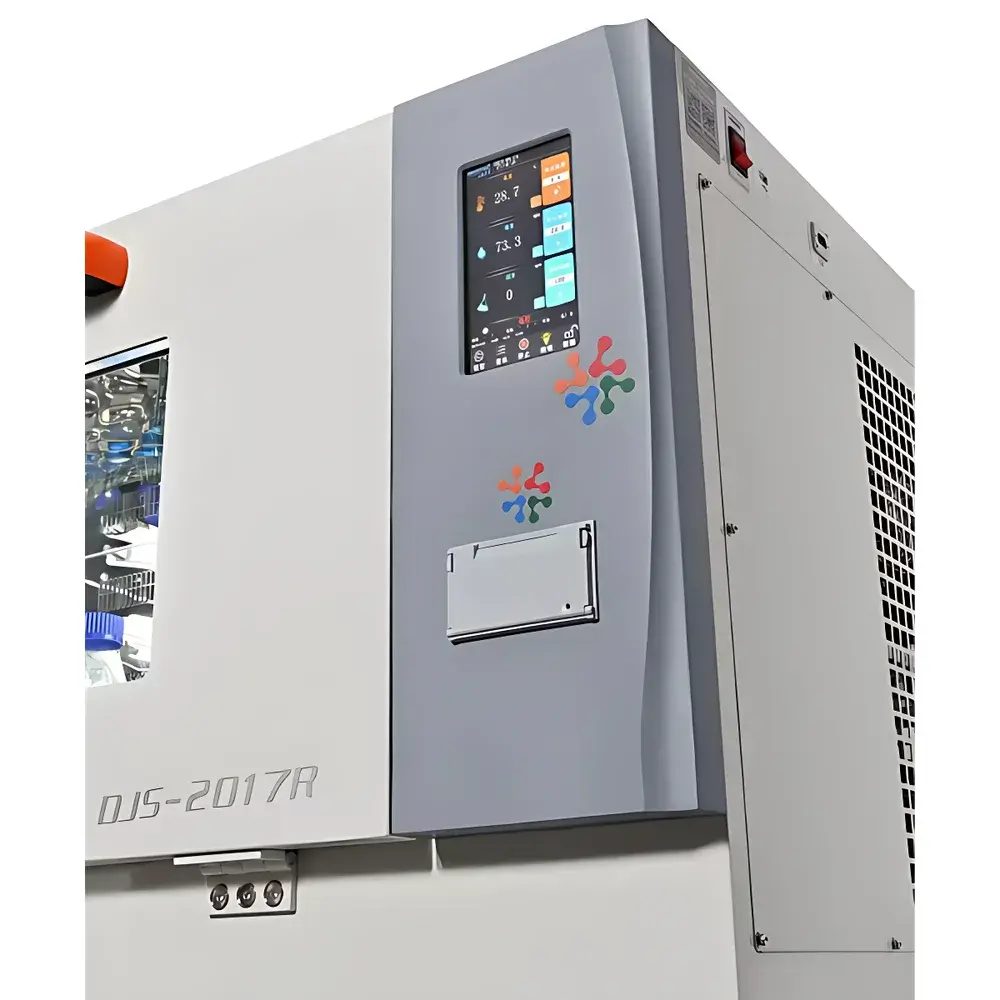
- 7-inch true-color capacitive touchscreen interface with PID-based environmental scanning logic enables intuitive parameter adjustment, real-time curve visualization, and programmable ramp-hold profiles (5 programs × 30 segments).
- Triple-layer safety architecture: hardware-level overtemperature/overspeed cutoffs, software-monitored sensor diagnostics, and electromechanical interlocks (e.g., door-open auto-stop) protect personnel, samples, and instrument longevity.
- Imported double-row precision bearings rated for ≥100,000 hours of continuous service, paired with 45# carbon steel shafts (220–250 HBW, quenched & tempered), form a robust mechanical core suitable for high-load fermentation vessels.
Sample Compatibility & Compliance
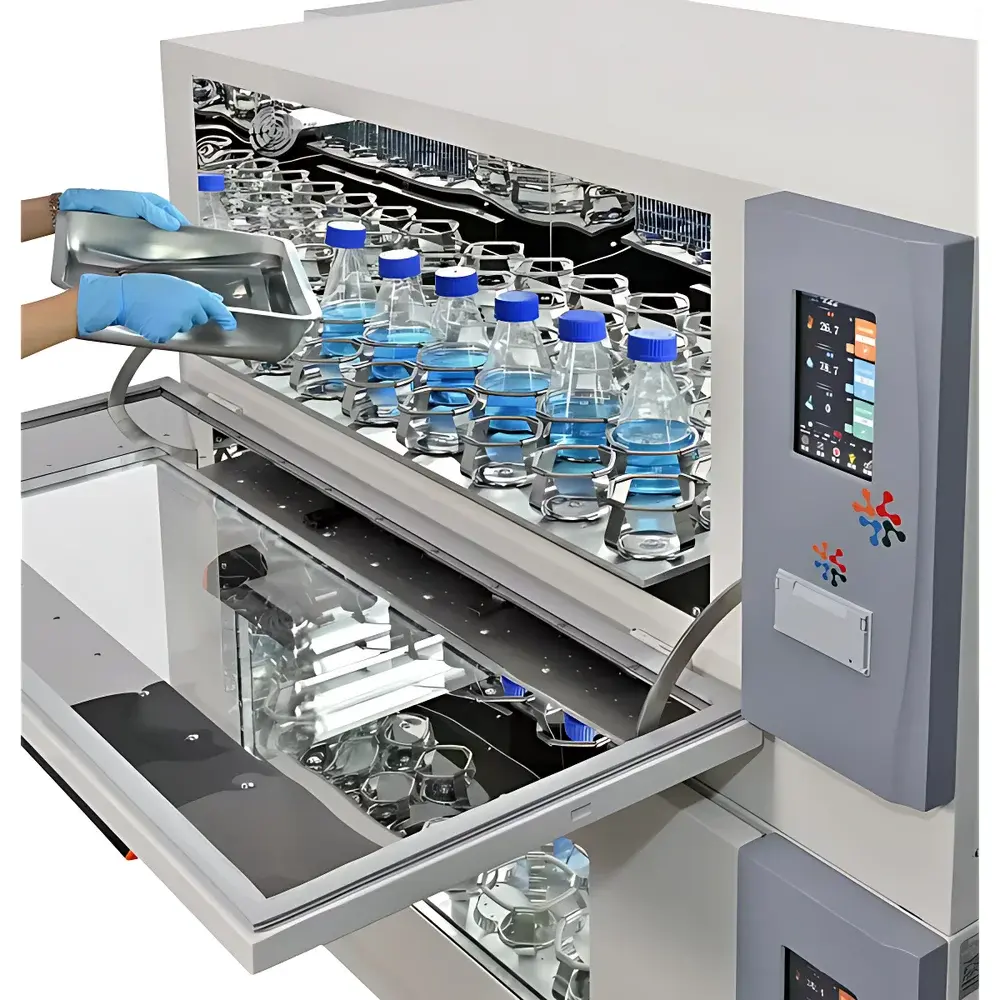
The DJS-2017R Plus accommodates diverse vessel formats—including Erlenmeyer flasks (250–5000 mL), test tubes, microtiter plates, and custom bioreactor bottles—via interchangeable platforms: spring-loaded clamps, bottle trays, enzyme-linked immunosorbent assay (ELISA) plate holders, and adhesive mats. Its chamber volume (354 L) and platform dimensions (940 × 530 mm) support high-density configurations while maintaining adequate headspace for gas exchange. Regulatory alignment includes support for FDA 21 CFR Part 11-compliant data integrity when configured with audit-trail-enabled firmware, electronic signatures, and time-stamped event logs. The system satisfies ISO 13485 preconditions for medical device manufacturing environments and aligns with ASTM E2500-22 guidance for verification of laboratory equipment used in regulated bioprocessing.
Software & Data Management
Firmware implements a secure, role-based access control system with three permission tiers (Administrator, Operator, Viewer), each governing parameter modification, method execution, and log export privileges. All operational events—including temperature setpoint changes, speed adjustments, alarm triggers, and door openings—are timestamped and stored locally with ≥1-year retention capacity. Historical data can be exported via USB 2.0 port in CSV format for external analysis or LIMS integration. Optional remote monitoring modules enable encrypted HTTPS-based access from desktop or mobile clients, supporting real-time telemetry and push notifications for critical alarms. Calibration records, including temperature and speed verification logs, are digitally signed and exportable as PDF reports compliant with ALCOA+ principles.
Applications
This shaker serves as a foundational tool in academic research, clinical diagnostics, and industrial biomanufacturing. Typical use cases include aerobic cultivation of Escherichia coli, Bacillus subtilis, and yeast strains; mammalian cell expansion in serum-free media; hybridoma culture for monoclonal antibody production; enzymatic reaction kinetics under controlled thermal gradients; and environmental microbiology assays (e.g., BOD determination). Its wide temperature range supports cold-shock protein induction, heat-shock response studies, and cryopreservation intermediate steps. In quality control labs, it fulfills USP sterility testing requirements when coupled with UV germicidal irradiation (8 W UVC lamp integrated into viewing window assembly).
FAQ
What is the maximum allowable ambient temperature for stable 4 °C operation?
The unit maintains 4 °C setpoint reliably when ambient temperature remains ≤25 °C; at 35 °C ambient, minimum achievable temperature rises to approximately 8 °C due to thermal load constraints.
Can multiple stacked units operate with independent temperature and speed profiles?
Yes—each unit features autonomous controller firmware; no master-slave dependency exists. Stacked configurations require dedicated 20 A circuits per unit.
Is the UV lamp certified for ISO 15223-1 biological indicator inactivation?
The 8 W UVC lamp (254 nm) achieves ≥3-log reduction of Bacillus atrophaeus spores in 15 minutes under direct exposure (validated per ISO 11138-3); routine qualification is user-responsible.
Does the system support IQ/OQ/PQ documentation packages?
Yes—factory-issued 3Q validation templates (including protocol drafts, acceptance criteria, and blank execution records) are available upon request; final PQ must be performed in situ by qualified personnel.
What maintenance intervals are recommended for the inverter compressor and drive bearings?
No scheduled lubrication is required. Annual verification of refrigerant pressure, PID calibration drift (<±0.05 °C), and bearing runout (<0.02 mm radial deviation) is advised per ISO/IEC 17025:2017 Annex A.3.