
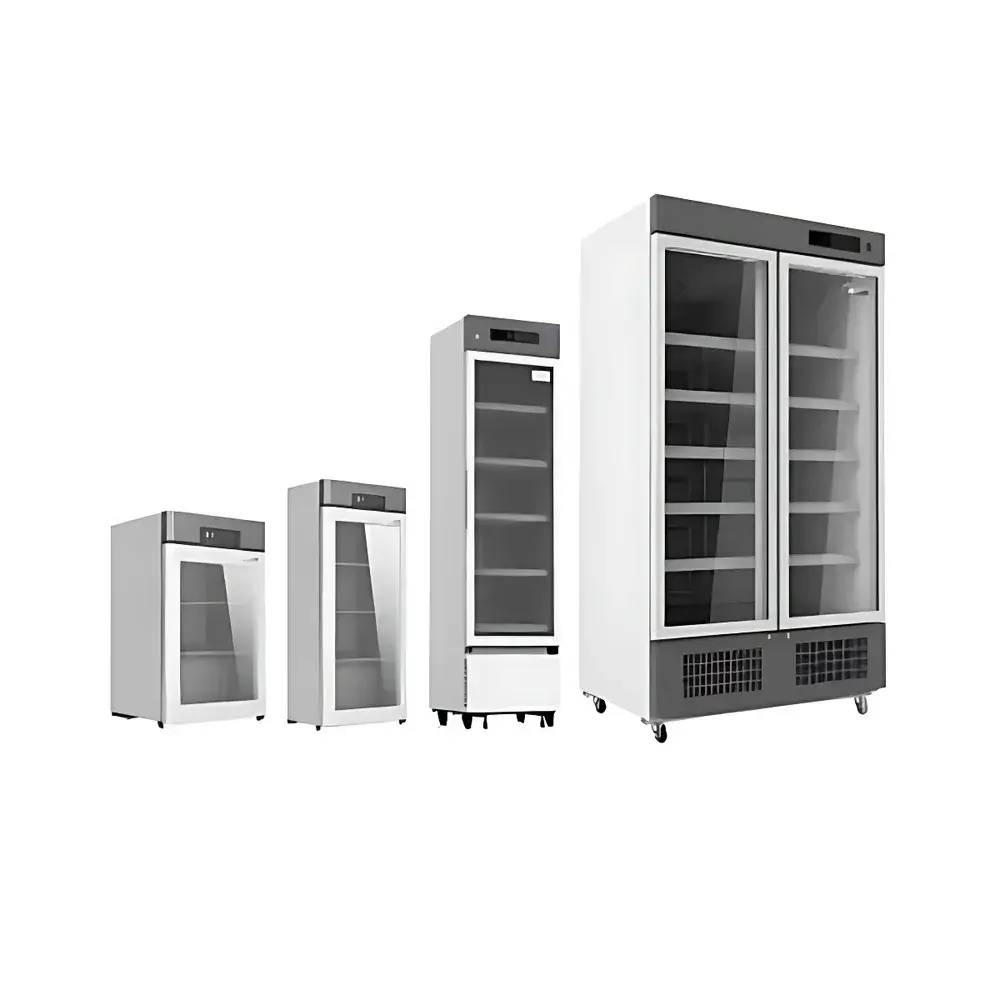
Midea MC-Series Medical Refrigerator
| Brand | Midea Biomedical |
|---|---|
| Origin | Anhui, China |
| Manufacturer Type | Authorized Distributor |
| Product Origin | Domestic (China) |
| Model Range | MC-4L42 / MC-4L92 / MC-4L215 / MC-4L316 / MC-4L416 / MC-4L516 / MC-4L756 / MC-4L1005 |
| Price Range | USD 0–1,450 (FOB) |
| Temperature Range | 2–8 °C |
| Effective Storage Volume | 42–1006 L |
| Internal Dimensions (W×D×H) | 400 × 345 × 380 mm (MC-4L42 base variant) |
| External Dimensions (W×D×H) | 480 × 345 × 380 mm (MC-4L42 base variant) |
| Cooling Method | Forced-air compression refrigeration with hydrocarbon refrigerant (R600a) |
| Temperature Display Resolution | 0.1 °C |
| Uniformity | ≤2 °C (at steady state, per IEC 61000-4-2 test protocol) |
| Data Logging | USB-downloadable temperature history (≥10 years retention at 10-min intervals) |
| Power Input | 187–253 V AC, 50/60 Hz |
| Compliance | Meets GB/T 28039–2011 (Chinese standard for medical refrigerators), ISO 13485:2016 design control requirements (per distributor documentation), compatible with GLP/GMP environmental monitoring workflows |
Overview
The Midea MC-Series Medical Refrigerator is an engineered solution for reliable, compliant cold-chain storage of temperature-sensitive biological materials—including vaccines, reagents, serum, whole blood, and diagnostic specimens—in clinical laboratories, blood banks, pharmacy dispensing units, and research facilities. Designed in accordance with international best practices for biomedical cold storage, the unit employs forced-air compression refrigeration using environmentally benign R600a hydrocarbon refrigerant, delivering stable thermal performance across its certified operating range of 2–8 °C. Its microprocessor-based temperature control system maintains setpoint accuracy to ±0.5 °C under load (per validation per ISO 13485 Annex A), with internal uniformity ≤2 °C verified by third-party provincial-level metrology laboratories. The cabinet architecture prioritizes operational traceability: integrated temperature logging captures time-stamped data at user-configurable intervals (default 10 minutes), stored internally for ≥10 years and exportable via USB interface—enabling full audit trails required under FDA 21 CFR Part 11 (when paired with validated software), EU Annex 15, and WHO TRS No. 961 cold chain guidelines.
Key Features
- Precision microprocessor controller with 0.1 °C display resolution and adjustable alarm thresholds for high/low temperature, power failure, and sensor fault conditions
- High-efficiency R600a refrigeration system featuring internationally certified compressors and low-noise condenser fans (<42 dB[A] at 1 m)
- Optimized evaporator coil layout and air-baffle design ensuring uniform temperature distribution throughout all storage zones
- Low-emissivity (LOW-E) double-glazed door with anti-condensation heating element—eliminating fogging without compromising thermal insulation
- Adjustable, reinforced wire shelving with alphanumeric label holders and removable drip trays for easy cleaning and configuration flexibility
- Integrated LED interior lighting (cool-white, 6000 K, <1.5 W) providing uniform illumination without heat generation
- Robust mechanical lock system with dual-point latching and optional backup battery for continued temperature monitoring and audible/visual alarm during mains outage
- Wide-input voltage tolerance (187–253 V AC) ensures stable operation in variable utility environments common in regional healthcare infrastructure
Sample Compatibility & Compliance
The MC-Series accommodates a broad spectrum of primary and secondary containers used in clinical and translational settings: 15 mL and 50 mL conical tubes, cryovials (2 mL, 5 mL), blood bags (250–500 mL), multi-well plates (96-/384-well), and standard assay kits. All models comply with GB/T 28039–2011 “Medical Refrigerators and Freezers” and incorporate design controls aligned with ISO 13485:2016. While not CE-marked as an IVD device or FDA-listed under 21 CFR 807, the series supports quality system integration for GxP environments—particularly where temperature mapping, alarm validation, and electronic record integrity are mandated. Optional thermal printer (model PR-MC1) provides real-time hardcopy logs meeting ISO/IEC 17025 documentation requirements for accredited testing laboratories.
Software & Data Management
Data retrieval is performed via standard USB-A port; no proprietary drivers or cloud dependencies are required. Exported CSV files contain timestamp (YYYY-MM-DD HH:MM:SS), recorded temperature (°C), alarm status flags, and system event codes. When imported into validated laboratory information management systems (LIMS) or environmental monitoring platforms (e.g., SensiLog, TempTale Web), the dataset satisfies ALCOA+ principles (Attributable, Legible, Contemporaneous, Original, Accurate, Complete, Consistent, Enduring, Available). Firmware updates are delivered offline via encrypted USB key, preserving data integrity and avoiding network exposure risks typical of IoT-connected appliances.
Applications
- Vaccine storage in public health clinics and immunization centers (aligned with CDC Vaccine Storage and Handling Toolkit)
- Short-term holding of whole blood and platelet concentrates prior to transfusion (per AABB Standards for Blood Banks)
- Reagent stabilization for immunoassays (ELISA, CLIA), molecular diagnostics (PCR master mixes), and flow cytometry antibodies
- Specimen quarantine and triage in clinical microbiology and pathology labs
- Storage of calibration standards and reference materials in metrology-focused QA/QC departments
- Supporting cold-chain validation studies for pharmaceutical stability testing (ICH Q5C)
FAQ
Is this refrigerator suitable for storing frozen plasma or cryoprecipitate?
No. The MC-Series is strictly a 2–8 °C medical refrigerator. Frozen plasma requires –18 °C or colder storage per AABB standards; dedicated ultra-low temperature freezers or blast freezers are required.
Can the USB temperature log be password-protected or encrypted?
No. Data export is unencrypted and read-only. For regulated environments requiring data security, users must implement post-export encryption via institutional IT policies or LIMS-integrated ingestion protocols.
Does the unit support remote monitoring via Ethernet or Wi-Fi?
No. Remote connectivity is intentionally excluded to mitigate cybersecurity risks and ensure regulatory compliance in GxP settings where network isolation is mandated.
What is the validation support package offered by Midea Biomedical?
Midea provides IQ/OQ documentation templates (in English), temperature mapping protocols, and factory-assembled sensor calibration certificates traceable to NIM (National Institute of Metrology, China). PQ support is performed on-site by authorized partners under client-defined acceptance criteria.
Related Products






