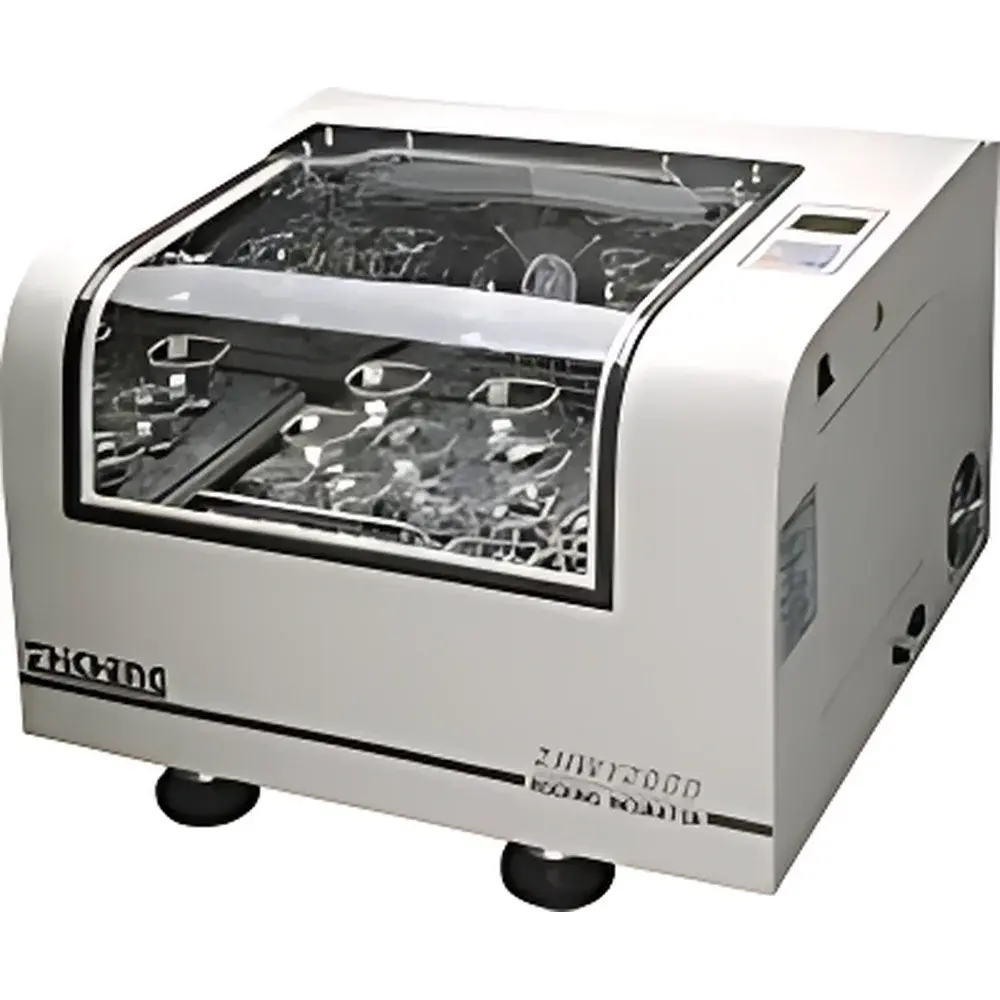
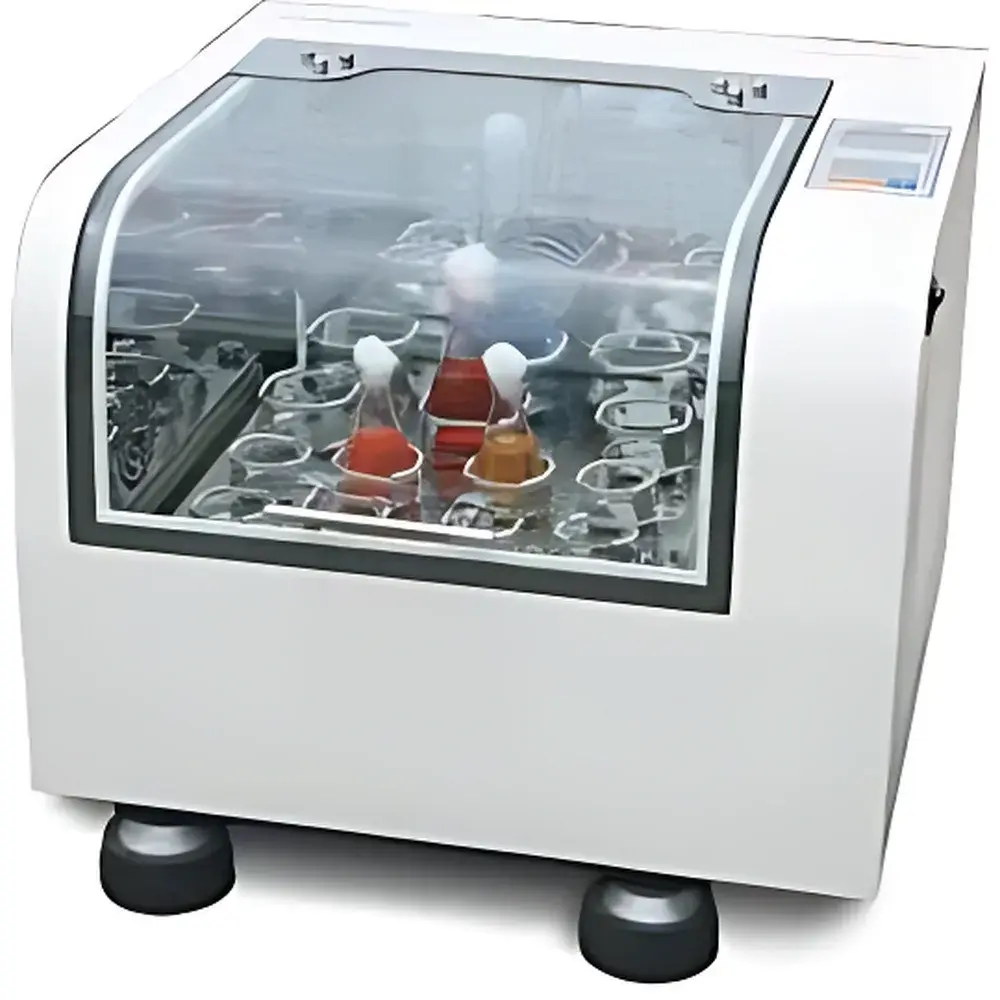
Shanghai Shiping ZHWY-100D/103D/200D Adjustable-Amplitude High-Speed Orbital Shaker
| Brand | Shanghai Shiping |
|---|---|
| Origin | Shanghai, China |
| Model | ZHWY-100D / ZHWY-103D / ZHWY-200D |
| Timer Range | 0–500 min |
| Oscillation Frequency | 30–600 rpm |
| Amplitude Adjustment | 0–50 mm, continuously variable |
| Temperature Control Range | ZHWY-100D/ZHWY-103D: Ambient +5°C to 60°C |
| ZHWY-200D | 4°C to 60°C |
| Temperature Uniformity | ≤ ±1°C (at 37°C) |
| Temperature Stability | ≤ ±0.5°C (at 37°C) |
| Temperature Resolution | 0.1°C |
| Orbit Diameter | Φ0–50 mm |
| Platform Quantity | 1 |
| Drive Type | Orbital (track-driven) |
| Control System | PID microprocessor-based environmental scanning chip |
| Display | Backlit LCD |
| Power Supply | AC 220 V, 50/60 Hz |
| Compliance | Designed for GLP-compliant laboratory environments |
Overview
The Shanghai Shiping ZHWY-100D/103D/200D series represents a family of precision-engineered orbital shakers designed for demanding life science applications requiring simultaneous control of temperature, oscillation frequency, and amplitude. These instruments operate on the principle of orbital motion—where the platform rotates in a horizontal circular path—generating consistent, non-turbulent mixing ideal for aerobic microbial culture, enzyme kinetics, cell suspension maintenance, and hybridization protocols. Unlike reciprocating or vortex shakers, orbital motion minimizes shear stress while maximizing oxygen transfer efficiency across a broad range of vessel types and volumes. Each model is built around a brushless AC induction motor delivering constant torque and speed stability across the full 30–600 rpm range, eliminating carbon brush wear and ensuring long-term operational reliability without scheduled maintenance.
Key Features
- Continuously variable amplitude adjustment (0–50 mm Φ orbit), enabling precise tuning of mixing intensity—from gentle suspension of sensitive eukaryotic cells to vigorous aeration of high-density bacterial cultures.
- Smooth ramp-up acceleration profile mitigates mechanical shock during startup, preserving sample integrity and reducing risk of tube leakage or foam formation.
- PID-controlled thermal regulation with forced-air convection ensures uniform chamber temperature distribution (≤ ±1°C at 37°C) and exceptional stability (≤ ±0.5°C at 37°C).
- Backlit LCD interface displays real-time values for temperature, speed, amplitude, and remaining timer duration; all parameters are password-locked to prevent unauthorized modification.
- Integrated safety systems include over-temperature audiovisual alarm, motor overheat protection, and automatic power cutoff upon thermal runaway or sensor failure.
- Memory retention function preserves user-defined settings after power interruption; auto-restart capability resumes operation under original conditions following mains recovery.
- Electrostatically coated steel enclosure with tempered glass viewing window provides corrosion resistance and visual monitoring without compromising structural rigidity.
Sample Compatibility & Compliance
The ZHWY series accommodates standard laboratory vessels including test tubes (50 mL × 9), Erlenmeyer flasks (250–1000 mL), and multi-well plates via optional platform adapters. Platform dimensions vary by model: ZHWY-103D (280 × 220 mm), ZHWY-100D (340 × 370 mm), and ZHWY-200D (400 × 370 mm), supporting scalable throughput from benchtop screening to pilot-scale cultivation. All units comply with IEC 61010-1 safety standards for laboratory equipment and are engineered to support Good Laboratory Practice (GLP) workflows. When operated with validated data acquisition software, the system meets traceability and electronic record requirements outlined in FDA 21 CFR Part 11, including time-stamped audit logs, user authentication, and immutable parameter history.
Software & Data Management
While the base instrument operates via standalone PID controller, optional RS-485 or USB interfaces enable integration with third-party laboratory information management systems (LIMS) or custom SCADA platforms. The embedded firmware records timestamped operational events—including setpoint changes, alarm triggers, and power cycle occurrences—into non-volatile memory. Exportable log files (CSV format) support retrospective analysis and regulatory reporting. For GMP-aligned facilities, optional validation packages—including IQ/OQ documentation templates and calibration certificate traceability to NIST standards—are available upon request.
Applications
These shakers serve critical roles in molecular biology (e.g., plasmid amplification, PCR master mix homogenization), microbiology (aerobic batch culture of E. coli, Bacillus, and yeast strains), immunology (antibody-antigen binding assays), and bioprocess development (seed train expansion, media optimization studies). Their wide amplitude and speed range make them suitable for both low-shear suspension of stem cells and high-oxygen-transfer fermentation of recombinant protein expression systems. The ZHWY-200D’s sub-ambient capability (4°C minimum) further extends utility to cold-adapted enzyme assays and chilled DNA ligation protocols.
FAQ
What distinguishes the ZHWY-103D, ZHWY-100D, and ZHWY-200D models?
The ZHWY-103D is a compact unit optimized for space-constrained benches with a 280 × 220 mm platform and 34 L chamber volume; the ZHWY-100D offers mid-range capacity (63 L) and platform size (340 × 370 mm); the ZHWY-200D features the largest chamber (69 L), widest platform (400 × 370 mm), and extended low-temperature range (4–60°C).
Is the amplitude adjustment truly continuous, or are there discrete steps?
Amplitude is adjusted via a calibrated linear potentiometer providing true analog control across the full 0–50 mm Φ range, verified by factory calibration against optical displacement sensors.
Can this shaker be used for sterile applications inside a biosafety cabinet?
Yes—the ZHWY-103D and ZHWY-100D models meet UL/CSA Class II cabinet compatibility requirements when installed with external power conditioning; airflow interference must be assessed case-by-case per cabinet manufacturer guidelines.
Does the system support external temperature probes for vessel-specific monitoring?
No native port exists for external probe input; however, optional third-party thermocouple modules with analog voltage output can be interfaced via the RS-485 expansion port using Modbus RTU protocol.
What maintenance intervals are recommended for long-term reliability?
No scheduled maintenance is required for the brushless motor or PID controller; annual verification of temperature accuracy (using NIST-traceable reference thermometer) and mechanical alignment of drive linkage is advised for ISO 17025-accredited labs.