
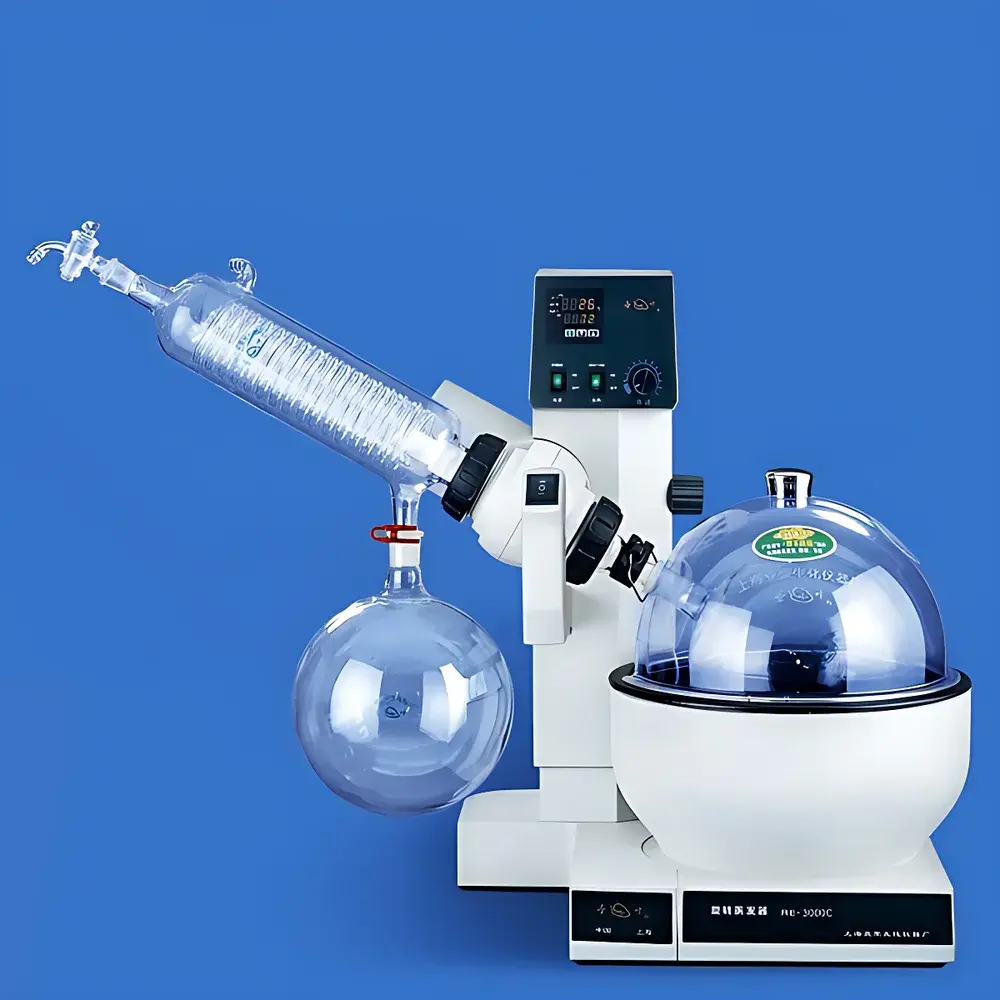
Shanghai Yarong RE-3000C Horizontal Rotary Evaporator
| Brand | Jinye |
|---|---|
| Origin | Shanghai, China |
| Manufacturer Type | Direct Manufacturer |
| Product Origin | Domestic (China) |
| Model | RE-3000C |
| Evaporation Flask Capacity | 50–3000 mL |
| Rotation Speed | 0–200 rpm |
| Temperature Control Range | Room temperature to 99 °C (PID digital temperature controller with LED display) |
| Temperature Control Accuracy | ±1 °C |
| Condenser Surface Area | 0.15 m² (standard-taper jacketed condenser with direct-coupled receiving flask) |
Overview
The Shanghai Yarong RE-3000C is a horizontally configured rotary evaporator engineered for reliable solvent removal, concentration, and purification in research and quality control laboratories. It operates on the principle of reduced-pressure distillation: rotation of the sample flask forms a thin, uniform film over its inner surface, significantly increasing evaporation area and heat transfer efficiency; simultaneous application of vacuum lowers the boiling point of solvents, while precise PID-controlled heating ensures thermal stability during gentle yet effective volatilization. Designed for routine use in biopharmaceutical development, fine chemical synthesis, natural product isolation, and analytical sample preparation, the RE-3000C integrates mechanical robustness with functional simplicity—featuring an automatic lifting mechanism for safe, repeatable flask positioning, standard-taper (24/40 or 29/32) glassware compatibility, and a high-efficiency vertical condenser assembly.
Key Features
- Horizontal configuration with integrated motorized lift system for ergonomic operation and reproducible flask immersion depth
- PID digital temperature controller with LED display, enabling stable bath temperature regulation from ambient to 99 °C with ±1 °C accuracy
- Stepless speed control (0–200 rpm) via electronic drive, ensuring consistent film formation across diverse viscosities and volumes
- Jacketed condenser with 0.15 m² effective cooling surface area, optimized for high-condensation efficiency under typical laboratory vacuum conditions (≤10 mbar)
- Standard-taper ground-glass joints (compatible with common 24/40 and 29/32 systems) for leak-tight, modular assembly with collection flasks, vapor ducts, and vacuum interfaces
- Stainless steel mainframe with corrosion-resistant coating, designed for long-term stability under continuous operation in organic solvent environments
Sample Compatibility & Compliance
The RE-3000C accommodates standard round-bottom flasks ranging from 50 mL to 3000 mL, supporting both batch and semi-continuous feed protocols via optional inlet adapters. It is suitable for low-to-medium boiling point solvents (e.g., diethyl ether, acetone, ethyl acetate, methanol, dichloromethane) and thermally sensitive compounds requiring gentle concentration below 100 °C. While not certified to specific ISO or ASTM standards as a standalone unit, its design adheres to general laboratory safety principles outlined in ISO 15190:2020 (Laboratory safety — General requirements) and supports GLP-compliant workflows when operated with documented procedures, calibrated temperature sensors, and traceable vacuum monitoring. The absence of programmable data logging limits native 21 CFR Part 11 compliance; however, external temperature and pressure loggers may be integrated for audit-ready process documentation.
Software & Data Management
The RE-3000C operates via analog-digital hybrid controls without embedded firmware or network connectivity. All operational parameters—including bath temperature setpoint, rotation speed, and lift position—are manually configured and monitored in real time via front-panel LED displays and tactile dials. No proprietary software, drivers, or cloud interface is provided. For laboratories requiring electronic recordkeeping, third-party USB or RS-485 data loggers can be connected to the temperature sensor output (typically 0–5 V or PT100 analog signal) and rotation encoder to capture time-stamped process variables. This approach enables alignment with internal SOPs for instrument qualification (IQ/OQ) and facilitates retrospective review during regulatory audits.
Applications
- Concentration of crude extracts in natural product chemistry and phytochemical analysis
- Solvent recovery and intermediate purification in API synthesis workflows
- Removal of volatile reaction byproducts during catalytic or polymerization reactions
- Preparative-scale dehydration of heat-labile biomolecules prior to lyophilization
- Batch-wise isolation of flavor/aroma compounds in food science applications
- Residual solvent reduction in QC sample preparation for HPLC or GC analysis
FAQ
What flask sizes are compatible with the RE-3000C?
Standard taper round-bottom flasks from 50 mL to 3000 mL can be mounted using appropriate chucks and support rods; 1000 mL and 2000 mL flasks are most commonly used for balanced throughput and film stability.
Does the unit include a vacuum pump or coolant recirculator?
No—the RE-3000C requires external vacuum source (e.g., diaphragm or water aspirator pump) and coolant supply (tap water or recirculating chiller) for condenser operation; these are specified separately per lab infrastructure.
Is the temperature sensor calibrated and traceable to national standards?
The built-in sensor is factory-adjusted but not supplied with NIST-traceable calibration certificate; users should perform periodic verification using a calibrated reference thermometer per internal metrology protocol.
Can the RE-3000C be used under inert atmosphere?
Yes—by connecting a nitrogen or argon inlet line to the vapor duct adapter, the system supports solvent evaporation under inert gas blanket to prevent oxidation of air-sensitive compounds.
What maintenance is required for long-term reliability?
Routine inspection of PTFE seals, lubrication of lifting screw threads every 6 months, and periodic cleaning of condenser jacket with descaling solution (if using hard tap water) are recommended to maintain performance and vacuum integrity.



