
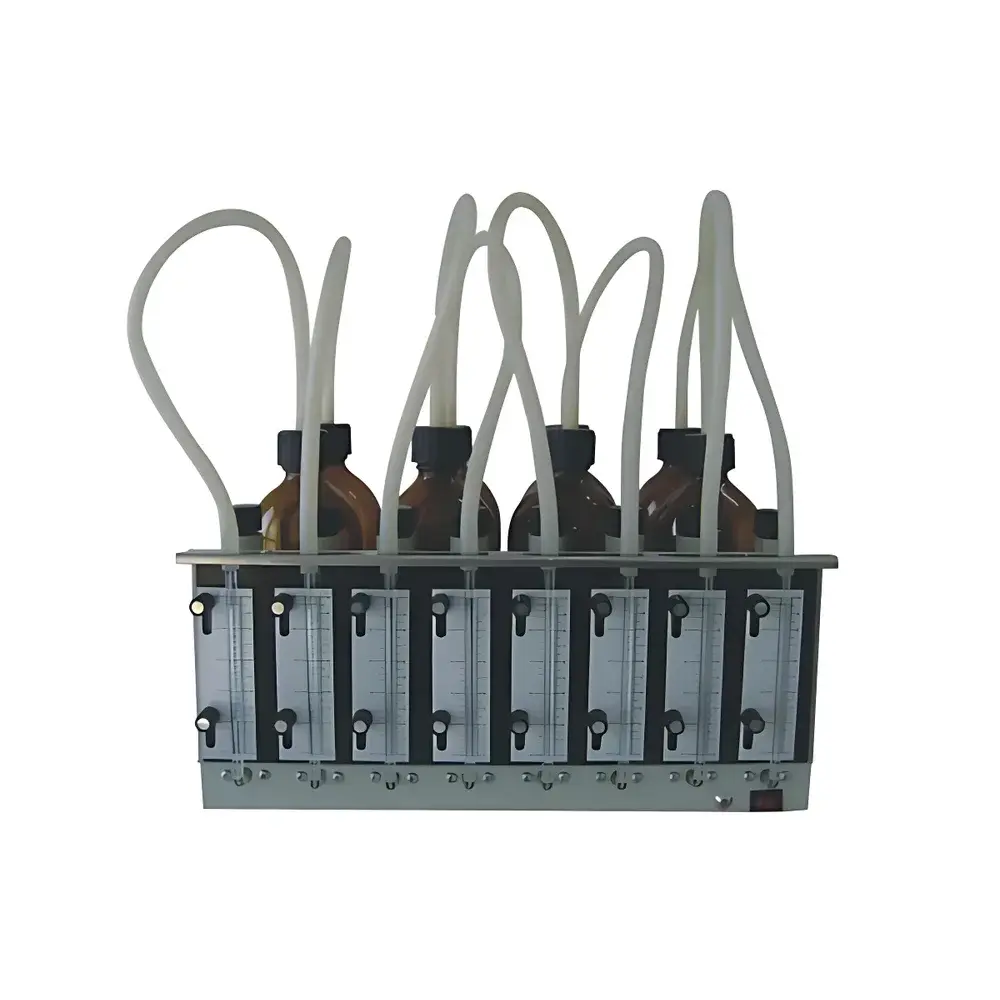
Shenchanghong CY-2 Direct-Reading BOD Analyzer
| Brand | Shenchanghong |
|---|---|
| Origin | Guangdong, China |
| Manufacturer Type | OEM Manufacturer |
| Product Category | Domestic |
| Model | CY-2 Direct-Reading |
| Instrument Type | Laboratory BOD Analyzer |
| Measurement Principle | Manometric (Pressure Differential) Method using Dissolved Oxygen Depletion |
| Measurement Range | 0–1000 mg/L |
| Detection Limit | ≤1 mg/L |
| Accuracy | Compliant with GB 7488–1987 |
| Single Sample Measurement Time | 5 days (standard incubation) |
| Repeatability | ±1 mg/L or ±2% of reading (whichever is greater) |
| Batch Capacity | 8 samples |
| Incubation Temperature Control | 20 ± 1 °C |
| Display | Direct-reading digital display (mg/L BOD₅) |
| Dimensions (W×D×H) | 400 × 270 × 350 mm |
| Net Weight | 6 kg |
| Power Consumption | <15 W |
Overview
The Shenchanghong CY-2 Direct-Reading BOD Analyzer is a laboratory-grade manometric biochemical oxygen demand (BOD) measurement system engineered for precision, reproducibility, and compliance with national standard GB 7488–1987. It operates on the pressure differential principle: during 5-day aerobic biodegradation at 20 ± 1 °C, microorganisms in the sample consume dissolved oxygen (DO), generating CO₂ as a metabolic byproduct. The CO₂ is chemically trapped by sodium hydroxide (NaOH) placed in an internal absorption cup, resulting in a measurable pressure drop within the sealed culture bottle. This pressure differential—detected via calibrated mercury column displacement—is directly correlated to oxygen consumption and converted in real time to BOD₅ concentration (mg/L) without manual titration or dilution calculations. Unlike dilution-based Winkler methods, the CY-2 eliminates operator-dependent variables such as endpoint judgment and volumetric transfer errors, delivering inherently stable baseline measurements ideal for routine wastewater monitoring, effluent compliance verification, and environmental lab accreditation workflows.
Key Features
- Direct-reading digital display showing real-time BOD₅ (mg/L) — no post-test calculation required.
- Integrated 8-position sample manifold enabling parallel analysis of up to eight independent water or wastewater samples under identical controlled conditions.
- Thermostatically regulated incubation chamber maintaining ±1 °C stability at 20 °C, conforming to ISO 5815-1:2019 and APHA Standard Methods 5210B requirements for BOD₅ testing.
- Robust mechanical architecture with sealed glass manometers and corrosion-resistant NaOH absorption cups ensuring long-term calibration integrity and minimal drift.
- Low-power design (<15 W) suitable for continuous operation in shared laboratory environments; no external gas supply or vacuum pump needed.
- Compliance-ready documentation support: instrument logbook templates, calibration verification records, and incubation temperature traceability logs align with GLP and ISO/IEC 17025 quality management expectations.
Sample Compatibility & Compliance
The CY-2 accommodates raw influent, secondary effluent, surface water, groundwater, and pretreated industrial discharges—provided samples are filtered (≤1.2 µm) and seeded (if low-microbe content) per GB 7488–1987 protocol. It excludes samples containing volatile organic compounds (VOCs) that may interfere with CO₂ absorption or high-sulfide matrices requiring chloramphenicol inhibition. All measurements satisfy the performance criteria outlined in China’s National Standard GB 7488–1987, which mirrors core elements of ISO 5815-1 and ASTM D5210 for five-day BOD determination. While not FDA 21 CFR Part 11–certified out-of-the-box, audit trails (manual entry logs), defined calibration intervals, and physical parameter locks support integration into GMP-aligned environmental monitoring programs where electronic signatures are managed externally.
Software & Data Management
The CY-2 is a hardware-centric, non-networked analyzer with no embedded firmware or proprietary software. Data output consists solely of direct analog-to-digital conversion of mercury column height into mg/L BOD₅, displayed on a front-panel LED screen. Users record results manually into LIMS-compatible spreadsheets or paper-based QA/QC notebooks. This architecture intentionally avoids cybersecurity vulnerabilities associated with connected instruments and simplifies validation: no software qualification (IQ/OQ/PQ) is required. For laboratories implementing digital workflows, optional USB-connected digital manometer adapters (third-party) may be integrated to capture time-series pressure data for trend analysis—though such configurations fall outside factory warranty scope.
Applications
- Routine BOD₅ monitoring in municipal wastewater treatment plants for process control and discharge permit compliance.
- Environmental monitoring stations conducting seasonal surface water quality assessments under China’s “Surface Water Environmental Quality Standards” (GB 3838–2002).
- Academic and research laboratories performing comparative biodegradability studies of synthetic organics or pharmaceutical intermediates.
- Third-party testing labs seeking cost-effective, standards-compliant alternatives to respirometric or optical BOD systems where high-throughput is secondary to regulatory defensibility.
- Educational institutions teaching fundamental principles of microbial respiration kinetics and environmental biochemistry.
FAQ
Does the CY-2 require sample dilution prior to analysis?
No—unlike classical dilution methods, the CY-2 measures undiluted samples across its full 0–1000 mg/L range. However, samples exceeding 1000 mg/L BOD must be diluted per GB 7488–1987 to avoid oxygen depletion before day 5.
Is mercury handling hazardous, and are alternatives available?
The instrument uses sealed mercury manometers compliant with IEC 61000-6-3 EMC standards. Mercury exposure risk is negligible during normal operation. Non-mercury digital transducer modules are not supported by the original design but may be retrofitted by qualified metrology service providers under calibration revalidation.
How often must the NaOH absorbent be replaced?
Fresh NaOH pellets must be loaded into each absorption cup before every test cycle. Residual carbonate formation invalidates subsequent runs; cups are single-use per assay.
Can the CY-2 be used for BOD₇ or other incubation durations?
While optimized for the standardized 5-day (BOD₅) protocol, extended incubation (e.g., BOD₇) is technically feasible but requires manual interpretation and is not covered by GB 7488–1987 validation.
What maintenance is required to ensure long-term accuracy?
Monthly verification of incubator temperature uniformity (using NIST-traceable thermometer), quarterly manometer zero-check, and annual seal integrity inspection of culture bottles constitute the recommended PM schedule. No user-serviceable electronics are present.







