

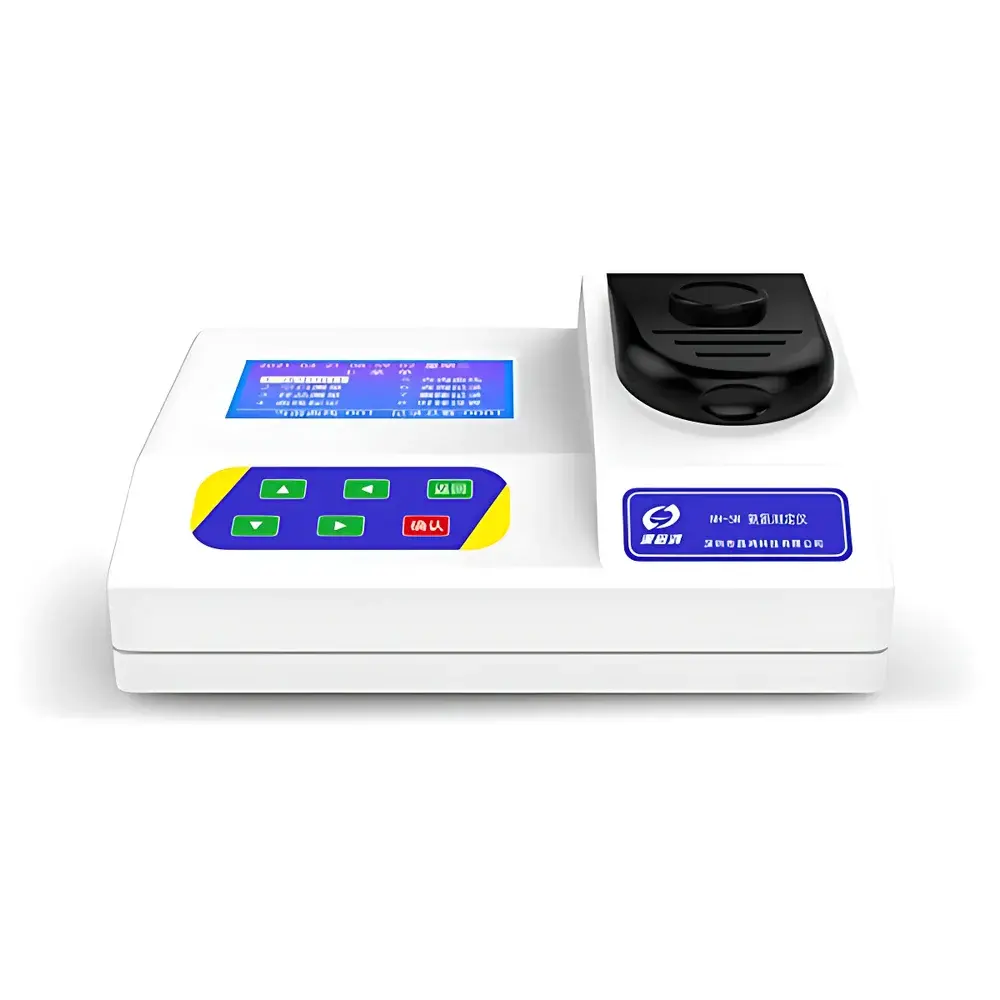
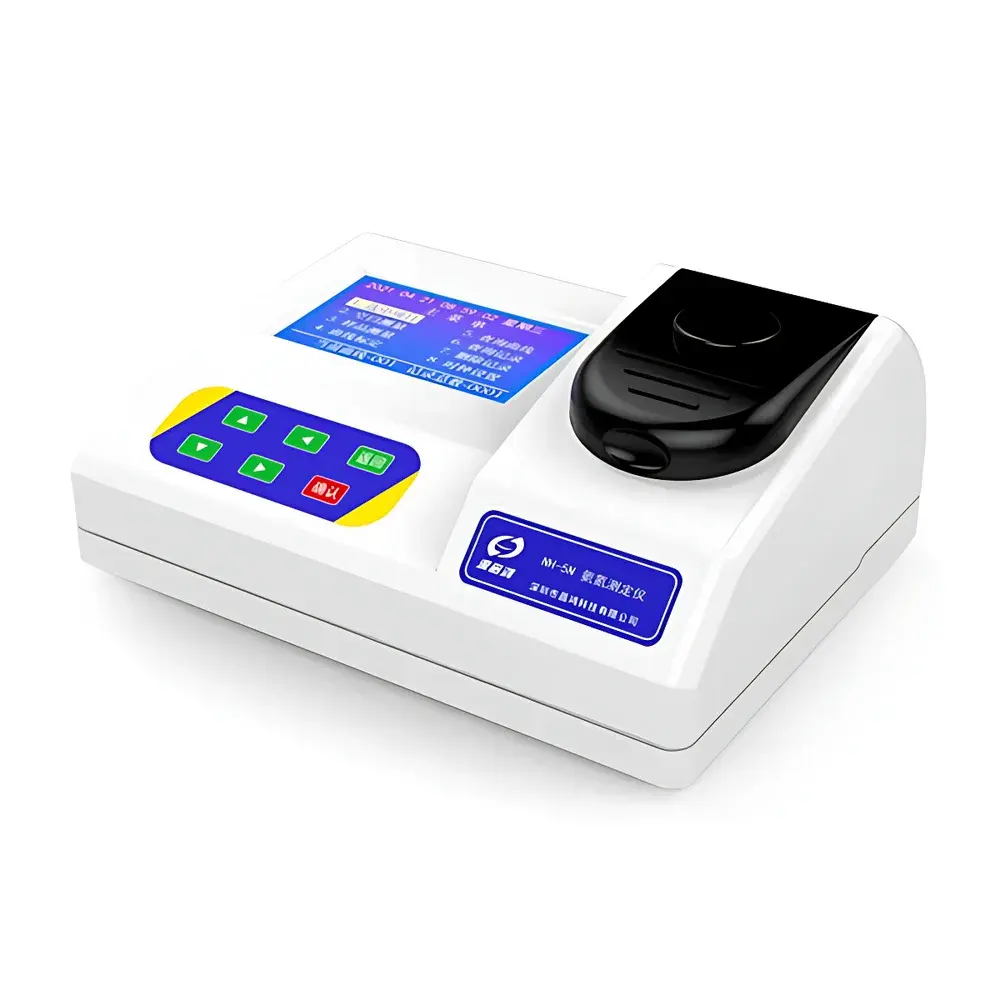
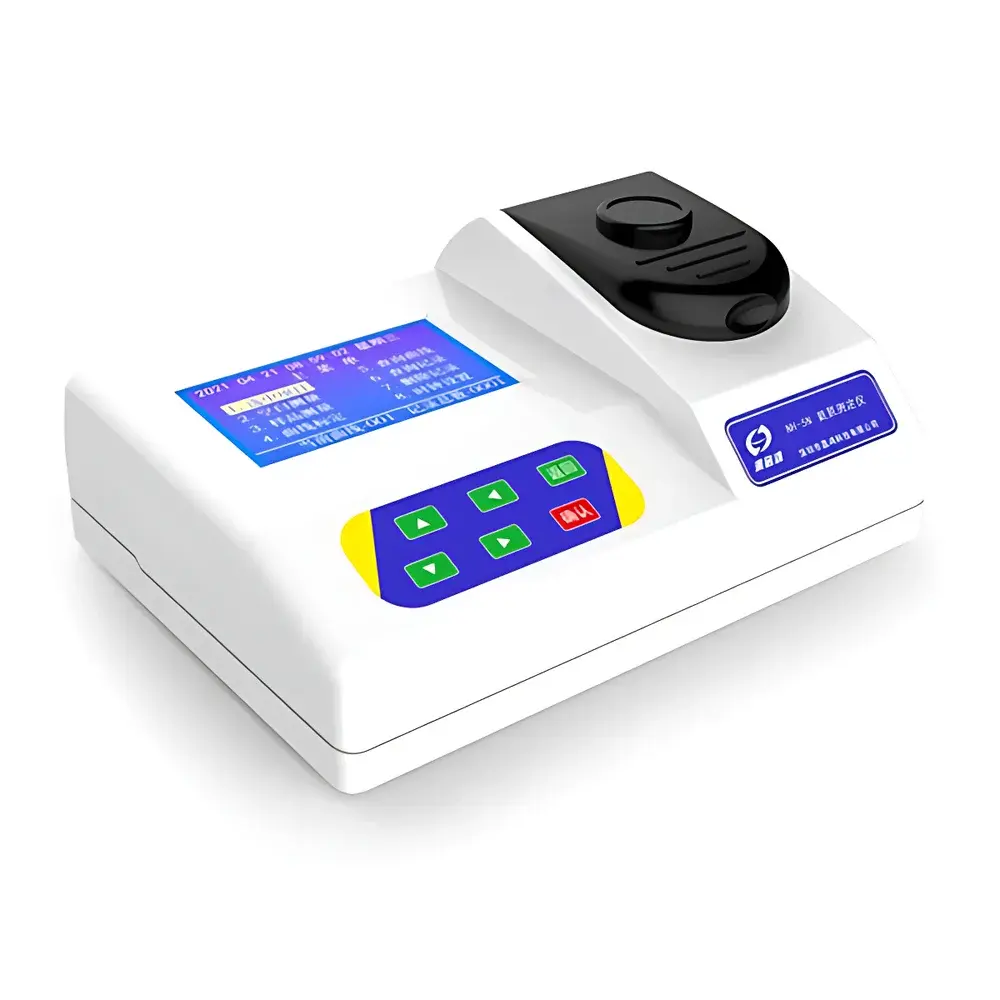
Shenchanghong NH-5N Ammonia Nitrogen Analyzer (Colorimetric Method)
| Brand | Shenchanghong |
|---|---|
| Origin | Guangdong, China |
| Manufacturer Type | Direct Manufacturer |
| Region of Origin | Domestic (China) |
| Model | NH-5N |
| Instrument Type | Benchtop Laboratory Analyzer |
| Measurement Principle | Nesslerization Colorimetry |
| Measurement Range | 0.02–25 mg/L NH₃–N (dilutable for over-range samples) |
| Accuracy | ≤ ±3% FS |
| Repeatability | ≤ ±2% |
| Detection Limit | 0.02 mg/L |
| Analysis Time | ≤10 minutes per batch (10 samples) |
| Batch Capacity | 10 water samples |
| Dimensions | 266 × 220 × 130 mm |
| Power Supply | AC 220 V, 50 Hz |
| Data Storage | 20 preloaded calibration curves + 500 measurement records (non-volatile memory) |
Overview
The Shenchanghong NH-5N Ammonia Nitrogen Analyzer is a dedicated benchtop instrument engineered for rapid, reliable quantification of ammonia nitrogen (NH₃–N) in aqueous environmental samples using the standardized Nessler colorimetric method. This technique relies on the stoichiometric reaction between free ammonia or ammonium ions and Nessler’s reagent (an alkaline solution of potassium iodide, mercuric chloride, and potassium hydroxide), forming a stable yellow-to-brown colloidal complex—iodo-mercurate of ammonia—whose absorbance at 420 nm is directly proportional to NH₃–N concentration. Designed for compliance with core regulatory frameworks including ISO 7150-1:1984, HJ 535–2009 (Chinese EPA standard), and aligned with principles referenced in ASTM D1426 and APHA Standard Methods 4500-NH₃ F, the NH-5N delivers trace-level sensitivity (0.02 mg/L LOD) and robust performance across diverse matrices—surface water, municipal wastewater effluent, industrial discharge streams, and treated drinking water sources.
Key Features
- Optimized optical architecture featuring imported high-luminance, long-life LED light source (420 nm peak emission) coupled with precision interference filters and low-drift photodetector, ensuring high photometric stability and repeatability (≤ ±2% RSD).
- Dedicated embedded microcontroller platform with large-character backlit LCD display and intuitive Chinese-language menu navigation—no PC dependency required for routine operation.
- Integrated batch processing capability: simultaneous analysis of up to 10 samples within ≤10 minutes, including reagent addition, reaction incubation, and photometric readout.
- Non-volatile memory system retains up to 20 user-defined or factory-calibrated calibration curves and 500 timestamped measurement records—even after power interruption.
- Compact footprint (266 × 220 × 130 mm) and 220 V AC input enable seamless integration into regulated laboratory environments without external power conditioning.
Sample Compatibility & Compliance
The NH-5N is validated for use with clarified, non-turbid aqueous samples meeting standard pretreatment requirements outlined in ISO 7150-1 and HJ 535–2009—including filtration (≤0.45 µm membrane), pH adjustment (to ≥11.0 for complete NH₃ liberation), and interference mitigation (e.g., removal of residual chlorine via sodium thiosulfate, masking of heavy metals with EDTA). It supports direct analysis of raw surface water, secondary-treated wastewater, cooling tower blowdown, and aquaculture pond water—provided suspended solids are minimized. While not intrinsically compliant with 21 CFR Part 11, its audit-ready data logging (with sample ID, date/time stamp, curve ID, and operator tag) facilitates GLP-aligned documentation when deployed under site-specific SOPs.
Software & Data Management
Operation is fully self-contained within the onboard firmware; no proprietary software installation is required. All calibration functions—including multi-point linear regression, zero-point verification, and slope validation—are executed interactively via the LCD interface. Measured results are stored with metadata (date, time, curve used, sample ID if entered), accessible via scrollable history log. Data export is not supported natively; however, manual transcription or optional third-party RS-232/USB serial logging (via compatible adapters) enables integration into LIMS or Excel-based QA/QC tracking systems. Curve management supports both factory-default Nessler response curves and user-generated calibrations using certified NH₄Cl reference standards traceable to NIST SRM 2022.
Applications
- Regulatory monitoring of NH₃–N in municipal wastewater treatment plant influent, effluent, and sludge dewatering streams per national discharge limits.
- Process control in industrial facilities (e.g., fertilizer production, semiconductor rinse water, food processing) where ammonia buildup indicates biological or chemical process deviation.
- Environmental field labs conducting rapid screening of eutrophication risk in lakes, rivers, and reservoirs.
- Educational laboratories performing standardized water chemistry experiments in accordance with APHA/AWWA/WEF curriculum guidelines.
- Aquaculture facility water quality assurance—tracking sublethal NH₃ thresholds (<0.02 mg/L unionized NH₃ at pH 7.5, 25°C) critical to fish health.
FAQ
What is the recommended sample pretreatment prior to analysis?
Samples must be filtered through a 0.45 µm membrane filter to remove particulates. For samples containing residual chlorine, add one drop of 3.5% sodium thiosulfate solution per 10 mL sample. Adjust pH to ≥11.0 using sodium hydroxide before Nessler reagent addition.
Can the NH-5N measure total ammonia (NH₃ + NH₄⁺) or only unionized ammonia?
It measures total ammonia-nitrogen (NH₃–N), representing the sum of dissolved NH₃ and NH₄⁺, as defined by standard Nessler methodology. Unionized NH₃ concentration requires concurrent pH and temperature measurement and calculation using equilibrium equations.
Is the instrument suitable for saline or seawater samples?
High chloride content (>1000 mg/L Cl⁻) may cause turbidity interference. Dilution with deionized water and matrix-matched calibration are advised. For marine applications, validation against ISO 15682 or ASTM D1426 with salinity correction is recommended.
How often should calibration verification be performed?
Daily verification using a mid-range check standard (e.g., 5.0 mg/L NH₃–N) is recommended for routine QC. Full multi-point calibration should be repeated weekly or after reagent lot changes.
Does the NH-5N include Nessler reagent, and what is its shelf life?
Reagent kits are supplied separately. Unopened Nessler reagent remains stable for 12 months at 2–8°C; once opened, use within 3 months when refrigerated and protected from light.
Related Products







