
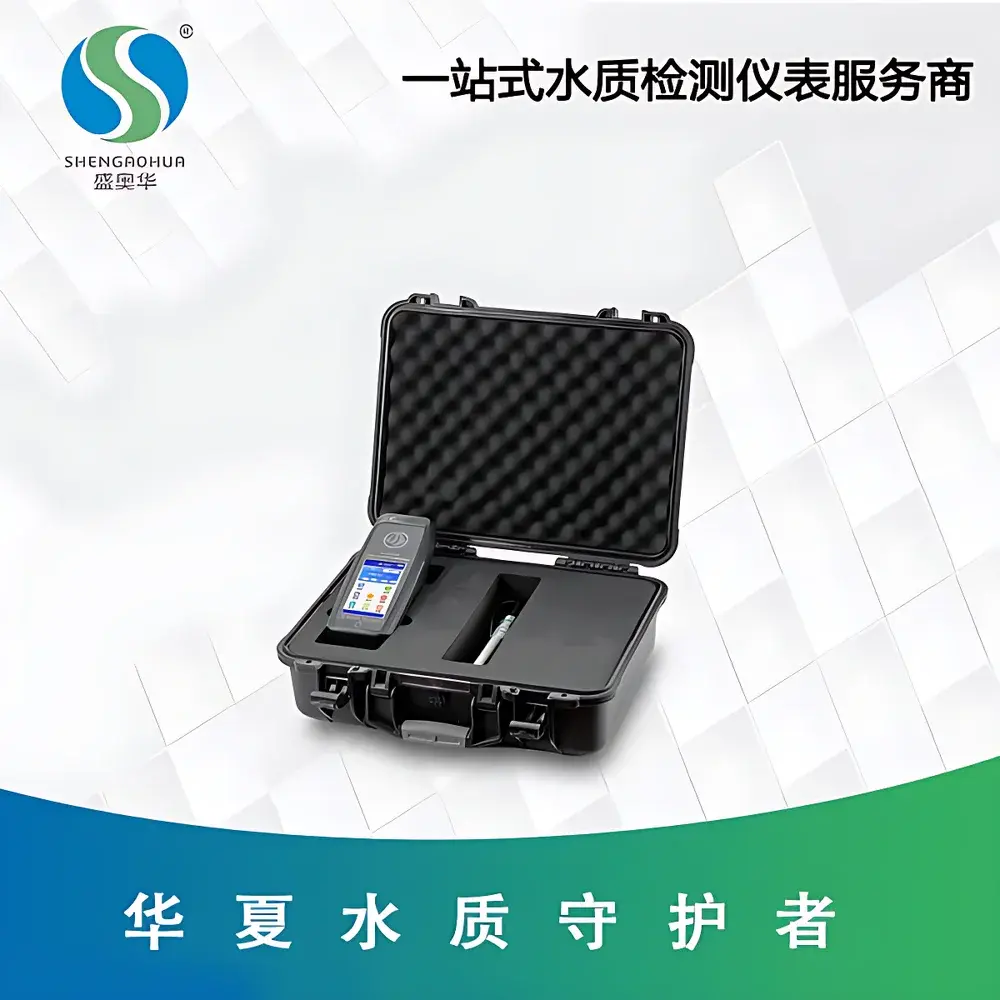
Shengaohua SH-5 Handheld Conductivity Meter
| Brand | Shengaohua |
|---|---|
| Origin | Jiangsu, China |
| Manufacturer Type | Manufacturer |
| Product Origin | Domestic (China) |
| Model | SH-5 |
| Detection Parameter | Single-parameter (Conductivity) |
| Portability | Portable |
| Application Site | Field & Lab Environments |
| Conductivity Range | 0–200,000 µS/cm |
| Temperature Range | 0–60 °C |
| Accuracy | ±3% of reading |
| Minimum Resolution | 0.1 µS/cm (dependent on range) |
| Electrode Type | Digital Four-Electrode Graphite Sensor |
| Temperature Compensation | Automatic, ±0.1 °C |
| Communication Interface | RS485 |
| Response Time | ≤15 s |
| Display | Backlit LCD with Clock Function |
| Calibration | Single-point calibration |
| Electrode Cable Length | 3 m (customizable) |
| Operating Environment | 0–60 °C, non-freezing |
| Power Supply | Rechargeable Lithium-ion Battery |
| Dimensions | 20 × 10 × 3.5 cm |
| Net Weight | 610 g |
Overview
The Shengaohua SH-5 Handheld Conductivity Meter is a field-deployable, single-parameter electrochemical analyzer engineered for precise and reliable measurement of aqueous conductivity across a broad dynamic range (0–200,000 µS/cm). It operates on the four-electrode graphite sensor principle—eliminating polarization errors inherent in two- or three-electrode configurations—and delivers stable, interference-free digital signal transmission directly from the probe to the meter. Unlike analog-based systems, the SH-5 employs a fully digitized sensor architecture, embedding both conductivity transduction and temperature sensing (±0.1 °C accuracy) within the electrode assembly. This integration enables high-fidelity automatic temperature compensation (ATC) without external thermistor drift or cable resistance effects. Designed for operational resilience, the instrument features an IP68-rated sensor head, enabling submersion and continuous operation in turbid, high-sediment, or chemically aggressive water matrices—including estuarine, wastewater, aquaculture, and industrial effluent environments.
Key Features
- Digital four-electrode graphite sensor with built-in Pt1000-grade temperature probe for simultaneous, co-located conductivity and temperature measurement
- Five auto-ranging conductivity scales (20.00, 200.0, 2,000, 20,000, and 200,000 µS/cm) with 0.1 µS/cm resolution at lowest range
- RS485 digital interface supporting Modbus RTU protocol for integration into SCADA, data loggers, or centralized monitoring platforms
- Rechargeable lithium-ion battery providing ≥12 hours of continuous field operation per full charge
- Backlit LCD display with real-time clock, date stamping, and user-adjustable contrast for low-light or outdoor use
- MicroSD (TF) card slot enabling unlimited timestamped data storage—no internal memory constraints or manual download bottlenecks
- Rugged handheld form factor (20 × 10 × 3.5 cm, 610 g) optimized for one-handed operation during river surveys, pond inspections, or mobile enforcement duties
Sample Compatibility & Compliance
The SH-5 is validated for direct immersion in natural waters (freshwater, brackish, and low-salinity seawater), municipal and industrial wastewater, aquaculture recirculation systems, cooling tower make-up water, and process rinse streams. Its graphite electrodes resist fouling from organic biofilm, calcium carbonate scaling, and suspended solids—reducing recalibration frequency in long-duration deployments. While not certified to ISO/IEC 17025 as a standalone measurement system, the SH-5 supports GLP-compliant workflows through traceable single-point calibration (using standard KCl solutions per ISO 7888), audit-ready timestamped logging, and firmware-locked calibration history. Its measurement uncertainty (±3% of reading) aligns with EPA Method 120.1 and ASTM D1125 guidelines for field-grade conductivity assessment where laboratory-grade precision is not mandated.
Software & Data Management
Data captured by the SH-5 is stored in CSV format on removable microSD cards, preserving raw conductivity values, compensated temperature readings, timestamps, and operator-defined site IDs. No proprietary software is required for data retrieval: files are natively readable in Excel, R, Python (pandas), or LIMS platforms. The RS485 interface permits real-time streaming to external controllers or telemetry gateways compliant with IEC 61158 or Modbus TCP/IP bridge configurations. Firmware updates are delivered via SD card—ensuring field-upgradability without hardware replacement. All stored records include metadata headers (instrument ID, firmware version, calibration date), satisfying basic 21 CFR Part 11 traceability requirements for non-GMP environmental monitoring applications.
Applications
- Regulatory field screening for surface water quality compliance (e.g., TDS estimation, salinity mapping, pollution plume tracking)
- Routine health monitoring in freshwater and marine aquaculture—correlating conductivity shifts with feed load, waste accumulation, or osmoregulatory stress
- Environmental law enforcement patrols—rapid verification of discharge permit limits during unannounced inspections
- Watershed-scale reconnaissance: identifying point-source contamination via conductivity anomalies along river transects
- Third-party environmental testing labs performing on-site pre-screening prior to lab-based IC or ICP-MS analysis
- Industrial facility self-monitoring of cooling water cycles, boiler feedwater purity, and RO pretreatment efficiency
FAQ
What calibration standards are recommended for the SH-5?
Standard KCl solutions conforming to ISO 7888 (e.g., 1413 µS/cm at 25 °C, 12.88 mS/cm at 25 °C) are used for single-point calibration. Multi-point calibration is not supported due to fixed-range auto-scaling architecture.
Can the SH-5 measure total dissolved solids (TDS) directly?
No—it reports conductivity only. TDS is estimated internally using a fixed 0.65 conversion factor (configurable via firmware update), but users must apply matrix-specific factors in post-processing for regulatory reporting.
Is the electrode compatible with acidic or alkaline samples?
Yes. The graphite electrode body and PEEK housing resist corrosion in pH 2–12 environments. However, prolonged exposure to strong oxidizers (e.g., >5 ppm free chlorine) may degrade the reference junction over time.
How is temperature compensation implemented?
A precision Pt1000 thermistor embedded in the electrode tip measures temperature simultaneously with conductivity, enabling real-time linear or nonlinear (NaCl-based) compensation algorithms per IEC 60746-3.
Does the SH-5 support GLP audit trails?
It maintains a non-erasable calibration log with date/time stamps and operator ID fields (entered manually), fulfilling minimum documentation requirements for field QA/QC—but lacks electronic signature or role-based access control required for full GLP/GMP validation.






