
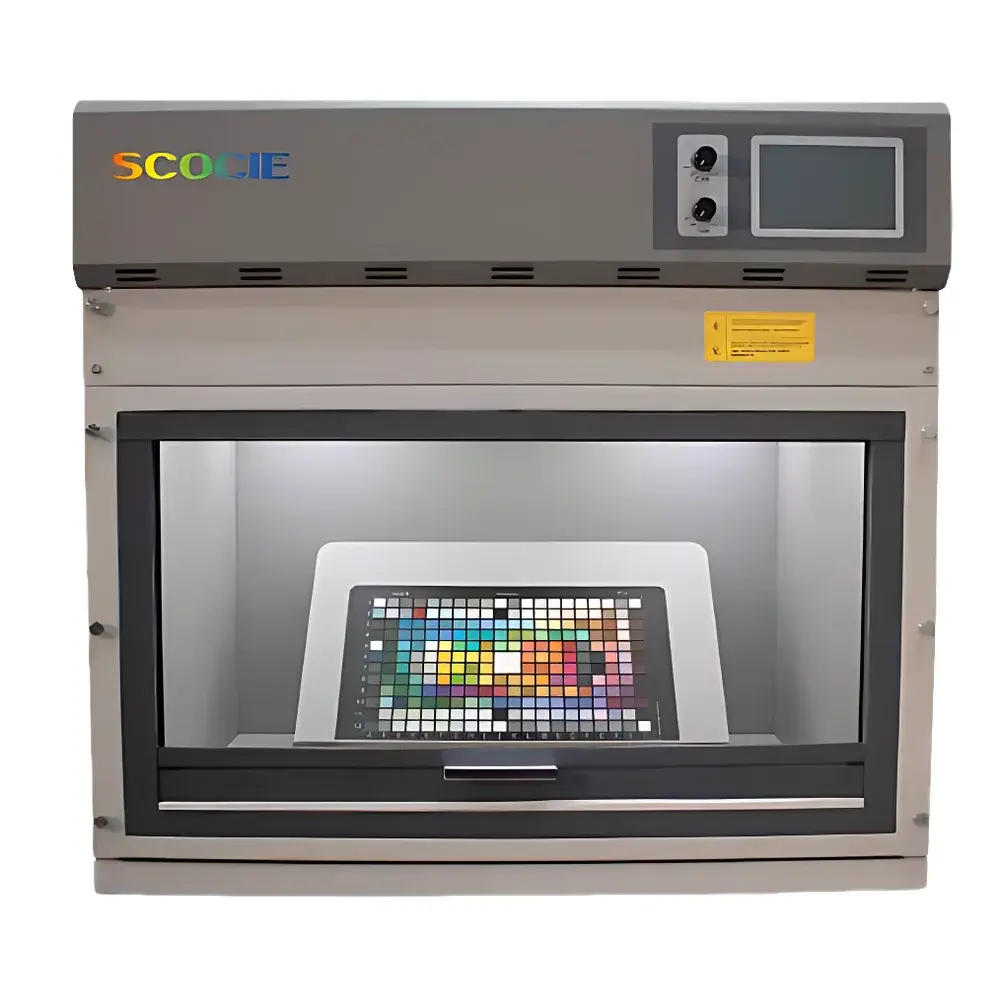
Shike FastnessGrade Desktop Spectrophotometric Colorfastness Analyzer
| Origin | Shanghai, China |
|---|---|
| Manufacturer Type | Authorized Distributor |
| Model | FastnessGrade |
| Price Range | USD 28,000 – 42,000 |
| Instrument Type | Benchtop Spectrophotometer |
| Optical Geometry | 0/45° Integrating Sphere |
| Light Source | LED Array |
| Spectral Range | 350–700 nm |
| Repeatability (ΔE*ab) | ≤0.03 |
Overview
The Shike FastnessGrade Desktop Spectrophotometric Colorfastness Analyzer is an ISO/ASTM-compliant optical measurement instrument engineered for objective, quantitative assessment of colorfastness performance in coated surfaces, textiles, paints, and printed materials. Unlike conventional visual evaluation under standard illuminants, the FastnessGrade integrates high-fidelity RGB imaging with spectrophotometric measurement in a single benchtop platform—operating on the principle of spectral reflectance capture (350–700 nm) followed by CIE L*a*b* color space transformation and ΔE*ab-based deviation analysis. Its 0/45° integrating sphere geometry ensures diffuse illumination and directional viewing, minimizing gloss and texture interference while maintaining compliance with ISO 105-A02, ISO 105-B02, ISO 105-X12, AATCC TM16, AATCC TM8, and AATCC TM116 test protocols. Designed for GLP-aligned laboratories, it bridges the gap between traditional gray-scale visual grading and digital metrology—enabling traceable, auditable, and operator-independent colorfastness classification across global R&D, QC, and regulatory submission workflows.
Key Features
- Integrated dual-mode operation: simultaneous spectrophotometric colorimetry (CIE L*a*b*, ΔE*ab, CMC, ΔE00) and high-resolution RGB image acquisition for morphological analysis
- LED-based illumination system with stable spectral output across CIE Illuminants D65, A, F2, and TL84—calibrated to meet ISO/CIE photometric tolerances for color evaluation
- Digital colorfastness grading engine compliant with ISO 105-A02 (gray scale), ISO 105-B02 (blue wool scale), and AATCC Evaluation Procedures for staining and fading
- Automated multi-sample imaging: up to eight specimens captured and analyzed per frame, reducing throughput time by >65% versus sequential manual grading
- Embedded reference library: preloaded digital standards including ISO Gray Scale (ISO 105-A02), Blue Wool Standards (ISO 105-B02), Pilling Standards (ISO 12945-1), and AATCC 8/20 pilling charts
- Modular software architecture supporting FDA 21 CFR Part 11-compliant audit trails, electronic signatures, and role-based user access control
Sample Compatibility & Compliance
The FastnessGrade accommodates flat, rigid, or semi-flexible substrates up to 150 × 150 mm—including coated panels, textile swatches, printed films, automotive trim samples, and food packaging laminates. Its non-contact optical design eliminates mechanical pressure artifacts common in contact-based spectrophotometers. All measurement modes adhere to international textile and coating testing standards: ISO 105-C06 (washing), ISO 105-X12 (rubbing), ISO 105-B02 (lightfastness), ISO 12945-1 (pilling), and ASTM D2244 (color difference). Data outputs include full spectral reflectance curves (350–700 nm, 10 nm intervals), CIE XYZ, L*a*b*, and custom pass/fail thresholds aligned with customer-defined specifications or industry benchmarks (e.g., automotive OEM color tolerance limits per GMW14872 or Ford WSS-M99P1111-A).
Software & Data Management
The FastnessGrade Control Suite is a Windows-based application featuring modular workflow modules: Calibration Manager, Test Method Builder, Image Grading Engine, and Report Generator. Each session logs timestamped metadata—including operator ID, environmental conditions (optional sensor integration), instrument calibration status, and raw spectral data—ensuring full traceability per ISO/IEC 17025 and GLP requirements. Export formats include CSV (for statistical process control), PDF (regulatory-ready reports), and XML (LIMS/SAP integration). The software supports automated report generation with embedded pass/fail flags, delta-E heatmaps, and side-by-side spectral overlays. Audit logs are immutable and exportable for internal QA review or external accreditation audits.
Applications
This instrument serves cross-industry quality assurance needs where color stability under stress is critical. In coatings and paint manufacturing, it quantifies pigment migration resistance in solvent-borne and waterborne systems after accelerated weathering (QUV, Xenon arc). In textile R&D, it replaces subjective gray-scale matching for wash, rub, light, and perspiration fastness per ISO 105 series. Packaging labs use it to verify UV-stabilized ink retention on flexible films; food processors apply it to assess browning kinetics in baked goods or ripening indices in produce. It also supports fluorescence quantification (via UV-LED excitation mode) for detecting optical brighteners in detergents or whitening agents in paper coatings—delivering both chromatic and metamerism-corrected assessments.
FAQ
Does FastnessGrade comply with ISO/IEC 17025 calibration requirements?
Yes—the instrument includes NIST-traceable calibration tiles and supports periodic verification using certified reference standards (e.g., BCRA Series II). Full calibration records are stored within the audit trail.
Can it evaluate metamerism in coated surfaces?
Yes—by capturing full spectral reflectance data and computing CIE DE2000 under multiple illuminants (D65, A, F2), it calculates metameric index (MI) per ISO 27668-1.
Is remote operation supported for distributed lab networks?
Yes—through secure HTTPS-based web interface, enabling real-time image upload, collaborative grading, and centralized database synchronization across geographically dispersed sites.
What sample preparation is required for pilling assessment?
No cutting or mounting is needed—standardized Martindale or ICI pilling specimens are placed directly on the stage; the system auto-detects test area and compares against ISO 12945-1 digital references.
How is data integrity maintained during long-term deployment?
All measurements are digitally signed and time-stamped. Software enforces password-protected method locking, version-controlled SOPs, and automatic backup to network storage with SHA-256 hash verification.





