
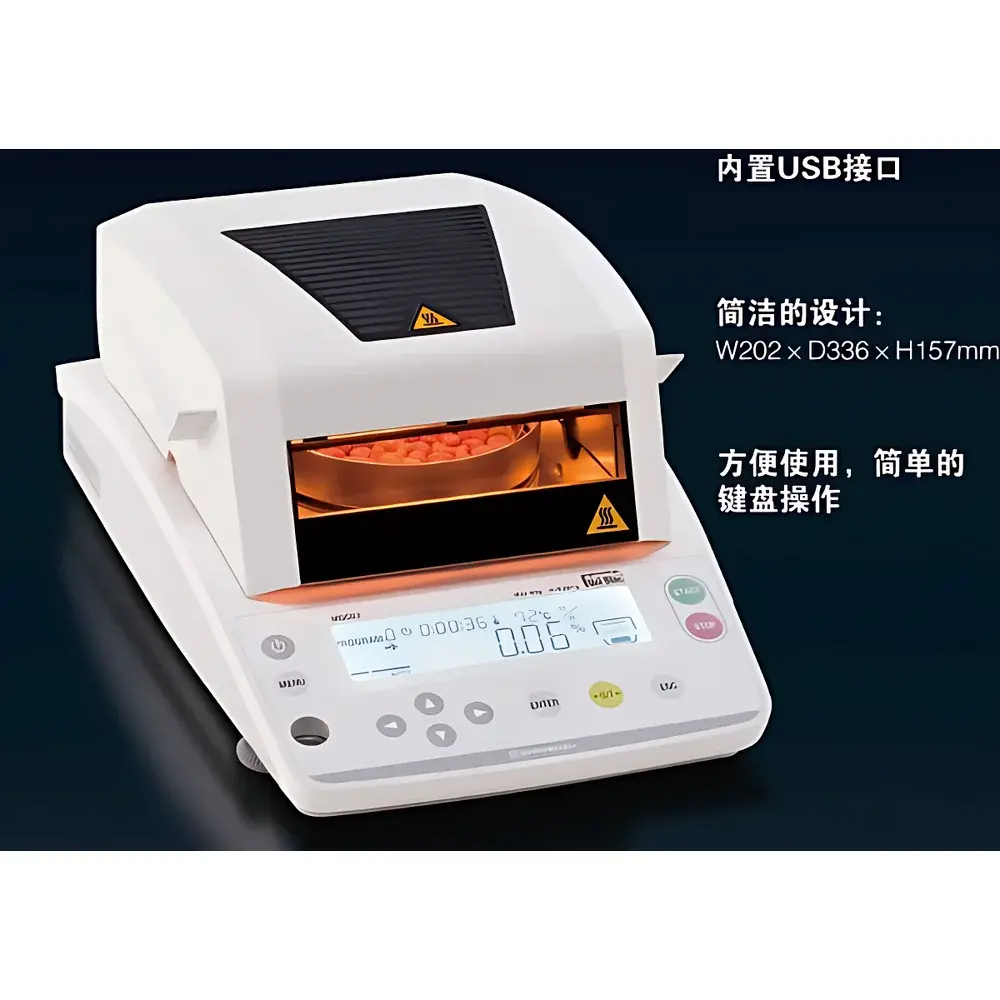
Shimadzu MOC63U Infrared Moisture Analyzer
| Brand | Shimadzu |
|---|---|
| Origin | Japan |
| Model | MOC63U |
| Maximum Sample Capacity | 60 g |
| Minimum Sample Weight | 0.02 g |
| Minimum Display Resolution | 0.001 g / 0.01% or 0.1% (selectable) |
| Repeatability | ±0.15% (2 g sample), ±0.05% (5 g sample), ±0.02% (10 g sample) |
| Heating Source | Halogen Lamp |
| Heating Power | 400 W |
| Temperature Setting Range | 50–200 °C (1 °C increments) |
| Display | Backlit LCD |
| Pan Diameter | 95 mm |
| Dimensions (W × D × H) | 202 × 336 × 157 mm |
| Weight | 4 kg |
| Operating Environment | 5–40 °C, ≤85% RH |
| Measurement Modes | Standard, Rapid Dry, Slow Dry, Step Dry |
| Measurement Duration | 1–120 min (extendable up to 12 h) |
| Interfaces | RS-232C (9-pin), DATA I/O, USB |
| Predefined Method Storage | 10 methods |
| Data Storage Capacity | 100 results |
| Optional Accessories | Temperature calibration kit |
Overview
The Shimadzu MOC63U Infrared Moisture Analyzer is a precision halogen-heated thermogravimetric instrument designed for rapid, reliable, and operator-independent moisture content determination in solid and semi-solid samples. It operates on the principle of loss-on-drying (LOD), where sample mass is continuously monitored during controlled thermal drying using a high-stability halogen lamp as the infrared radiation source. The system records real-time mass loss until stabilization—enabling accurate quantification of volatile components, primarily water, expressed as weight percent (% w/w). Engineered for laboratory environments requiring routine QC/QA testing across pharmaceuticals, food, chemicals, polymers, and raw materials, the MOC63U delivers traceable, reproducible results aligned with standardized test methodologies including ASTM D4442, ISO 1183, and USP <921>. Its compact benchtop architecture integrates analytical balance functionality with programmable thermal control, eliminating the need for separate oven and weighing steps.
Key Features
- High-power 400 W halogen heating system with precise temperature control from 50 to 200 °C in 1 °C increments, ensuring consistent energy delivery and minimized thermal lag.
- Dual-resolution display mode: selectable readout of 0.001 g mass resolution or 0.01%/0.1% moisture resolution, supporting both gravimetric sensitivity and regulatory reporting requirements.
- Repeatability validated per ISO 8573-8 and internal Shimadzu calibration protocols: ±0.15% RSD at 2 g, improving to ±0.02% RSD at 10 g sample load—demonstrating robustness across typical operational ranges.
- Four configurable drying profiles—Standard, Rapid Dry, Slow Dry, and Step Dry—allow method optimization for heat-sensitive, hygroscopic, or heterogeneous matrices without manual intervention.
- Integrated backlit LCD interface with intuitive navigation and real-time graphical trend display of mass loss vs. time, facilitating immediate assessment of drying kinetics and endpoint detection.
- Built-in RS-232C (9-pin), DATA I/O, and USB interfaces support seamless integration into LIMS environments and automated data capture under 21 CFR Part 11-compliant workflows when paired with validated software.
Sample Compatibility & Compliance
The MOC63U accommodates samples up to 60 g on its 95 mm diameter stainless-steel weighing pan, suitable for powders, granules, pellets, pastes, and thin films. Its open-chamber design permits direct loading of irregular or oversized specimens within mechanical stability limits. The instrument complies with general safety standards IEC 61010-1 and electromagnetic compatibility per EN 61326-1. While not intrinsically certified for hazardous locations, it meets GLP/GMP documentation expectations through audit-trail-capable data export and user-accessible method storage (up to 10 pre-programmed protocols). Temperature calibration kits (optional) enable periodic verification against NIST-traceable reference standards, supporting ISO/IEC 17025 accreditation requirements for testing laboratories.
Software & Data Management
Data output via RS-232C or USB supports ASCII-formatted reports compatible with Excel, LabArchives, and enterprise LIMS platforms. Each stored result (up to 100 entries) includes timestamp, sample ID, method name, initial/final mass, moisture %, drying curve metadata, and operator ID if enabled. Shimadzu’s optional PC-based software provides advanced features including statistical batch analysis, SPC charting, PDF report generation with digital signature fields, and electronic record retention compliant with FDA 21 CFR Part 11 Annex 11 guidelines—provided appropriate access controls, audit trails, and electronic signature validation are implemented at the system level.
Applications
- Pharmaceutical manufacturing: residual solvent and hydrate water quantification in APIs and excipients per ICH Q5C and USP <921>.
- Food quality control: moisture monitoring in flour, dairy powders, snacks, and pet food to ensure shelf-life compliance and microbial safety limits.
- Polymer processing: determination of moisture content in engineering resins (e.g., PA6, PET) prior to extrusion or injection molding to prevent hydrolytic degradation.
- Chemical raw material release: verification of specification adherence for catalysts, pigments, and battery electrode materials.
- Agricultural product grading: rapid field-lab assessment of grain, feed, and botanical extracts for moisture-related quality indices.
FAQ
What is the recommended sample preparation procedure for optimal repeatability?
Samples should be homogenized and evenly distributed across the pan surface; particle size reduction may be required for coarse or fibrous materials to ensure uniform heat penetration and minimize edge effects.
Can the MOC63U be used for non-aqueous volatiles?
Yes—while calibrated and validated primarily for water, the LOD principle applies to any volatile component lost within the selected temperature range; method development and reference correlation (e.g., Karl Fischer titration) are required for quantitative interpretation.
Is external calibration required before first use?
Internal mass calibration is performed automatically on startup; however, external verification using certified weights (e.g., Class F1 or better) and temperature calibration with a traceable probe are recommended prior to routine operation.
How does the Step Dry mode improve measurement accuracy for thermally unstable samples?
Step Dry allows sequential heating segments with dwell times and variable ramp rates, enabling gradual removal of surface moisture before applying higher temperatures—reducing charring, splattering, or decomposition artifacts.
Does the instrument support multi-language UI or custom report templates?
The base firmware supports English only; report formatting is determined by downstream software—custom templates can be configured in third-party data analysis tools or Shimadzu’s optional PC application.




