
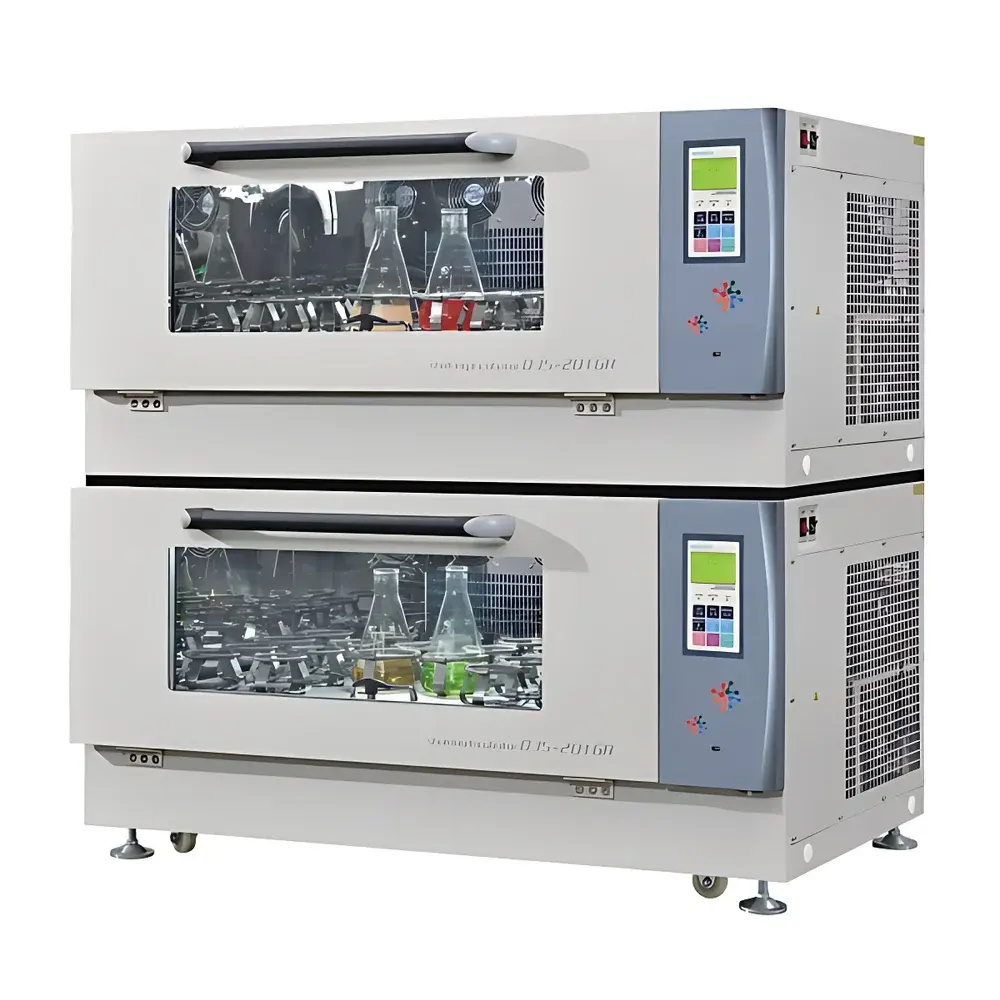
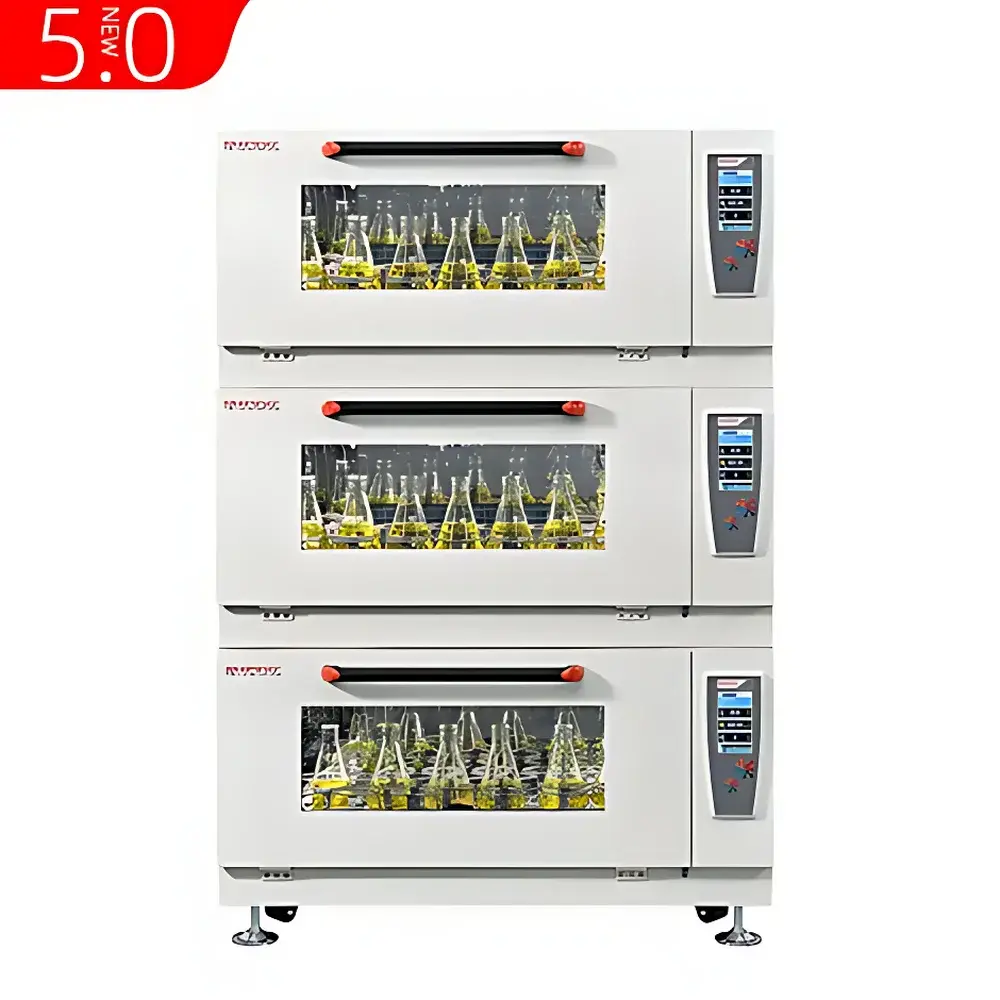
ShiPing DJS-2016R Plus Stackable Incubated Orbital Shaker
| Brand | ShiPing |
|---|---|
| Origin | Shanghai, China |
| Manufacturer Type | Direct Manufacturer |
| Instrument Type | Orbital Shaker for Incubation |
| Model | DJS-2016R Plus |
| Timing Range | 0–999 min 59 sec |
| Oscillation Frequency | 0–300 rpm |
| Orbit Diameter | 25 mm |
| Temperature Range | 4–60 °C |
| Number of Shaking Platforms | 1 |
| Chamber Volume | 265 L |
| Platform Dimensions | 920 × 540 mm |
| Max Load Capacity | 60 × 250 mL flasks or equivalent |
| Temperature Uniformity | ≤ ±1 °C (at 37 °C) |
| Temp. Resolution | 0.1 °C |
| Temp. Stability | ±0.1 °C |
| Power Supply | AC 200–240 V, 50–60 Hz |
| Total Power Consumption | 1746 W |
| Net Weight | 220 kg |
Overview
The ShiPing DJS-2016R Plus Stackable Incubated Orbital Shaker is an engineered solution for high-throughput, temperature-controlled cell culture, microbial growth, and biochemical incubation applications requiring precise orbital agitation. It operates on the principle of controlled horizontal circular motion (orbital shaking) combined with active air-circulating thermostatic control—enabling simultaneous regulation of temperature, speed, and time across large-volume liquid cultures. Designed for laboratory environments where floor space is constrained yet scalability is essential, the unit supports up to three vertically stacked configurations without compromising footprint or thermal/kinematic performance. Its chamber employs forced-air convection with dual P.I.D.-regulated heating and R134a refrigeration, delivering stable thermal conditions from 4 °C (refrigerated storage) to 60 °C (high-temperature induction), with resolution of 0.1 °C and uniformity ≤ ±1 °C at 37 °C—a critical benchmark for mammalian cell culture compliance per ISO 5600-2 and USP . The single-axis balanced drive system minimizes mechanical vibration transmission, ensuring sample integrity during long-term incubation protocols.
Key Features
- Stackable architecture: Three units can be vertically integrated using reinforced structural frames and independent leveling feet—retaining full operational autonomy per tier while occupying only one standard bench footprint (1410 × 790 mm).
- Front-access design: Dual-mode door operation—lower two tiers feature downward-pulling doors; top tier uses upward-lifting hinged access—optimized for ergonomic loading/unloading in multi-tier setups.
- Chamber construction: Interior lined with electropolished 304 stainless steel with seamless arc-corner welding; exterior housing fabricated from high-tensile QT cast iron, cold-rolled steel, and powder-coated electrostatic finish for corrosion resistance and mechanical stability.
- Drive & motion control: NSK-sourced double-row precision bearings, hardened 45# carbon steel shaft (220–250 HBW), and variable-frequency motor enabling smooth acceleration profiles, ±1 rpm speed accuracy, and noise emission <55 dB(A) at 1 m distance.
- Safety architecture: Independent dual-limit thermal protection (mechanical + electronic), over-speed cutoff, real-time sensor fault diagnostics, earth-leakage circuit interruption (ELCI), compressor overload safeguard, and automatic power recovery after grid interruption.
- Intelligent interface: Large LCD dual-display panel showing real-time temperature and RPM; password-protected parameter locking; non-volatile memory for up to eight programmable multi-step cycles including ramp-hold sequences.
Sample Compatibility & Compliance
The DJS-2016R Plus accommodates standard laboratory vessels—including Erlenmeyer flasks (250–2000 mL), test tubes, deep-well plates, and custom bioreactor bags—via its 920 × 540 mm aluminum platform with anodized surface and stainless-steel universal clamps (360° elastic retention, 420 HV hardness). Platform load distribution supports up to 60 × 250 mL flasks or 15 × 2000 mL bottles without resonance-induced imbalance. All materials contacting the chamber interior comply with ISO 10993-5 (cytotoxicity) and EU Regulation EC No. 1935/2004 for food-contact-equivalent inertness. The system meets IEC 61010-1:2010 safety requirements for laboratory equipment and supports GLP/GMP-aligned audit trails when integrated with optional external data loggers compliant with FDA 21 CFR Part 11.
Software & Data Management
While the DJS-2016R Plus operates via embedded microprocessor control (P.I.D. algorithm with environmental scanning feedback), it supports RS-485 Modbus RTU communication for integration into centralized lab management systems. Optional PC software enables remote monitoring, export of timestamped temperature/RPM logs (CSV), alarm event history, and calibration certificate generation. All parameter changes are logged with user ID, timestamp, and pre-/post-value—fulfilling traceability requirements under ISO/IEC 17025:2017 Clause 7.7 and supporting internal quality audits. Firmware updates are performed via secure USB interface with version rollback capability.
Applications
This shaker serves core workflows in academic research, biopharmaceutical development, and industrial QC laboratories—including aerobic bacterial cultivation (E. coli, Bacillus spp.), yeast fermentation optimization, suspension CHO cell expansion, enzyme kinetics assays, protein solubilization studies, and antibiotic susceptibility testing (AST) per CLSI M07-A10. Its sub-ambient capability (4 °C) also supports cold-adapted enzyme expression and low-temperature metabolic profiling. The consistent orbital motion (Φ25 mm) ensures homogeneous oxygen transfer (kLa > 120 h⁻¹ in 1 L baffled flasks at 200 rpm), making it suitable for scale-down modeling of stirred-tank bioreactors.
FAQ
Can the DJS-2016R Plus operate unattended for extended periods (e.g., 72+ hours)?
Yes—the system includes auto-restart after power failure, non-volatile parameter memory, and redundant thermal cutoffs, enabling validated continuous operation under ISO 13485-compliant environmental monitoring protocols.
Is the refrigeration system maintenance-free?
The R134a-based air-cooled system requires no routine refrigerant servicing; however, periodic cleaning of condenser coils and intake filters is recommended per manufacturer guidelines every 6 months.
Does it support validation documentation (IQ/OQ/PQ)?
Standard delivery includes factory calibration certificates for temperature and speed. Full qualification packages—including protocol templates, acceptance criteria aligned with ASTM E2500, and electronic raw data exports—are available upon request.
What is the maximum allowable ambient temperature for installation?
Operating ambient must remain between 5 °C and 35 °C with ≤80% non-condensing relative humidity, as specified in IEC 60068-2-1/2 for stable thermal regulation.
Are third-party flask holders compatible?
Yes—the platform accepts ISO-standard 920 × 540 mm mounting patterns; custom fixtures may be designed using provided CAD drawings (available under NDA).




