
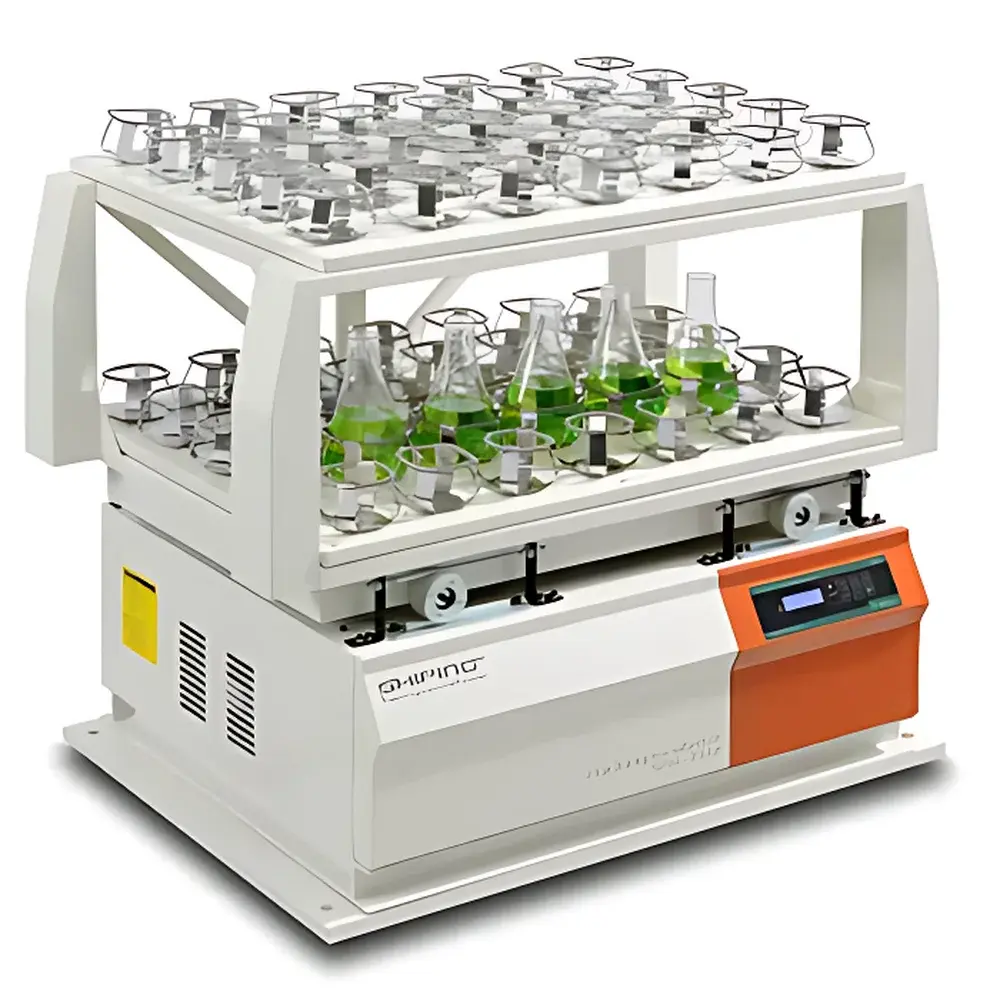
Shiping SPH-3332 / SPH-3432 Dual-Layer (SPH-3332) and Triple-Layer (SPH-3432) Orbital Shaker Platform
| Brand | Shiping |
|---|---|
| Origin | Shanghai, China |
| Model | SPH-3332 / SPH-3432 |
| Timing Range | 0–500 h |
| Oscillation Frequency | 50–300 rpm (SPH-3332), 50–250 rpm (SPH-3432) |
| Orbit Diameter | 50 mm |
| Number of Shaking Platforms | 2 (SPH-3332), 3 (SPH-3432) |
| Power Consumption | 1.1 kW (SPH-3332), 1.1 kW (SPH-3432) |
| Net Weight | 750 kg (SPH-3332), 850 kg (SPH-3432) |
| External Dimensions (W×D×H) | 1590×1120×950 mm (SPH-3332), 1590×1120×1310 mm (SPH-3432) |
| Drive Mechanism | Patented Single-Axis Orbital Drive |
| Control System | PID Microprocessor with 8-Stage Programmable Logic |
| Frequency Accuracy | ±1 rpm |
| Safety Certifications | Overcurrent, Leakage Current, Overtemperature, Overspeed Protection |
| Construction | Reinforced Cold-Rolled Steel Frame with Cast Iron Structural Components |
| Operating Environment | Controlled Indoor Temperature (Non-Heated / Ambient-Temperature Operation) |
Overview
The Shiping SPH-3332 and SPH-3432 are heavy-duty, multi-layer orbital shaker platforms engineered for high-throughput microbial cultivation, bioprocess development, and parallel fermentation screening in industrial biotechnology and pharmaceutical R&D environments. Unlike benchtop shakers, these systems operate exclusively within user-maintained temperature-controlled rooms—eliminating integrated heating/cooling modules to maximize mechanical stability, energy efficiency, and long-term operational reliability. The core motion principle is orbital oscillation (rotational shaking) with a fixed 50 mm diameter orbit, generating uniform, low-shear fluid mixing ideal for aerobic suspension cultures in Erlenmeyer flasks, baffled bottles, and disposable bioreactors. Designed for scalability, the SPH-3332 features two independently supported shaking decks, while the SPH-3432 extends capacity with three decks—enabling simultaneous processing of up to 450 × 250 mL flasks or 324 × 500 mL vessels under identical kinematic conditions.
Key Features
- Patented single-axis orbital drive mechanism—reducing mechanical resonance, vibration transmission, and acoustic noise while extending bearing service life beyond 20,000 operating hours.
- PID microprocessor controller with eight-stage programmable logic: each stage supports independent setpoints for speed (50–300 rpm) and duration (0–500 h), enabling complex multi-phase culture protocols without manual intervention.
- High-precision frequency regulation: real-time closed-loop feedback maintains speed accuracy within ±1 rpm across full load range—even under varying flask fill volumes and viscosity profiles.
- Fail-safe protection architecture: independent hardware-level circuits monitor overspeed, overtemperature (motor winding), leakage current (>30 mA), and overcurrent—triggering immediate power cutoff without software dependency.
- Intelligent motor start-up sequence: ramped acceleration prevents liquid splashing and meniscus disruption during initiation, preserving sterile integrity and sample homogeneity.
- Structural rigidity achieved via hybrid frame construction—cold-rolled steel chassis reinforced with cast iron cross-bracing, precision-machined mounting surfaces, and imported sealed ball bearings at all critical rotating interfaces.
- Electrostatically applied polyester powder coating ensures corrosion resistance in humid laboratory environments and complies with ISO 14644-1 Class 8 cleanroom-compatible surface finish standards.
Sample Compatibility & Compliance
The SPH-3332/3432 accommodates standard microbiological glassware and single-use bioprocess containers—including 250 mL to 1000 mL Erlenmeyer flasks (with stainless-steel clamps), spinner flasks, and vented culture bags mounted on custom adapter plates. Flask loading configurations follow ASTM D4003-22 guidelines for orbital shaker uniformity assessment. While the system itself operates at ambient temperature, its mechanical design meets IEC 61000-6-2 (immunity) and IEC 61000-6-4 (emission) for electromagnetic compatibility in shared lab infrastructure. All electrical safety circuits conform to IEC 61010-1:2010 for laboratory equipment, including double insulation, reinforced grounding, and residual-current device (RCD) integration. No integrated thermal control means no USP , , or FDA 21 CFR Part 11 requirements apply—but full audit trails for program execution, runtime logs, and fault events are exportable via RS-232 interface for GLP/GMP documentation.
Software & Data Management
Operation is managed through an integrated LCD interface with tactile membrane keys—no external PC or proprietary software required. All user-defined programs, runtime history, and alarm records are stored in non-volatile memory with battery-backed clock retention. The system supports “power-loss recovery”: upon grid interruption, it resumes the exact same program stage and speed setting once power is restored. Parameter memory retains last-used settings—including speed, timer value, and active program index—across cold starts. For traceability, the built-in event logger captures timestamps for every start/stop command, speed change, alarm trigger (e.g., “Overspeed Alert @ 302.4 rpm”), and thermal fault. Logs export as CSV via serial port for integration into LIMS or electronic lab notebook (ELN) systems compliant with ALCOA+ data integrity principles.
Applications
- High-density seed train expansion for mammalian, bacterial, and yeast expression systems.
- Parallel strain selection and media optimization studies requiring >100 replicate cultures per run.
- Bioreactor inoculum preparation where consistent oxygen transfer rate (OTR) and kLa matching across vessels is critical.
- Long-duration stability testing of biologics under agitation stress (ICH Q5C).
- Phage propagation, plasmid amplification, and enzymatic reaction kinetics under controlled shear conditions.
- Teaching laboratories conducting industrial-scale fermentation principles with scalable hardware.
FAQ
Does the SPH-3332/3432 include built-in temperature control?
No. These models are designed for use in externally regulated environments—such as climate-controlled rooms maintained at 25°C, 30°C, or 37°C—ensuring thermal uniformity without introducing heat-generating components into the shaker frame.
What flask capacities are supported out-of-the-box?
Standard configurations include clamps for 250 mL, 500 mL, and 1000 mL Erlenmeyer flasks. Custom fixture plates for spinner flasks, tube racks, or microplate carriers are available as optional accessories.
Is remote monitoring or Ethernet connectivity supported?
The base configuration includes RS-232 serial communication only. Ethernet or Wi-Fi modules are not factory-installed but can be retrofitted via third-party industrial gateways compatible with Modbus RTU protocol.
How is mechanical calibration performed?
Speed calibration is traceable to NIST-certified tachometers. A calibration certificate documenting verification at 100, 200, and 300 rpm (±1 rpm tolerance) is supplied with each unit. No field recalibration is required under normal operation.
Can the shaker operate continuously for >1000 hours?
Yes. Rated for continuous duty (IEC 60034-1 S1 rating), the IP54-rated inverter-duty motor and sealed bearing assembly support uninterrupted operation across extended campaigns—validated by 5000-hour accelerated life testing per ISO 13374-2 condition monitoring standards.




