
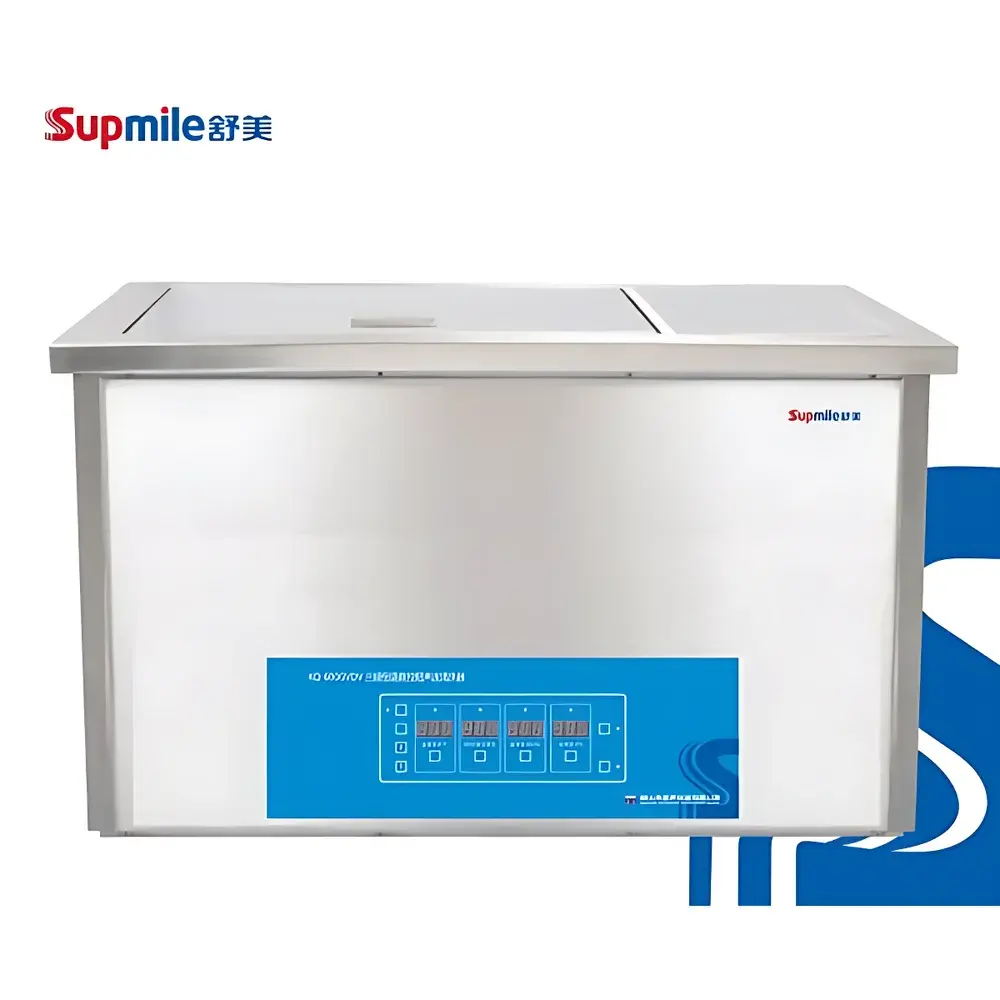
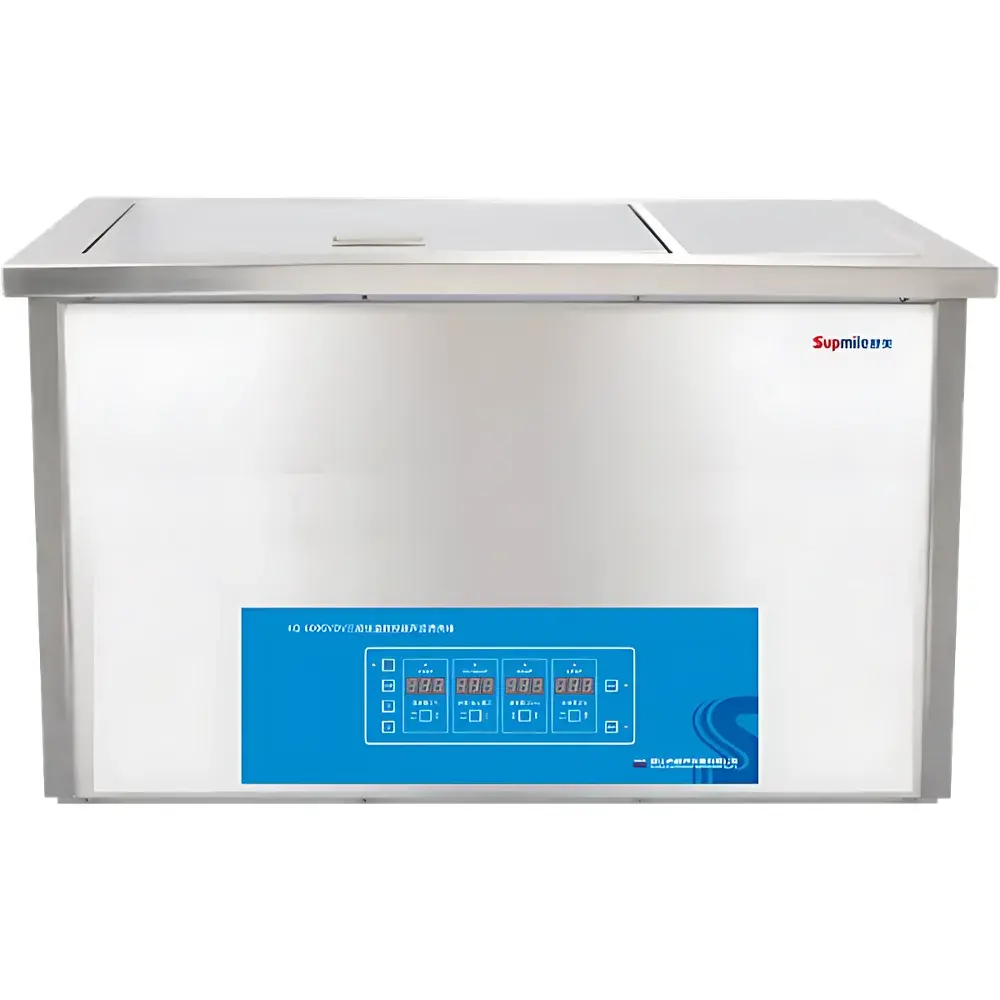
Shumei KQ-600GVDV Benchtop Tri-Frequency Programmable Temperature-Controlled Ultrasonic Cleaner
| Brand | Shumei |
|---|---|
| Origin | Jiangsu, China |
| Manufacturer Type | Direct Manufacturer |
| Instrument Type | General-Purpose Ultrasonic Cleaner |
| Capacity | 27 L |
| Ultrasonic Frequencies | 45 / 80 / 100 kHz |
| Ultrasonic Power Output | 600 W (Adjustable 40–100%) |
| Heating Power | 800 W |
| Cooling Power | 350 W |
| Temperature Control Range | 0–80 °C (±2 °C accuracy) |
| Timer Range | 1–480 min |
| Noise Reduction Lid | Included |
| Automatic Fill/Drain | Electrically Controlled |
| Input Power | AC 220 V / 50 Hz |
| Internal Tank Dimensions | 500 × 300 × 180 mm |
| External Dimensions | 905 × 490 × 540 mm |
| Liquid Level Monitoring & Protection | Yes |
| Standard Accessories | Stainless Steel Mesh Basket, Stainless Steel Rack, Noise-Reduction Lid |
Overview
The Shumei KQ-600GVDV is a benchtop tri-frequency programmable temperature-controlled ultrasonic cleaner engineered for precision cleaning of delicate and high-value laboratory components—including optical lenses, semiconductor wafers, microfluidic devices, precision filters, and analytical sample vials. It operates on the principle of cavitation-induced mechanical agitation, where high-frequency acoustic energy generates transient microbubbles in the cleaning solution; their controlled collapse produces localized shear forces and microstreaming that dislodge particulate contaminants without surface abrasion. The system integrates three discrete ultrasonic frequencies—45 kHz, 80 kHz, and 100 kHz—each optimized for distinct cleaning challenges: lower frequencies deliver higher cavitation intensity for robust particulate removal from macro-scale surfaces, while higher frequencies provide finer, more uniform energy distribution suitable for microstructures and fragile substrates. Built with a fully welded 304 stainless steel tank and chamber, the unit ensures long-term corrosion resistance and structural integrity under repeated thermal cycling and solvent exposure.
Key Features
- Tri-frequency ultrasonic generation (45 / 80 / 100 kHz) with user-selectable frequency switching and adjustable dwell time per frequency (0–999 s), enabling method optimization for heterogeneous sample loads.
- Programmable temperature control (0–80 °C) with ±2 °C stability, supported by dual-function heating (800 W) and active cooling (350 W) to maintain consistent bath conditions during extended cycles.
- Digital microprocessor-based control system with real-time display of actual and set values for temperature, ultrasonic power (40–100% of 600 W), timer (1–480 min), and liquid level.
- Comprehensive safety architecture: automatic shutdown triggered by low liquid level, over-temperature, over-current, or over-voltage events; visual alarm indicators for each fault condition.
- Integrated electrically actuated fill-and-drain system with level-sensing feedback, eliminating manual handling and reducing operator exposure to solvents or heated media.
- Acoustically insulated enclosure with hinged noise-reduction lid (included), achieving >15 dB(A) reduction in operational sound pressure level versus open-tank equivalents.
- Full stainless steel construction (ASTM A240 304 grade) for tank, transducer mounting frame, and internal support structures—compatible with aqueous, alcoholic, and mild alkaline cleaning solutions.
Sample Compatibility & Compliance
The KQ-600GVDV accommodates a broad range of sample geometries and materials, including glassware (volumetric flasks, cuvettes, pipette tips), metal components (calibration standards, sensor housings), ceramic substrates, and polymer-based microdevices. Its 27 L capacity and 500 × 300 × 180 mm tank volume support batch processing of up to 12 standard 50 mL centrifuge tubes or four 100 mm Petri dishes simultaneously. The unit complies with IEC 61000-6-3 (EMC emission limits) and IEC 61000-6-2 (immunity requirements) for laboratory environments. While not certified for ISO 13485 or FDA 21 CFR Part 11 out-of-the-box, its digital logging capability—retaining timestamped records of temperature setpoints, power levels, cycle durations, and fault events—supports GLP/GMP-aligned documentation when integrated into validated lab workflows. All electrical interfaces conform to GB 4793.1–2007 (equivalent to IEC 61010-1) for safety in laboratory equipment.
Software & Data Management
The embedded control firmware supports non-volatile parameter memory: all user-defined settings—including frequency sequence, power percentage per stage, temperature ramp profiles, and total cycle duration—are retained after power cycling. Real-time operational data (actual bath temperature, instantaneous power draw, elapsed time) are continuously displayed on a high-contrast LCD interface with backlighting. Although the device does not feature USB or Ethernet connectivity, its digital log retains the last 100 operational cycles with timestamps, accessible via front-panel navigation. For audit-ready environments, users may manually record session parameters using standardized SOP templates aligned with ISO/IEC 17025 clause 7.7 (control of technical records). Optional external data loggers (e.g., calibrated thermocouple arrays or power analyzers) can be deployed to cross-validate thermal and electrical performance during IQ/OQ protocols.
Applications
- Cleanroom maintenance: residue-free decontamination of photomasks, wafer carriers, and probe station fixtures prior to lithography or metrology steps.
- Pharmaceutical QC labs: removal of residual active pharmaceutical ingredients (APIs) from HPLC vials, syringe filters, and dissolution apparatus parts—critical for preventing carryover in potency assays.
- Materials science: dispersion stabilization of nanomaterial suspensions (e.g., graphene oxide, TiO₂ nanoparticles) in solvent-based media prior to TEM grid preparation.
- Electronics manufacturing: post-reflow cleaning of PCB assemblies to eliminate flux residues without damaging solder joints or conformal coatings.
- Environmental testing labs: preparation of quartz fiber filters used in PM₂.₅ gravimetric analysis—ensuring zero background interference from organic or inorganic contaminants.
- Academic research: reproducible cleaning of AFM cantilevers, microelectrodes, and microfluidic chips where surface energy homogeneity directly affects experimental repeatability.
FAQ
What is the purpose of tri-frequency operation?
Tri-frequency capability allows users to sequentially apply 45 kHz (high-energy cavitation), 80 kHz (balanced penetration and resolution), and 100 kHz (gentle, uniform micro-cleaning) within a single cycle—enabling comprehensive contaminant removal across multiple size scales and substrate sensitivities.
Can the unit operate without heating or cooling enabled?
Yes. Temperature control is fully decoupled from ultrasonic operation; users may run ambient-temperature cycles or activate only heating or only cooling as required by the cleaning protocol.
Is the electric fill/drain system compatible with purified water or solvent delivery systems?
The inlet and outlet ports accept standard 8–10 mm ID tubing and are rated for continuous use with deionized water, ethanol, isopropanol, and aqueous alkaline cleaners (pH ≤ 12); compatibility with chlorinated or strongly acidic solvents requires prior consultation with Shumei engineering.
How is calibration verification performed for temperature control?
A traceable NIST-calibrated PT100 probe may be immersed alongside the built-in sensor during routine verification; deviation exceeding ±2 °C triggers adjustment via service-mode access—documented in accordance with ISO/IEC 17025 clause 6.6.
What maintenance intervals are recommended for sustained performance?
Transducer coupling integrity should be verified quarterly using impedance spectroscopy; tank interior inspection for pitting or weld seam degradation is advised semiannually; and the drain valve seal should be replaced every 18 months under daily use conditions.



