
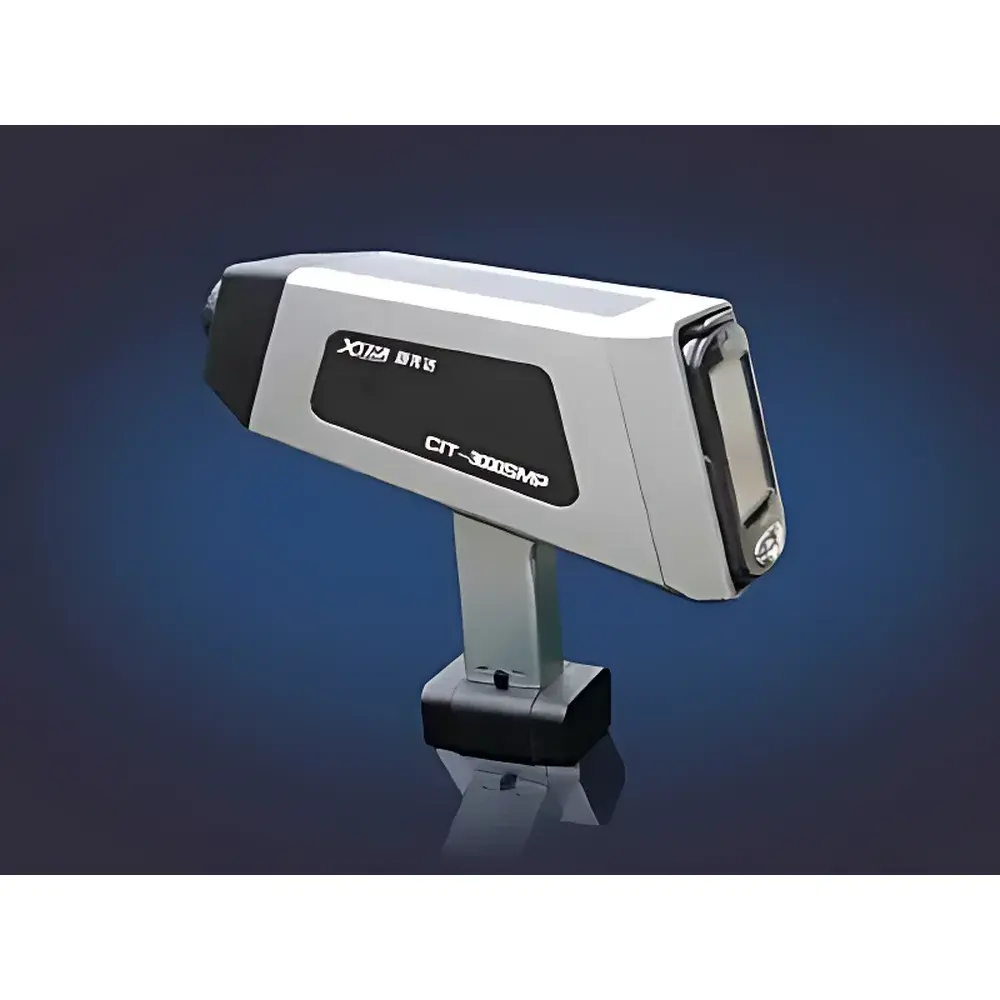
Sichuan Xinxianda CIT-3000SMP Handheld Energy Dispersive X-Ray Fluorescence Spectrometer
| Brand | Sichuan Xinxianda |
|---|---|
| Origin | Sichuan, China |
| Model | CIT-3000SMP |
| Detector | Si(Li) semiconductor, Peltier-cooled |
| Energy Resolution | ≤150 eV (Mn Kα, 5.9 keV) |
| Analytical Range | 2–30 keV |
| Elements Analyzed | S to U (Z = 16–92) |
| Detection Limits | Cd/Cr/Hg/Br ≤ 1 ppm, Pb ≤ 2 ppm |
| Precision | RSD ≤ 0.08% (standard deviation) |
| Measurement Time | < 200 s |
| Power Consumption | 4 W |
| Weight | 1.75 kg |
| Battery Life | ≥ 8 h (full-load operation) |
| Operating System | Embedded Chinese GUI on integrated PDA |
| Connectivity | Bluetooth v4.0, GPS module |
| Safety Indicators | Dual-color LED (green = power on, red = X-ray emission) |
| Sample Forms | Solid blocks, powders, pressed pellets |
| Compliance | IEC 61010-1, IEC 62471 (LED safety), RoHS-compliant construction |
| Data Storage | Internal flash memory (≥ 16 GB) |
Overview
The Sichuan Xinxianda CIT-3000SMP is a handheld energy dispersive X-ray fluorescence (ED-XRF) spectrometer engineered for field-deployable, multi-element elemental analysis with laboratory-grade reliability. Based on the fundamental principle of X-ray fluorescence—where primary X-rays from a micro-focus X-ray tube excite atoms in a sample, causing emission of characteristic secondary X-rays—the CIT-3000SMP captures and resolves these emissions using a high-resolution, Peltier-cooled Si(Li) semiconductor detector. Its compact architecture integrates excitation, detection, signal processing, and data interpretation into a single ergonomic unit weighing only 1.75 kg. Designed explicitly for regulatory screening and process control in resource-constrained or remote environments, it delivers quantitative results for elements from sulfur (S) to uranium (U) without requiring sample dissolution or vacuum conditions. The instrument operates within the 2–30 keV energy range, enabling detection of key regulated elements—including Pb, Hg, Cd, Cr, and Br—at sub-ppm levels, making it suitable for rapid compliance verification against RoHS, WEEE, and consumer product safety directives.
Key Features
- High-fidelity spectral acquisition using a factory-calibrated, imported Si(Li) detector with energy resolution ≤150 eV at Mn Kα (5.9 keV), ensuring reliable peak separation for overlapping elemental lines (e.g., As Kα / Pb Lα, S Kα / Cl Kα)
- Micro-focus X-ray tube (no radioactive isotopic source) providing stable, low-power excitation (<4 W total system draw) and eliminating licensing, transport, or disposal requirements associated with gamma sources
- Digital multi-channel analyzer (1024-channel MCA) with real-time dead-time correction and pulse pile-up rejection to maintain counting integrity at high flux rates
- Proprietary multi-parameter automatic classification algorithm—patented in China—that applies pattern recognition to spectral shape, intensity ratios, and matrix absorption features to auto-select optimal calibration models per sample type (e.g., plastics, alloys, ceramics, soils)
- Integrated industrial PDA running a localized Chinese GUI with full onboard data editing, report generation, and GPS-tagged measurement logging
- Dual-status LED indicator system (green = standby/ready; red = active X-ray emission) compliant with IEC 62471 for optical radiation safety and reinforcing ALARA (As Low As Reasonably Achievable) operational discipline
Sample Compatibility & Compliance
The CIT-3000SMP accepts heterogeneous solid samples—including irregular metal parts, polymer housings, electronic circuit boards, powdered ores, and pressed pellets—without grinding, digestion, or coating. Its open-beam geometry accommodates samples up to 10 cm × 10 cm in planar dimension and 5 cm in height. No helium purge or vacuum chamber is required, reducing setup time and maintenance overhead. From a regulatory standpoint, the device conforms to IEC 61010-1 (safety requirements for electrical equipment for measurement) and incorporates hardware interlocks and exposure timers aligned with national radiation protection guidelines for portable XRF devices. While not certified to ISO/IEC 17025 for accredited testing, its performance metrics—including repeatability (RSD ≤ 0.08%), detection limits (Cd/Cr/Hg/Br ≤ 1 ppm), and linearity across 0.001–99.99% concentration ranges—support internal quality control, supplier audits, and pre-screening workflows under GLP-aligned documentation practices.
Software & Data Management
The embedded software suite provides full lifecycle data handling: acquisition, qualitative identification, semi-quantitative screening, and calibrated quantification using fundamental parameters (FP) and empirical calibrations. All spectra are stored with metadata (timestamp, GPS coordinates, operator ID, measurement duration, tube voltage/current settings). Bluetooth 4.0 enables wireless synchronization with external PCs or LIMS servers; exported data formats include CSV, XML, and proprietary .XRF binary files compatible with third-party spectral evaluation tools. Audit trails record all user actions—including method changes, calibration updates, and result edits—with tamper-evident timestamps. Although not FDA 21 CFR Part 11–certified out-of-the-box, the system supports password-protected user roles and exportable logs suitable for GxP environment validation protocols when deployed within controlled QA/QC frameworks.
Applications
- Rapid RoHS/WEEE screening of electronic components, cables, connectors, and plastic enclosures for restricted heavy metals and halogens
- On-site alloy grade verification in scrap yards, fabrication shops, and pipeline maintenance crews
- Field-based geochemical surveying for base metal exploration (Cu, Zn, Ni, Co) and environmental soil screening (As, Pb, Cr)
- Quality assurance of incoming raw materials (e.g., pigments, catalysts, battery cathode powders) prior to batch processing
- Forensic material identification in customs inspections, recycling facilities, and product compliance investigations
FAQ
Is the CIT-3000SMP suitable for regulatory submission of test reports?
It is intended for screening and process control—not for issuing legally defensible certificates of conformance. Final compliance decisions should be verified using accredited laboratory methods (e.g., ICP-MS, AAS) per ASTM F2853 or IEC 62321-5.
Does the instrument require annual recalibration or certification?
While no mandatory annual certification exists for portable XRF under most national radiation safety regimes, we recommend quarterly verification using NIST-traceable reference materials (e.g., SRM 2582, 2583) and annual factory recalibration of detector gain and energy scale.
Can the device analyze liquids or thin films?
No—its open-beam design and lack of vacuum/helium path limit sensitivity for low-Z elements (e.g., Na, Mg, Al) and prohibit direct liquid analysis due to potential spill risk and X-ray scatter artifacts.
What safety training is required before operation?
Operators must complete site-specific radiation safety orientation covering time–distance–shielding principles, proper use of the LED status indicators, and emergency shutdown procedures—consistent with local regulatory authority requirements for Class II B X-ray generating devices.
Is firmware upgrade support available after purchase?
Yes—Sichuan Xinxianda provides free firmware updates via USB or Bluetooth for bug fixes, spectral library expansion, and minor feature enhancements, documented in release notes traceable to version control identifiers.





