
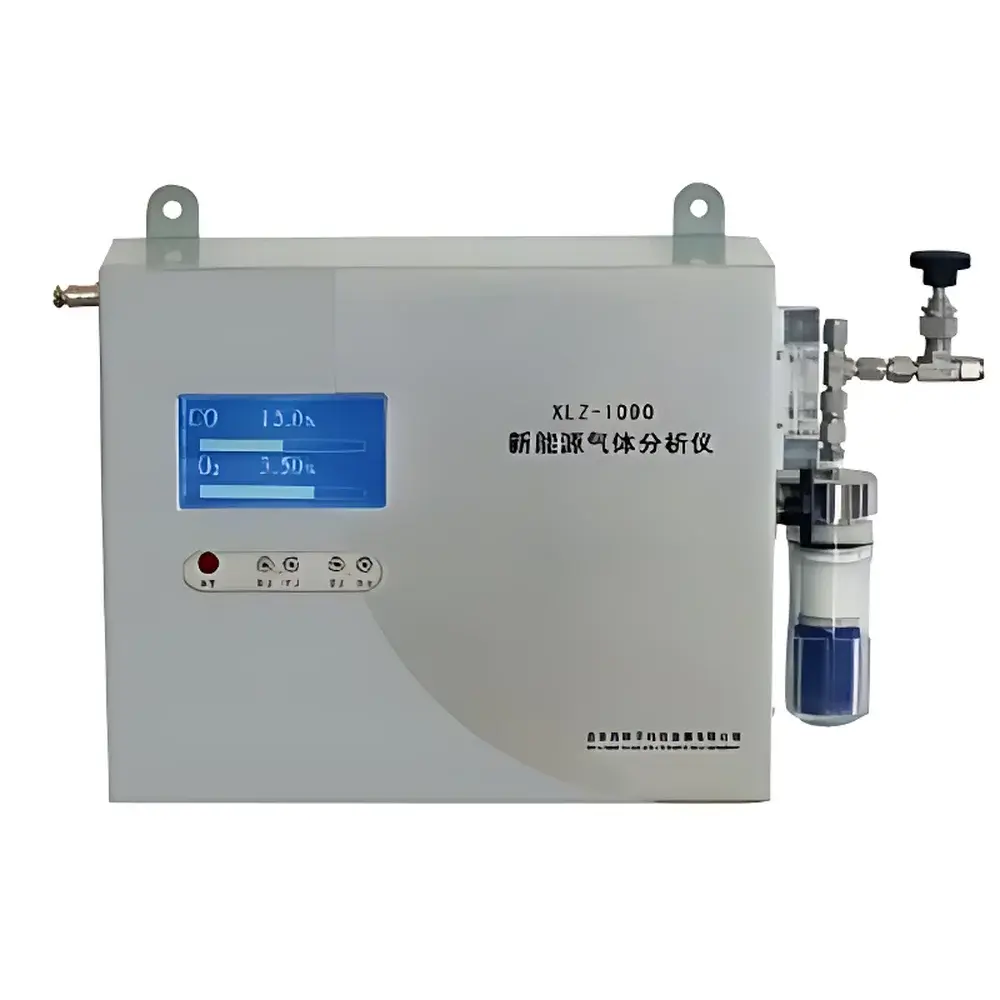
SIELINS XLZ-1090 Online Biogas Analyzer
| Brand | SIELINS |
|---|---|
| Origin | Beijing, China |
| Model | XLZ-1090 |
| Instrument Type | Online Gas Analyzer |
| Detection Gases | CO₂ (0–50% vol), CH₄ (0–100% vol), O₂ (0–20% vol), H₂S (0–1000 ppm) |
| Response Time | ≤10 s |
| Accuracy | ±1% FS |
| Resolution | CH₄/O₂/CO₂: 0.1% vol |
| H₂S | 1 ppm |
| Warm-up Time | 45 min |
| Output | RS232 digital interface, 4–20 mA analog output |
| Power Supply | AC 220 V or DC 12 V |
| Compliance | Designed for continuous emission monitoring and industrial process control per ISO 14644-1 ambient air quality reference practices and ASTM D6785 for biogas composition analysis |
Overview
The SIELINS XLZ-1090 Online Biogas Analyzer is a non-dispersive infrared (NDIR) gas analyzer engineered for continuous, real-time quantification of key biogas constituents—including methane (CH₄), carbon dioxide (CO₂), oxygen (O₂), and hydrogen sulfide (H₂S)—in complex gas matrices. Its measurement principle relies on the characteristic absorption bands of these gases in the mid-infrared spectrum: CH₄ at ~3.3 µm, CO₂ at ~4.26 µm, and H₂S at ~7.7 µm. The instrument employs a single broadband IR source, a dual-compartment single-tube optical cell (half-cell design), and thermopile-based detectors optimized for signal stability and thermal drift compensation. This architecture ensures high reproducibility under variable ambient conditions—critical for unattended operation in anaerobic digestion plants, landfill gas collection systems, and biogas upgrading facilities. Unlike filter-wheel or FTIR-based platforms, the NDIR configuration delivers deterministic selectivity without spectral overlap interference, making it suitable for regulatory-grade monitoring where trace-level H₂S detection and percent-level CH₄/CO₂ quantification must coexist within a single analytical stream.
Key Features
- Simultaneous multi-gas analysis with independent optical channels for CH₄, CO₂, O₂, and H₂S—no cross-sensitivity correction required for standard biogas compositions
- Robust optical path design featuring temperature-stabilized IR source and dual-compartment gas cell to minimize zero drift and enhance long-term baseline stability
- Digital signal processing engine with adaptive baseline compensation and auto-zero referencing cycle (configurable interval)
- High-contrast backlit LCD display with intuitive menu navigation and real-time trend visualization for all measured parameters
- Modular analog/digital I/O: isolated 4–20 mA outputs per gas channel (NIST-traceable calibration), RS232 serial interface for data logging and remote configuration
- Extended service life via field-replaceable optical components and user-accessible calibration port—designed for >18 months mean time between maintenance (MTBM) in continuous operation
Sample Compatibility & Compliance
The XLZ-1090 accepts conditioned sample gas streams with dew point ≤5 °C and particulate load <1 µm (pre-filtration recommended). It operates reliably across sample flow rates of 0.5–2.0 L/min and pressures from 80–110 kPa (absolute). The analyzer meets functional requirements for continuous emissions monitoring systems (CEMS) as defined in EN 15267-3 for automated measuring systems and aligns with the performance criteria outlined in ISO 14064-3 for greenhouse gas verification. While not certified to EPA Method 3A or EN 14792, its accuracy specification (±1% FS) satisfies internal QA/QC thresholds for biogas process control per ADI (Anaerobic Digestion Industry) best practice guidelines. Optional integrated sample conditioning units (heated line, particle filter, condensate trap) are available to meet GLP-compliant sampling protocols for laboratory validation studies.
Software & Data Management
The analyzer supports ASCII-based serial communication protocol for seamless integration with SCADA, DCS, or PLC environments. A Windows-compatible data acquisition software package (optional) provides time-stamped logging, alarm threshold configuration (high/low limits per channel), and CSV export compliant with ASTM E2500-22 for raw data archiving. Audit trail functionality includes operator login timestamps, calibration event logs, and firmware version tracking—supporting basic 21 CFR Part 11 readiness when deployed with networked authentication servers. All calibration records (span/zero events, date, operator ID, reference gas lot number) are stored onboard with 32 MB non-volatile memory capacity.
Applications
- Real-time monitoring of biogas composition in anaerobic digesters for feedstock optimization and digester health assessment
- Landfill gas collection system compliance reporting (CH₄ oxidation efficiency, flare bypass detection)
- Biogas upgrading plant inlet/outlet analysis for membrane or PSA process control
- Continuous O₂ monitoring in inerted storage tanks to prevent explosive atmospheres (per IEC 60079-29-1)
- Research-grade quantification of fermentation off-gases in pilot-scale biohydrogen or syngas trials
- Stack emission verification for small-scale biomass CHP units operating under EU Directive 2010/75/EU (IED)
FAQ
What gases does the XLZ-1090 measure simultaneously, and how is selectivity achieved?
The analyzer measures CH₄, CO₂, O₂, and H₂S concurrently using dedicated NDIR optical paths and electrochemical sensing for O₂. Selectivity is ensured by wavelength-specific optical filters and physical separation of detection chambers—eliminating algorithmic cross-interference corrections.
Is factory calibration traceable to national standards?
Yes—each unit ships with NIST-traceable calibration certificates for CH₄, CO₂, and H₂S using certified reference gases (CRM) from ISO/IEC 17025-accredited providers.
Can the instrument be integrated into an existing industrial automation network?
Yes—via RS232 serial interface or isolated 4–20 mA analog outputs compatible with Modbus RTU, Profibus DP, or standard DCS input cards.
What maintenance intervals are recommended for unattended operation?
Zero/span verification every 7 days; optical window cleaning and filter replacement every 90 days; full calibration check every 6 months under typical biogas conditions.
Does the analyzer support custom measurement ranges beyond the standard specifications?
Yes—custom span ranges (e.g., CH₄ 0–20% for low-concentration landfill seepage monitoring) can be configured during manufacturing or via firmware update with authorized service tools.
Related Products







