
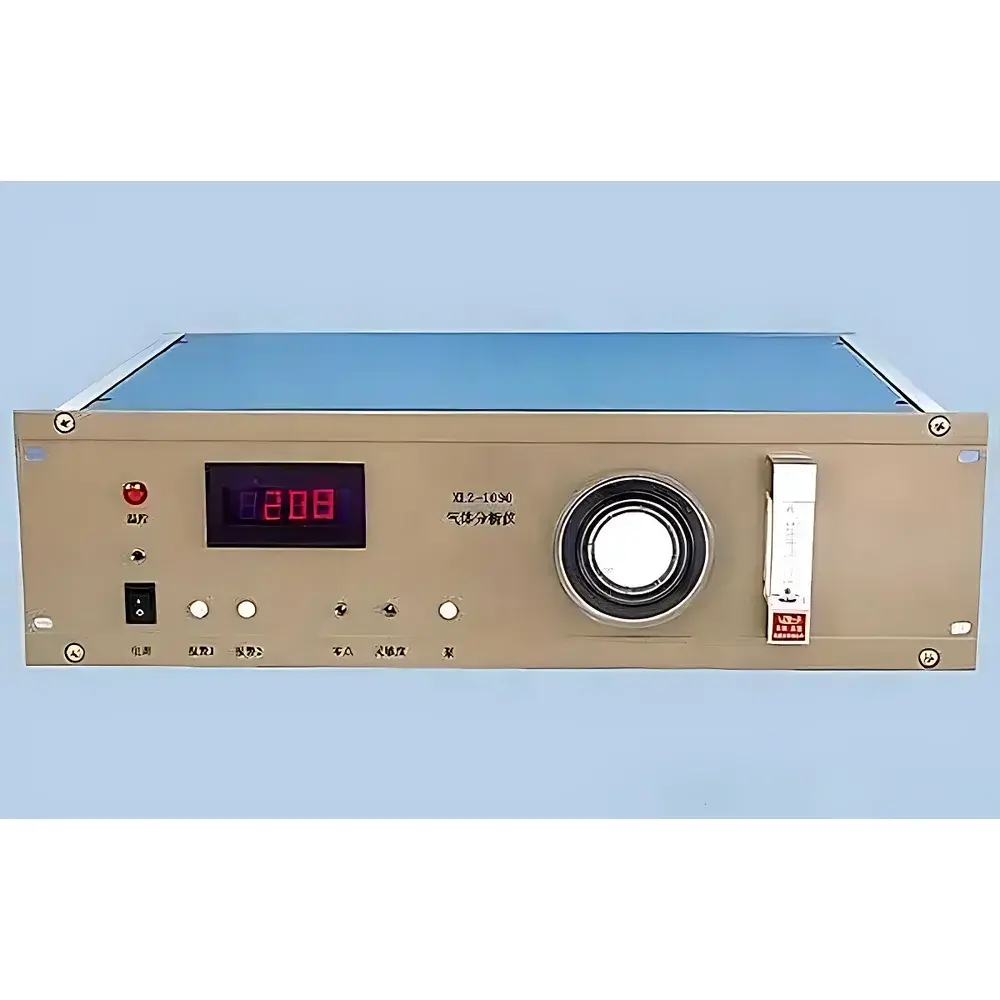
SIELINS XLZ-1090GXH Non-Dispersive Infrared (NDIR) Methane Analyzer
| Brand | SIELINS |
|---|---|
| Origin | Beijing, China |
| Model | XLZ-1090GXH |
| Instrument Type | Online Fixed-Mount Gas Analyzer |
| Target Gas | CH₄ (also configurable for CO, CO₂, SO₂, NH₃) |
| Response Time (T₉₀) | ≤15 s |
| Measurement Accuracy | Bulk range: ≤0.01% v/v |
| Trace range | 1 ppm |
| Measurement Range | 0–50 ppm (min) to 0–100% v/v (max) |
| Repeatability | ≤1% FS |
| Zero Drift | ≤±1% FS / 48 h |
| Span Drift | ≤±1% FS / 48 h |
| Linearity Error | ≤±1% FS |
| Sample Flow Rate | 0.5–3 L/min |
| Operating Temperature | 0–40 °C |
| Relative Humidity | ≤90% RH |
| Power Supply | 220 V ±10%, 50 ±0.5 Hz, 150 W |
| Analog Outputs | 0–20 mA, 4–20 mA, 0–10 mV, 1–5 V (load ≤600 Ω) |
| Display | Digital LCD |
Overview
The SIELINS XLZ-1090GXH is a fixed-installation, non-dispersive infrared (NDIR) gas analyzer engineered for continuous, real-time quantification of methane (CH₄) in ambient air, industrial process streams, and emission ducts. Its core measurement principle relies on the characteristic absorption of infrared radiation at specific wavelengths (e.g., ~3.3 µm for CH₄), where target gas molecules attenuate incident IR energy in proportion to their concentration—governed by the Beer–Lambert law. Unlike dispersive spectrometers, this NDIR system employs a single broadband IR source, a dual-compartment (half-cell) sample chamber with matched optical paths, and a high-stability pyroelectric or micro-machined thermopile detector. This architecture eliminates moving gratings or filters, delivering inherent mechanical robustness, long-term baseline stability, and immunity to spectral interference from particulates or condensable vapors when properly conditioned. Designed for unattended operation in field-deployed environmental monitoring stations or integrated into plant-wide emissions reporting systems, the XLZ-1090GXH meets the functional requirements of continuous emission monitoring systems (CEMS) and ambient air quality networks under routine operational conditions.
Key Features
- Optimized NDIR optical path with single-source, dual-chamber design ensuring high signal-to-noise ratio and minimal cross-sensitivity to background gases (e.g., H₂O vapor compensated via internal reference channel or algorithmic correction)
- Configurable measurement ranges spanning trace-level detection (0–50 ppm) to high-concentration applications (0–100% v/v), selectable per installation requirements without hardware modification
- T₉₀ response time ≤15 seconds—enabling dynamic monitoring of transient methane releases during fugitive emission surveys or biogas flare control
- Thermal and electronic stability engineered for ≤±1% full-scale drift over 48 hours, supporting extended calibration intervals compliant with EPA Method 21 and ISO 13864 guidelines
- Modular analog output interface (4–20 mA standard, plus optional 0–10 mV/1–5 V) compatible with SCADA, DCS, and PLC systems; outputs are isolated and load-independent up to 600 Ω
- Ruggedized enclosure rated for indoor industrial environments (IP54 equivalent); operates reliably across 0–40 °C and ≤90% RH non-condensing
Sample Compatibility & Compliance
The XLZ-1090GXH accepts conditioned sample gas streams within 0.5–3 L/min flow rate. For optimal accuracy in real-world deployments, inlet conditioning—comprising particulate filtration (≤1 µm), moisture removal (chiller or permeation dryer), and pressure regulation—is recommended prior to analyzer entry. While not certified to ATEX or IECEx for hazardous area use, the unit complies with electromagnetic compatibility (EMC) standards per GB/T 18268 (equivalent to IEC 61326-1) and safety requirements under GB 4793.1 (IEC 61010-1). Its performance characteristics align with technical validation protocols referenced in EPA Reference Method 25A for hydrocarbon analysis and support data integrity expectations under ISO/IEC 17025-accredited laboratories when operated within defined environmental and maintenance parameters.
Software & Data Management
The analyzer operates autonomously with embedded firmware managing zero/span calibration routines, diagnostic self-checks (lamp intensity, detector responsivity, temperature stabilization), and alarm thresholds (e.g., high-CH₄, flow loss, temperature out-of-range). Local digital display provides real-time concentration, status flags, and event logs. For integration into centralized data platforms, optional RS-485 Modbus RTU communication enables bidirectional parameter configuration and historical value polling. All analog outputs include built-in linearization and temperature compensation algorithms. While the base unit does not include FDA 21 CFR Part 11-compliant audit trail functionality, its analog output signals may feed into validated third-party data acquisition systems meeting GLP/GMP traceability requirements for regulated environmental reporting.
Applications
- Ambient air quality monitoring networks measuring background and episodic CH₄ concentrations near landfills, wastewater treatment plants, and agricultural zones
- Continuous emissions monitoring (CEM) at natural gas compressor stations, LNG terminals, and biogas upgrading facilities per national greenhouse gas inventory protocols
- Process control in chemical synthesis reactors and catalytic oxidation units where methane serves as feedstock or byproduct
- Indoor air quality assessment in livestock barns, anaerobic digestion labs, and confined-space safety verification
- Research-grade quantification in combustion studies, soil flux chambers, and atmospheric simulation chambers requiring stable, calibrated trace-gas detection
FAQ
What gases can the XLZ-1090GXH measure besides methane?
The analyzer is factory-configured for CH₄ but can be reconfigured—via optical filter replacement and firmware calibration—for CO, CO₂, SO₂, or NH₃, subject to optical absorption band compatibility and required recalibration.
Is field calibration supported?
Yes—zero calibration using certified nitrogen (or synthetic air) and span calibration using certified CH₄/N₂ standard gas mixtures (traceable to NIST or equivalent national metrology institutes) are fully supported via front-panel menu or remote command.
Does the instrument require periodic consumables?
No consumables are required; the IR source has a typical lifetime exceeding 5 years under continuous operation. Recommended preventive maintenance includes quarterly inlet filter replacement and annual optical path inspection.
Can it operate outdoors without an enclosure?
No—the unit is rated for indoor use only. Outdoor deployment requires a climate-controlled, weatherproof shelter with stable power and sample gas conditioning infrastructure.
How is measurement linearity verified across the full range?
Linearity is validated during factory calibration using at least five certified standard gas points spanning 0–100% of selected range, with residuals reported per ISO 6142 and documented in the Certificate of Conformance supplied with each unit.







