
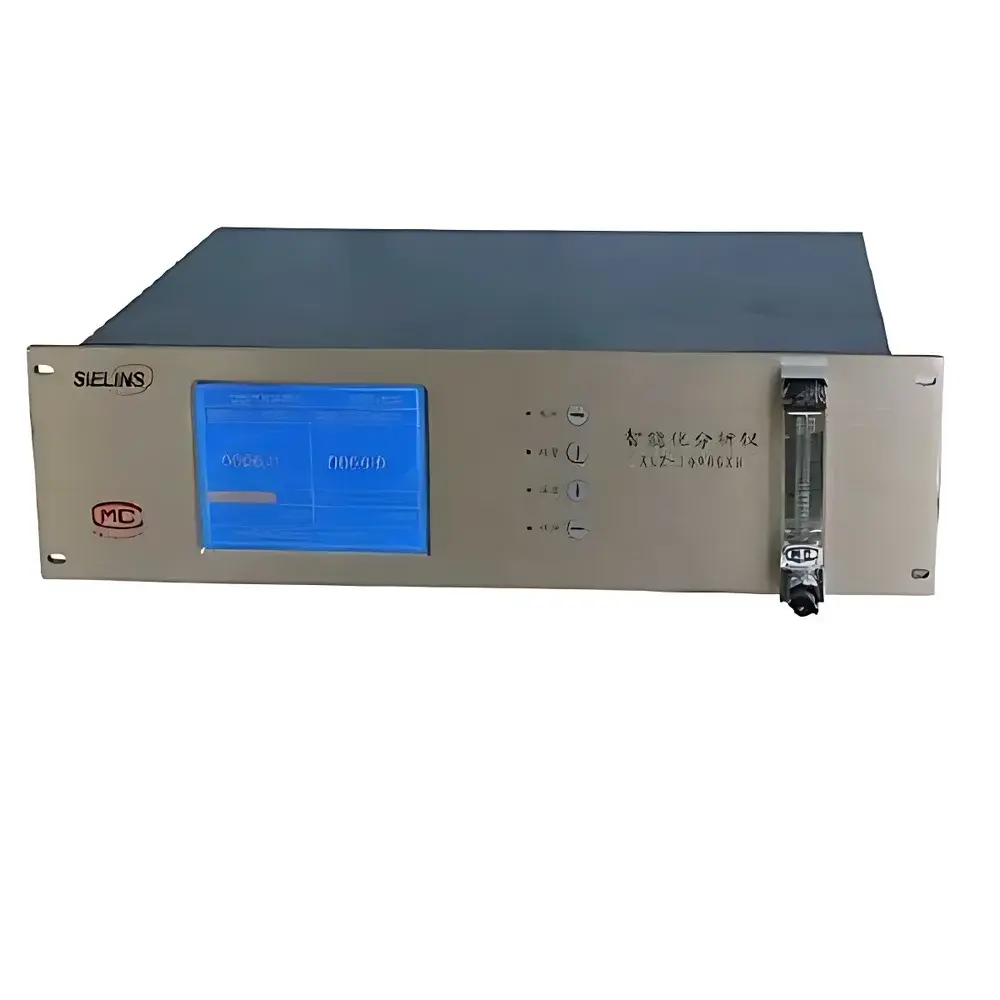
SIELINS XLZ-1090GXH Non-Dispersive Infrared (NDIR) Multicomponent Gas Analyzer
| Brand | SIELINS |
|---|---|
| Model | XLZ-1090GXH |
| Origin | Beijing, China |
| Instrument Principle | Non-Dispersive Infrared (NDIR) Absorption Spectroscopy |
| Configuration | Online Fixed-Mount Analyzer |
| Response Time | ≤20 s |
| Repeatability | ≤0.5% FS |
| Zero Drift | ±1% FS |
| Span Drift | ±1% FS |
| Linearity Error | ±1% FS |
| Measurement Ranges | CO (0–30 ppm), CO₂ (0–30 ppm), CH₄ (0–300 ppm), SO₂, NH₃ (configurable per gas) |
| Output Signals | Isolated 4–20 mA (default, load ≤400 Ω) and 1–5 V (default, load ≥250 Ω) |
| Power Supply | (220 ± 22) VAC, (50 ± 0.5) Hz |
| Power Consumption | <100 W |
| Operating Temperature | 5–40 °C |
| Relative Humidity | ≤80% RH |
| Enclosure | 19″ rack-mount chassis (standard depth), IP20-rated |
| Weight | ~15 kg |
| Compliance | Designed for continuous emission monitoring (CEM), process safety integrity level (SIL)-aware deployment, and GLP/GMP-aligned data handling |
Overview
The SIELINS XLZ-1090GXH is a fixed online multicomponent gas analyzer engineered for continuous, real-time quantification of infrared-active gases—including CO, CO₂, CH₄, SO₂, and NH₃—in complex industrial and environmental gas streams. It operates on the physical principle of non-dispersive infrared (NDIR) absorption spectroscopy: specific molecular bonds (e.g., C=O, C–H, S=O, N–H) absorb characteristic mid-infrared wavelengths; the analyzer measures attenuation at these discrete wavelengths using a single broadband IR source, dual-channel detection architecture (reference/analytical), and precision optical filtering. Unlike dispersive systems, this NDIR configuration eliminates moving parts and grating mechanisms—enhancing long-term stability, reducing maintenance frequency, and delivering high reproducibility under field conditions. The instrument is designed for integration into stack monitoring systems, process control loops, and laboratory combustion test benches where regulatory-grade reliability and traceable calibration are required.
Key Features
- Robust NDIR optical path with single-source, dual-beam (half-cell reference/analytical chamber) design for inherent drift compensation and improved signal-to-noise ratio
- Full digital signal processing chain: 24-bit ADC, adaptive baseline correction, temperature-compensated detector output, and real-time spectral deconvolution for multi-gas interference mitigation
- 19″ rack-mount enclosure (standard depth, front-accessible I/O) compliant with IEC 60297-3-100 mechanical specifications and suitable for DCS/PLC integration
- High-contrast monochrome LCD with intuitive Chinese-language menu interface, context-sensitive prompts, and built-in operation guidance
- Dual-mode calibration support: manual or automated zero/span adjustment via integrated solenoid valves and certified calibration gas ports
- Isolated analog outputs (4–20 mA and 1–5 V, configurable per channel) with galvanic isolation (>1500 VDC) and status-indicating relay outputs for fault, alarm, and calibration states
- RS-232 serial interface supporting Modbus RTU protocol for remote configuration, data logging, and firmware updates
Sample Compatibility & Compliance
The XLZ-1090GXH is validated for use with dry, non-corrosive, particle-free gas matrices. For wet or particulate-laden streams (e.g., flue gas), optional heated sample lines, condensate traps, and particulate filters must be deployed upstream per ISO 12039 and EPA Method 3A guidelines. It meets electromagnetic compatibility requirements per IEC 61326-1 (industrial environment) and safety standards per IEC 61010-1. While not certified to SIL 2 or ATEX/IECEx out-of-the-box, its architecture supports functional safety integration when deployed with external safety relays and documented procedures aligned with IEC 61511. Data integrity features—including timestamped calibration logs, user-access audit trails, and non-volatile memory retention—support compliance with GLP and basic GMP documentation practices.
Software & Data Management
The analyzer operates autonomously without host software but provides standardized ASCII-based serial communication for integration with SCADA, DCS, or custom LabVIEW/Python acquisition platforms. All operational parameters—including measurement values, calibration history, fault codes (e.g., “Optical Path Obstruction”, “Detector Saturation”), and environmental sensor readings—are accessible via RS-232. Internal storage retains ≥30 days of 1-minute averaged data (user-configurable). Optional PC utility software (provided separately) enables trend visualization, report generation (PDF/CSV), and batch export for QA/QC review. Data timestamps comply with ISO 8601; no internal clock battery is included—synchronization relies on host system or external NTP via connected controller.
Applications
- Continuous emissions monitoring (CEMS) for combustion sources: coal-fired boilers, waste incinerators, and cement kilns (CO, CO₂, SO₂)
- Process gas analysis in petrochemical refining, syngas production, and ammonia synthesis units (CH₄, NH₃, CO)
- Indoor air quality (IAQ) assessment in public buildings, hospitals, and agricultural facilities (CO₂, CH₄)
- Combustion efficiency testing in R&D labs and engine test cells (O₂ inferred via stoichiometric balance with CO/CO₂)
- Biogas upgrading plant feedstock and product stream verification (CH₄, CO₂, H₂S—when paired with electrochemical H₂S module)
FAQ
What gases can the XLZ-1090GXH measure simultaneously?
It measures one target gas per optical channel; multi-gas capability requires factory configuration with multiple NDIR modules (e.g., dual-channel for CO + CO₂). Standard delivery is single-gas; up to three gases may be supported with optional hardware expansion.
Is the analyzer compatible with EPA or EU regulatory reporting protocols?
It satisfies technical performance criteria outlined in EN 15267-3 and ISO 12039 for NDIR analyzers but requires third-party QAL1 certification for official CEMS compliance in EU or U.S. jurisdictions.
Can it operate in high-humidity environments?
No—ambient humidity must remain ≤80% RH, and sample gas must be dried to dew point <5 °C prior to inlet. Condensation inside the optical cell causes irreversible signal attenuation.
Does it support automatic zero calibration with ambient air?
Yes—when configured with an integrated zero-air pump and carbon scrubber, it performs periodic automatic zeroing; however, certified span gas remains mandatory for full two-point calibration per ISO 14055-1.
What maintenance intervals are recommended?
Optical window cleaning every 6 months; detector and source replacement every 5 years (typical lifetime); annual verification of calibration accuracy against traceable standards is advised for regulated applications.
Related Products







