
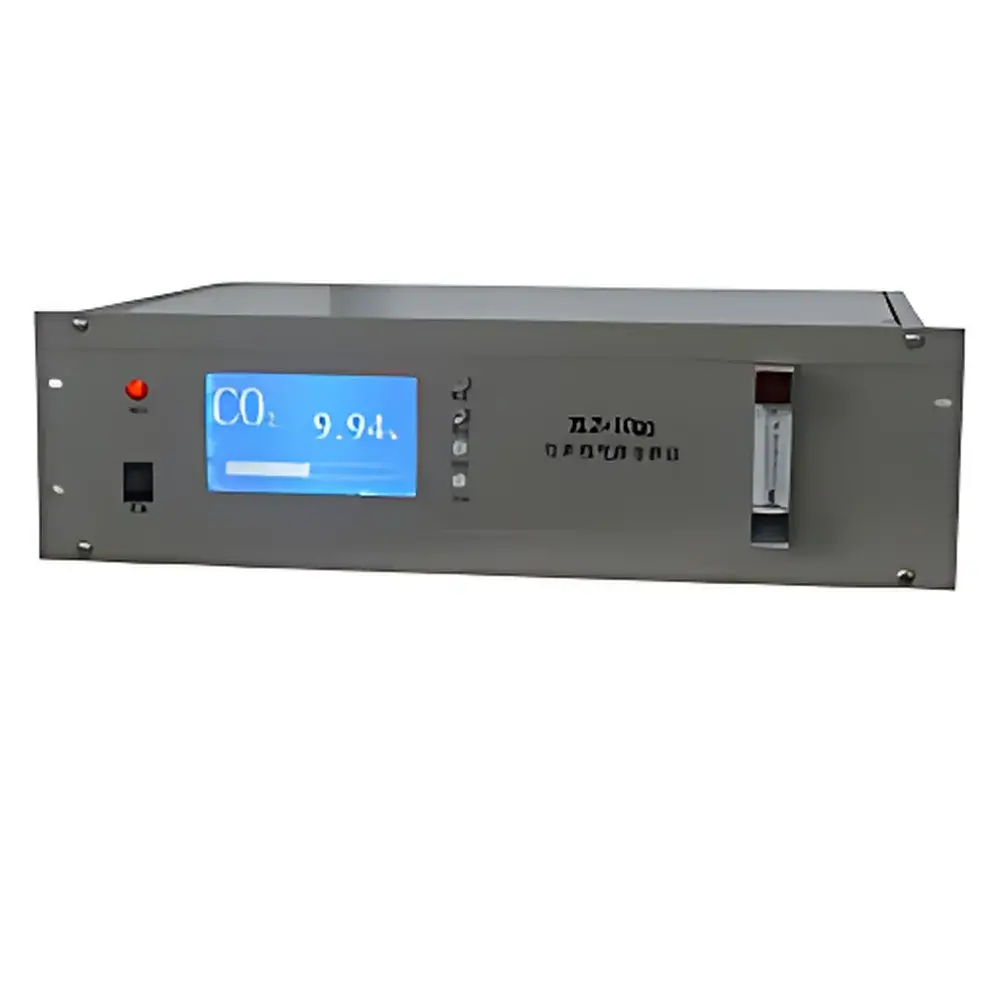
SIELINS XLZ-1090GXH Non-Dispersive Infrared (NDIR) Nitrogen Oxides (NOₓ) Analyzer
| Brand | SIELINS |
|---|---|
| Origin | Beijing, China |
| Model | XLZ-1090GXH |
| Analysis Principle | Non-Dispersive Infrared (NDIR) Spectroscopy |
| Gas Measured | NO (Nitric Oxide), with cross-sensitivity to NO₂ in multi-component gas streams |
| Measurement Range | 0–50 ppm (min) to 0–100% v/v (max, configurable) |
| Detection Limit | 0.01 ppm for O₂/N₂ (as background reference), 1 ppm for NO (trace mode) |
| Accuracy | ≤ 0.01% v/v (major component), ≤ 1 ppm (trace) |
| Repeatability | ≤ 1% FS |
| Zero Drift | ≤ ±1% FS / 48 h |
| Span Drift | ≤ ±1% FS / 48 h |
| Linearity Error | ≤ ±1% FS |
| Response Time (T₉₀) | ≤ 15 s |
| Sample Flow Rate | 0.5–3 L/min |
| Operating Temperature | 0–40 °C |
| Relative Humidity | ≤ 90% RH (non-condensing) |
| Power Supply | 220 V ±10%, 50 ±0.5 Hz, 150 W |
| Analog Outputs | 4–20 mA (isolated, ≤400 Ω load) and 1–5 V (isolated, ≥250 Ω load), configurable |
| Digital Interface | RS232 (standard), protocol-compatible with SCADA/DCS systems |
| Compliance | Designed per IEC 61000-6-2 (EMC immunity) and IEC 61000-6-3 (EMC emission) |
Overview
The SIELINS XLZ-1090GXH is a fixed-installation, single-beam non-dispersive infrared (NDIR) gas analyzer engineered for continuous, real-time quantification of nitric oxide (NO) in complex gaseous matrices. It operates on the fundamental principle of selective infrared absorption—NO exhibits characteristic vibrational-rotational absorption bands near 5.3 µm, enabling highly specific detection without optical filters or dispersive elements. Unlike chemiluminescence or electrochemical sensors, this NDIR architecture delivers inherent stability, minimal drift, and immunity to cross-interference from CO₂, SO₂, or hydrocarbons when properly conditioned. The instrument integrates a precision dual-chamber measurement cell (single-source, split-path configuration), thermally stabilized detector, and high-fidelity digital signal processing to ensure metrological integrity across both trace (ppm-level) and bulk (percentage-level) concentration ranges. Its design targets long-term unattended operation in industrial process environments, environmental monitoring stations, and regulated laboratory test benches where repeatability, auditability, and low maintenance are critical.
Key Features
- Single-beam NDIR optical path with thermally compensated dual-chamber gas cell—eliminates mechanical chopper wear and enhances zero stability
- Digital signal processing engine with adaptive baseline correction and temperature-compensated gain control
- Full-range programmable measurement spans: 0–50 ppm (high-sensitivity mode) up to 0–100% v/v (bulk analysis), user-configurable via front-panel LCD or RS232
- T₉₀ response time ≤15 seconds under nominal flow conditions (1.5 L/min), meeting EPA Method 6C and ISO 12039 timing requirements for continuous emissions monitoring
- Isolated analog outputs (4–20 mA and 1–5 V) compliant with IEC 61131-2 current loop standards; output signals fully decoupled from internal power and ground references
- Front-panel LCD with intuitive Chinese-language menu navigation, real-time diagnostics, and context-sensitive operation prompts
- Manual and automated zero/span calibration routines with password-protected access levels for operator and engineer roles
- RS232 serial interface supporting ASCII command protocol for integration into PLCs, DCS, or data acquisition systems—no proprietary drivers required
Sample Compatibility & Compliance
The XLZ-1090GXH is validated for use with dry, particle-free gas streams containing NO in air, flue gas, syngas, combustion exhaust, and ambient air. Sample conditioning (e.g., particulate filtration, moisture removal via Nafion™ or chilled mirror dew point control) is recommended prior to inlet to prevent optical window fouling and condensation-induced signal attenuation. While optimized for NO, the analyzer exhibits measurable cross-sensitivity to nitrogen dioxide (NO₂) due to overlapping IR absorption features; users requiring speciated NOₓ (NO + NO₂) must apply empirical correction factors or deploy paired instruments with selective scrubbers. The system meets electromagnetic compatibility requirements per IEC 61000-6-2 (immunity) and IEC 61000-6-3 (emissions), and its firmware architecture supports timestamped calibration event logging—enabling alignment with GLP and GMP documentation practices. Though not CE-marked for EU hazardous area use, it complies with general-purpose industrial safety standards (IEC 61010-1) for non-explosive atmospheres.
Software & Data Management
No embedded PC or proprietary software is required for basic operation; all configuration, calibration, and status monitoring occur via the built-in LCD interface or ASCII-based RS232 commands. For centralized data aggregation, the analyzer outputs linearized concentration values synchronized with analog signals—facilitating direct ingestion into historian systems (e.g., OSIsoft PI, Ignition SCADA) without protocol translation. Calibration records—including date/time stamps, operator ID (manual entry), span gas concentration, and pre-/post-calibration deviations—are stored in non-volatile memory and retrievable via serial query. While the device does not natively support FDA 21 CFR Part 11 electronic signatures, its deterministic calibration workflow and immutable log structure permit integration into validated environments when paired with compliant third-party data management platforms that enforce audit trails and role-based access control.
Applications
- Continuous emissions monitoring (CEMS) of NO in coal-fired, gas-turbine, and biomass boiler exhaust stacks—aligned with EPA Performance Specification 2 (PS-2) and EN 15267-3 verification criteria
- Process control in ammonia oxidation reactors, nitric acid plants, and selective catalytic reduction (SCR) system feedback loops
- Ambient air quality networks (AQS) for urban NO monitoring per ISO 7935 and ASTM D6330 protocols
- Combustion research laboratories performing engine-out or furnace exhaust characterization under standardized test cycles (e.g., ISO 8178, SAE J1939)
- Indoor air quality (IAQ) assessment in parking garages, tunnels, and industrial workspaces where NO exposure limits (ACGIH TLV®: 25 ppm TWA) must be verified
FAQ
Does the XLZ-1090GXH measure NO₂ directly?
No—it is optimized for NO detection via its primary 5.3 µm absorption band. NO₂ contributes secondary absorption at adjacent wavelengths; quantification requires either empirical correction or complementary instrumentation.
Can the instrument operate in high-humidity gas streams?
Not without external sample conditioning. Relative humidity >70% may cause condensation on optical surfaces, leading to signal attenuation and calibration drift. A heated sample line or permeation dryer is strongly recommended.
What calibration gases are required for routine verification?
Certified NO-in-N₂ standard gases traceable to NIST or equivalent national metrology institutes—typically at 20% and 80% of full scale for span validation, plus zero air (NO < 0.1 ppb) for baseline verification.
Is the 4–20 mA output intrinsically safe?
No—the output is isolated but not intrinsically safe; it must be connected through an approved barrier if deployed in Class I, Division 1 hazardous locations.
How often should zero and span calibration be performed?
Per ISO 12039, daily zero checks and weekly span verification are recommended for CEMS applications; for laboratory use, calibration frequency depends on usage intensity and regulatory requirements—typically every 7–30 days.




