
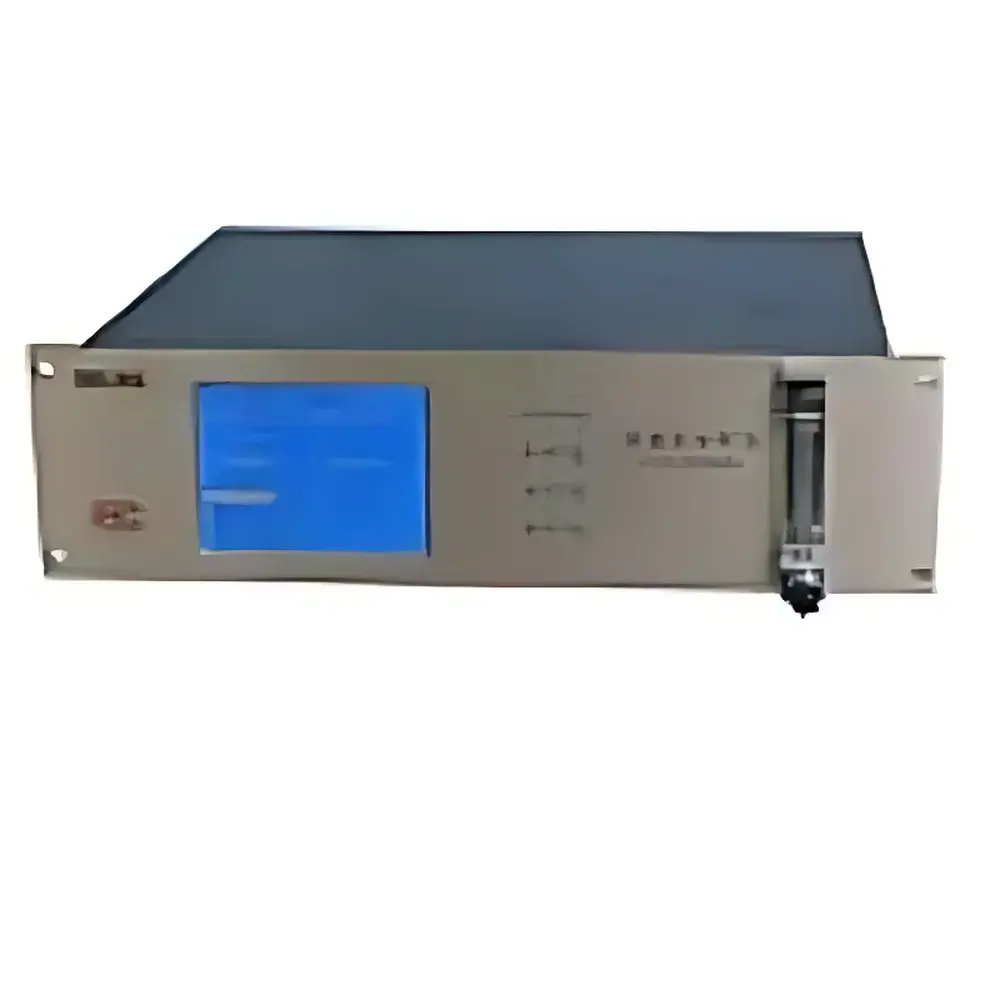
SIELINS XLZ-1090GXH Online NDIR Carbon Monoxide Analyzer
| Brand | SIELINS |
|---|---|
| Model | XLZ-1090GXH |
| Type | Online NDIR Gas Analyzer |
| Detection Principle | Non-Dispersive Infrared (NDIR) Absorption |
| Measurement Target | Single-component CO |
| Range | 0–50 ppm (standard), up to 0–200 ppm (configurable) |
| Repeatability | ≤1% FS |
| Resolution | 0.1 ppm |
| Response Time (T90) | ≤20 s |
| Zero Drift | ≤±1% FS / 48 h (high-concentration mode) |
| Span Drift | ≤±1% FS / 48 h (high-concentration mode) |
| Linearity Error | ≤±2% FS |
| Output Signals | Isolated 4–20 mA (default), 0–20 mA, 0–5 V, 1–5 V (selectable) |
| load | ≤400 Ω (current), ≥250 Ω (voltage) |
| Communication | RS232 standard interface |
| Enclosure | 19" rack-mount chassis (483 × 267 × 177 mm, 3U) |
| Display | Backlit LCD with on-screen menu navigation and real-time status prompts |
| Calibration | Manual/auto zero & span calibration |
| Compliance | Designed for continuous emission monitoring (CEM), compatible with EPA Method 10, EN 15267, and ISO 12039 requirements for CO quantification in industrial and environmental applications |
Overview
The SIELINS XLZ-1090GXH Online NDIR Carbon Monoxide Analyzer is an industrial-grade, fixed-position gas analyzer engineered for continuous, real-time measurement of carbon monoxide (CO) concentration in gaseous streams. It operates on the principle of non-dispersive infrared (NDIR) spectroscopy—exploiting the characteristic absorption band of CO near 4.6 µm. A single infrared source illuminates a dual-compartment measurement cell (half-cell design), where one side serves as a reference and the other as the sample path. An advanced pyroelectric or photonic detector captures differential absorption signals, which are processed via high-stability analog front-end circuitry and a 24-bit ADC. The instrument’s optical architecture minimizes cross-sensitivity to water vapor and CO₂ through spectral filtering and pressure/temperature compensation algorithms, ensuring robust performance in variable process environments.
Key Features
- Rack-mount 19″ chassis (3U height) compliant with IEC 60297-3-100 mechanical standards, enabling seamless integration into DCS cabinets, analyser shelters, or OEM skid systems.
- Backlit monochrome LCD display with intuitive Chinese-language menu interface—including contextual help prompts, real-time diagnostics, and multi-level user access control (operator/engineer/admin).
- Dual-mode calibration architecture: supports manual zero/span adjustment, automated periodic calibration sequences, and programmable mid-range point verification—critical for GLP/GMP traceability and regulatory audit readiness.
- Fully digital signal processing chain eliminates analog drift; embedded firmware implements real-time baseline correction, temperature-compensated gain stabilization, and outlier rejection filters.
- Standard isolated analog outputs: default 4–20 mA (HART-compatible current loop) and 1–5 V DC; configurable for 0–20 mA or 0–5 V with adjustable scaling per IEC 61131-3 conventions.
- RS232 serial port enables direct connection to SCADA systems, PLCs, or local PCs for configuration, data logging, and remote firmware updates—supporting ASCII command protocol and Modbus RTU optional firmware upgrade.
Sample Compatibility & Compliance
The XLZ-1090GXH is validated for use with dry, non-corrosive gas matrices including ambient air, flue gas (post-desulfurization), syngas, biogas, and combustion exhaust streams. Sample conditioning—such as particulate filtration (≤0.3 µm), moisture removal (chiller or permeation dryer), and pressure regulation (±10 kPa)—is recommended upstream when inlet dew point exceeds 5 °C or particulate loading exceeds 1 mg/m³. The analyzer meets structural and electromagnetic compatibility requirements per EN 61326-1 (industrial environment) and EN 61000-6-2/-6-3. Its measurement methodology aligns with EPA Method 10 for CO in stationary source emissions and satisfies technical prerequisites of EN 15267-3 (QAL1 certification framework) and ISO 12039:2000 for continuous CO monitoring in waste incineration plants.
Software & Data Management
Configuration and operational data are managed via built-in EEPROM-based memory supporting ≥10,000 timestamped records (concentration, temperature, pressure, calibration events, fault logs). All critical parameters—including zero/span coefficients, alarm thresholds, output scaling factors, and communication settings—are stored with write-protection and CRC-16 validation. Optional PC software (Windows 10/11 compatible) provides historical trend visualization, CSV export, calibration certificate generation (per ISO/IEC 17025 template), and audit trail review with user-action timestamps—fully compliant with FDA 21 CFR Part 11 electronic record requirements when deployed in regulated pharmaceutical or food safety applications.
Applications
- Continuous emission monitoring (CEMS) at municipal solid waste incinerators, coal-fired power plants, and cement kilns—providing CO data for NOₓ reduction optimization and thermal efficiency assessment.
- Process safety interlocks in hydrogen production units, ammonia synthesis loops, and Fischer–Tropsch reactors—where CO concentration directly impacts catalyst lifetime and reaction selectivity.
- Ambient air quality networks (AAQNs) operated by environmental agencies—deployed in urban traffic corridors, industrial perimeters, and indoor parking facilities per WHO and EU Directive 2008/50/EC limit values.
- Research-grade combustion analysis in university laboratories and national metrology institutes—supporting flame chemistry studies, burner optimization, and emission factor validation under ASTM D6522 and ISO 871 test protocols.
- Indoor air quality (IAQ) assurance in underground garages, boiler rooms, and enclosed manufacturing cells—integrated with BMS systems for demand-controlled ventilation (DCV) per ASHRAE Standard 62.1.
FAQ
What gases can interfere with CO measurement on the XLZ-1090GXH?
Water vapor and carbon dioxide exhibit overlapping IR absorption bands near 4.6 µm. The analyzer mitigates interference through narrow-band optical filtering, differential cell design, and real-time H₂O/CO₂ compensation algorithms—validated to maintain ≤±2% FS total error in mixed streams containing up to 10% CO₂ and 2% H₂O (v/v).
Is field calibration required before commissioning?
Yes. Initial site-specific calibration using certified CO span gas (e.g., 25 ppm in N₂, ±2% uncertainty) and zero gas (ultra-pure N₂) is mandatory to establish baseline accuracy. Subsequent calibration intervals depend on application severity—typically every 7 days for CEMS duty, every 30 days for ambient monitoring.
Can the device operate in hazardous areas?
The base model is rated for general-purpose industrial environments (IP54 enclosure). For Zone 1/21 hazardous locations, an ATEX/IECEx-certified variant with intrinsic safety barrier integration (e.g., Ex ia IIC T4 Ga) is available upon request.
Does it support MODBUS TCP or Ethernet/IP?
The standard RS232 interface does not natively support industrial Ethernet protocols. However, third-party protocol gateways (e.g., Moxa EDS-G205A) may be used to bridge RS232 to Modbus TCP or EtherNet/IP networks without firmware modification.
How is long-term stability verified during QA/QC procedures?
Stability is assessed via 72-hour drift testing per ISO 10851:2017 Annex B—measuring zero and span response deviation under constant environmental conditions (23 ±2 °C, 50 ±5% RH). Drift reports must document all environmental parameters, gas certification details, and statistical evaluation (mean, SD, max deviation) for regulatory submission.







