
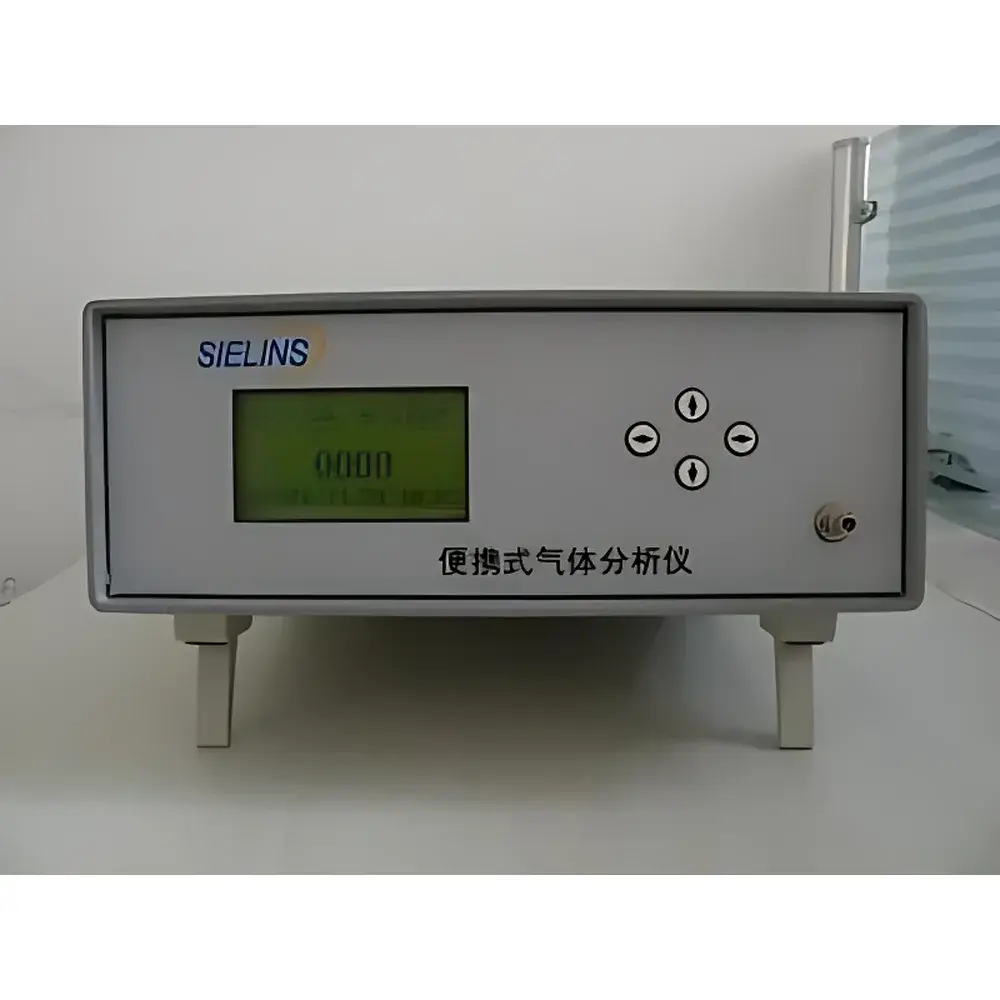
SIELINS XLZ-3091GXH Portable NDIR Carbon Monoxide Analyzer
| Brand | SIELINS |
|---|---|
| Origin | Beijing, China |
| Model | XLZ-3091GXH |
| Instrument Type | Portable |
| Detection Principle | Non-Dispersive Infrared (NDIR) |
| Measuring Range | 0–50.0 ppm or 0–200.0 ppm CO |
| Resolution | 0.1 ppm |
| Repeatability | ≤0.5% |
| Linearity Error | ≤±1% F.S. |
| Zero Drift | ≤±1% F.S. |
| Span Drift | ≤±1% F.S. |
| Response Time (T90) | ≤60 s |
| Power Supply | AC 220 V / Internal Rechargeable Battery |
| Weight | ≤3 kg |
| Dimensions | 245 × 190 × 85 mm |
| Data Interface | RS232 |
| Calibration | Field-calibratable with certified CO standard gas |
Overview
The SIELINS XLZ-3091GXH Portable NDIR Carbon Monoxide Analyzer is a field-deployable, single-gas measurement instrument engineered for precise, real-time quantification of carbon monoxide (CO) in ambient air and indoor environments. It operates on the principle of non-dispersive infrared (NDIR) spectroscopy — leveraging the characteristic absorption band of CO near 4.6 µm. According to the Beer-Lambert law, the intensity attenuation of infrared radiation passing through a gas sample is directly proportional to the concentration of CO present. This physics-based detection method ensures high selectivity against common interferents such as CO₂, CH₄, and water vapor — especially when combined with optical filtering and temperature-stabilized detector architecture. Designed for environmental health monitoring, occupational safety assessments, and indoor air quality (IAQ) verification, the XLZ-3091GXH delivers laboratory-grade accuracy in a rugged, handheld form factor weighing under 3 kg.
Key Features
- True NDIR optical path design with dual-wavelength reference compensation to minimize drift and enhance long-term stability
- Integrated sampling pump enabling continuous, active draw-through measurement without external accessories
- High-resolution LCD display with intuitive menu navigation supporting zero adjustment, span calibration, and full-scale linearization
- Onboard data logging capability with timestamped storage for up to 10,000 measurement records
- RS232 serial interface compliant with standard ASCII protocol for direct connection to PCs, data loggers, or SCADA systems
- Field-serviceable six-port valve system with built-in particulate filter for reliable operation in dusty or humid conditions
- AC/DC dual-power architecture: operates continuously from 220 V AC mains or up to 8 hours on internal rechargeable Li-ion battery
- Compact ergonomic housing (245 × 190 × 85 mm) with IP54-rated ingress protection for transport and outdoor use
Sample Compatibility & Compliance
The XLZ-3091GXH is optimized for gaseous samples at ambient temperature and pressure (15–35 °C, 80–106 kPa). It accepts undiluted ambient air, ventilation duct effluents, and confined-space headspace gases — provided particulate loading remains below 10 mg/m³ and relative humidity does not exceed 90% non-condensing. The instrument meets essential performance criteria aligned with ISO 9001 manufacturing controls and conforms to technical requirements specified in GB/T 18204.2–2014 (Chinese national standard for CO detection in public places). While not certified to EU ATEX or IECEx directives, its intrinsic safety profile supports use in non-hazardous zones per IEC 60079-0. All firmware and hardware configurations support audit-ready calibration traceability using NIST-traceable CO reference standards.
Software & Data Management
The analyzer includes a dedicated PC-based data acquisition and analysis software suite (optional accessory), compatible with Windows 10/11 and supporting CSV export, trend plotting, and statistical summary generation (mean, min/max, SD). Raw output via RS232 follows a fixed-frame ASCII protocol with configurable baud rate (9600–115200 bps) and optional Modbus RTU mapping for industrial integration. All calibration events, zero adjustments, and alarm triggers are time-stamped and stored internally with user-defined identifiers — satisfying basic GLP documentation needs. Though not natively 21 CFR Part 11 compliant, the system supports manual electronic record archiving with operator signature logs when used within validated workflows.
Applications
- Indoor air quality assessment in schools, offices, hospitals, and residential buildings per ASHRAE Standard 62.1
- Workplace exposure monitoring in garages, boiler rooms, welding facilities, and generator enclosures (OSHA PEL: 50 ppm TWA)
- Post-combustion emissions screening during HVAC commissioning or combustion appliance servicing
- Emergency response and fire investigation — rapid identification of incomplete combustion byproducts
- Educational laboratories for teaching gas sensing principles, environmental chemistry, and instrumental analysis fundamentals
- Field validation of fixed-site CO monitoring networks and sensor cross-sensitivity studies
FAQ
What calibration gases are required for field verification?
A certified CO/N₂ mixture (e.g., 50 ppm ±2% uncertainty, traceable to NIST SRM 1690) is recommended for span calibration; zero air (hydrocarbon-free, <0.1 ppm CO) is used for baseline adjustment.
Can the instrument measure CO in high-humidity environments?
Yes — the integrated hydrophobic filter and thermal stabilization reduce condensation effects; however, prolonged exposure above 90% RH may require periodic desiccant replacement.
Is the RS232 interface compatible with modern USB-equipped computers?
Yes — standard USB-to-RS232 adapters (FTDI chipset recommended) enable plug-and-play connectivity with current-generation laptops.
How often should routine calibration be performed?
For regulatory compliance applications, quarterly calibration is advised; for general surveillance, biannual verification against reference gas suffices if zero and span checks remain within tolerance.
Does the device support alarm outputs or relay triggers?
No — the XLZ-3091GXH provides visual and audible alerts only; external relay interfacing requires third-party signal conditioning modules.







