
Sievers M9 SEC Detector for LC–TOC Coupling
| Brand | Sievers (Veolia) |
|---|---|
| Origin | USA |
| Manufacturer Type | Original Equipment Manufacturer (OEM) |
| Category | Imported Instrument |
| Model | M9 SEC |
| Instrument Type | Benchtop TOC Detector for SEC Integration |
| Detection Principle | Membrane Conductivity Detection |
| Oxidation Method | UV/Persulfate Oxidation |
| Measurement Range | 0.03 ppb – 50 ppm TOC |
| Accuracy | ±2% or ±0.5 ppb |
| Resolution | 0.01 ppb |
| Detection Limit | 0.03 ppb |
| Repeatability | <1% RSD |
Overview
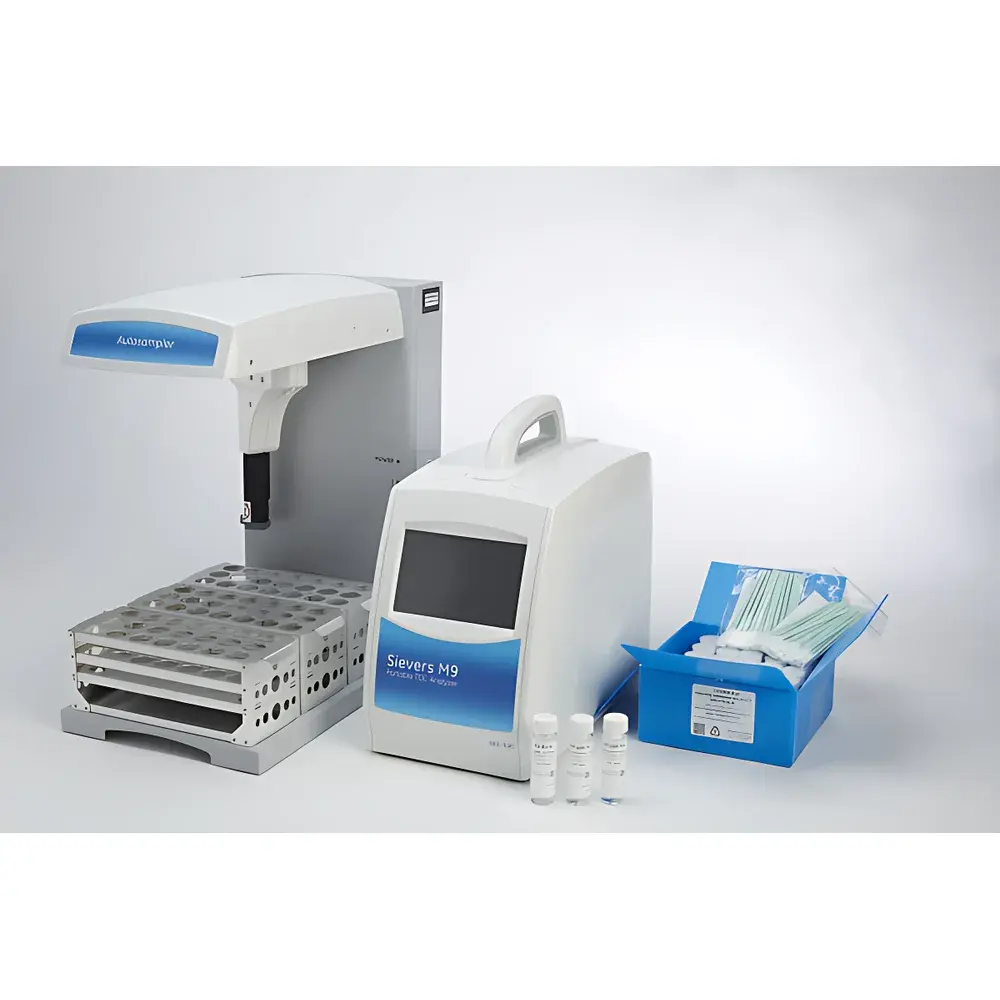
The Sievers M9 SEC Detector is a purpose-engineered benchtop total organic carbon (TOC) detection module designed exclusively for integration with high-performance size-exclusion chromatography (SEC) systems. Unlike conventional standalone TOC analyzers, the M9 SEC operates as a real-time, flow-through DOC (dissolved organic carbon) detector—receiving eluent directly from an HPLC pump and delivering continuous, high-fidelity carbon quantification across molecular weight fractions. Its core measurement principle relies on membrane conductivity detection following complete oxidation of organic carbon via synchronized UV/persulfate chemistry—a method standardized under ASTM D5907 and ISO 8245 for aqueous carbon speciation. The instrument is calibrated using potassium hydrogen phthalate (KHP) standards and validated against certified molecular weight standards (e.g., PEG or PSS), enabling traceable assignment of carbon mass to retention time. This configuration supports rigorous characterization of natural organic matter (NOM) in source water, treated effluent, ultrapure water loops, and process streams where molecular weight distribution critically influences disinfection byproduct formation (e.g., trihalomethanes), membrane fouling, boiler corrosion kinetics, and semiconductor rinse water purity.
Key Features
- Optimized signal-to-noise architecture for sub-ppb DOC detection—achieving 0.03 ppb method detection limit and <1% RSD repeatability at low-concentration levels
- Dedicated SEC interface firmware supporting turbo-mode data acquisition (4-second sampling interval) to resolve narrow chromatographic peaks without temporal undersampling
- Integrated inorganic carbon removal (ICR) module with acidification and sparging, enabling selective NPOC (non-purgeable organic carbon) or TC (total carbon) quantification per run
- Field-reconfigurable operation: seamlessly switches between SEC-dedicated detection mode and full-featured standalone TOC analysis mode without hardware modification
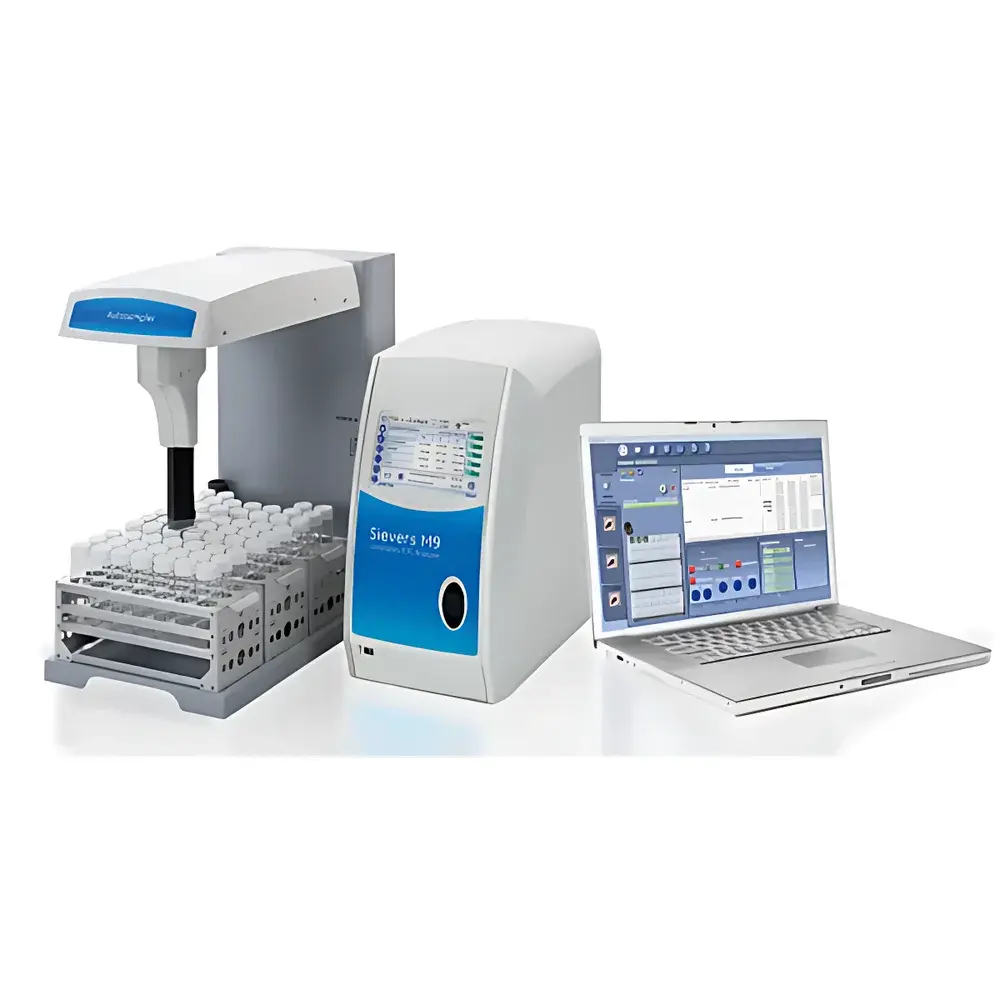
- Onboard 7″ WVGA color touchscreen (800 × 480) with intuitive workflow navigation, real-time chromatogram overlay, and embedded calibration management
- Comprehensive I/O suite including dual USB host ports (for keyboard/mouse and external storage), USB device port, 4–20 mA analog output (×3), binary input (×1), alarm relay (×4), and Modbus TCP/IP Ethernet protocol support
Sample Compatibility & Compliance
The M9 SEC accepts discrete or continuous eluent streams from isocratic HPLC pumps operating at 1.0 mL/min, compatible with common SEC columns such as Tosoh Bioscience TSK-GEL columns (e.g., model 44782). Sample introduction requires pre-filtration through 0.45 µm membranes to prevent particulate ingress. Mobile phase must be inorganic—typically 0.004 M phosphate buffer (pH 6.8) with 0.025 M Na₂SO₄—to eliminate carbon background interference. The system meets IP21 enclosure rating and carries ETL and CE safety certifications. It complies with GLP/GMP data integrity expectations through audit-trail-enabled software logging, user-access controls, and electronic signature support—fully aligned with FDA 21 CFR Part 11 requirements when deployed with compliant LIMS or chromatography data systems (CDS).
Software & Data Management
Data acquisition and peak integration are performed externally via industry-standard HPLC software (e.g., Waters Empower, Thermo Chromeleon, Agilent OpenLab), while the M9 SEC provides raw conductivity values, temperature-corrected TC/NPOC concentrations, and timestamp-synchronized analog outputs. Internal firmware stores up to 10,000 measurement records with metadata (calibration date, operator ID, sample ID, oxidation efficiency logs). All exported data conform to ASTM E1447 and ISO/IEC 17025 traceability frameworks. USB mass storage enables direct export of CSV-formatted datasets for post-run molecular weight calibration using third-party tools (e.g., MATLAB, Python SciPy) or commercial SEC analysis packages.
Applications
- Characterization of NOM molecular weight distribution in drinking water treatment optimization and DBP precursor tracking
- Monitoring organic leachables and extractables in pharmaceutical water-for-injection (WFI) and clean steam systems per USP and EP 2.2.44
- Quantifying humic/fulvic acid fractions influencing reverse osmosis membrane scaling and biofouling potential
- Validating carbon removal efficiency of advanced oxidation processes (AOPs) and electrochemical treatment units
- Supporting microelectronics manufacturing specifications requiring ≤1 ppb DOC in ultrapure water (UPW) per SEMI F63
- Research applications in environmental biogeochemistry, wastewater reuse, and soil leachate profiling
FAQ
Can the M9 SEC operate independently as a standard TOC analyzer?
Yes—the instrument includes dual operational modes. A single firmware toggle reconfigures it from SEC-coupled DOC detection to full-featured TOC analysis with TC/IC/NPOC reporting, auto-calibration, and regulatory-compliant reporting templates.
What is the recommended column and mobile phase for SEC–TOC coupling?
Tosoh Bioscience TSK-GEL G3000PWXL or equivalent aqueous-compatible SEC columns are advised. Use inorganic mobile phase only: 0.004 M phosphate buffer (pH 6.8) + 0.025 M Na₂SO₄, filtered through 0.22 µm PVDF membrane.
Does the M9 SEC support automated calibration and QC checks?
Yes—built-in calibration routines support multi-point KHP calibration with drift monitoring; daily system suitability tests (SST) verify oxidation efficiency (>95%) and baseline stability per USP guidelines.
Is the detector compatible with non-Sievers HPLC systems?
Yes—any isocratic HPLC system with stable 1.0 mL/min flow, low pulsation, and analog/digital trigger capability can interface via the universal analog I/O or Modbus TCP/IP protocol.
What maintenance intervals are recommended for routine operation?
UV lamp replacement every 12 months; persulfate reagent cartridge every 6 months or 2,000 injections; membrane conductivity cell cleaning quarterly; ICR acid and purge gas filters replaced semiannually.
Related Products







