
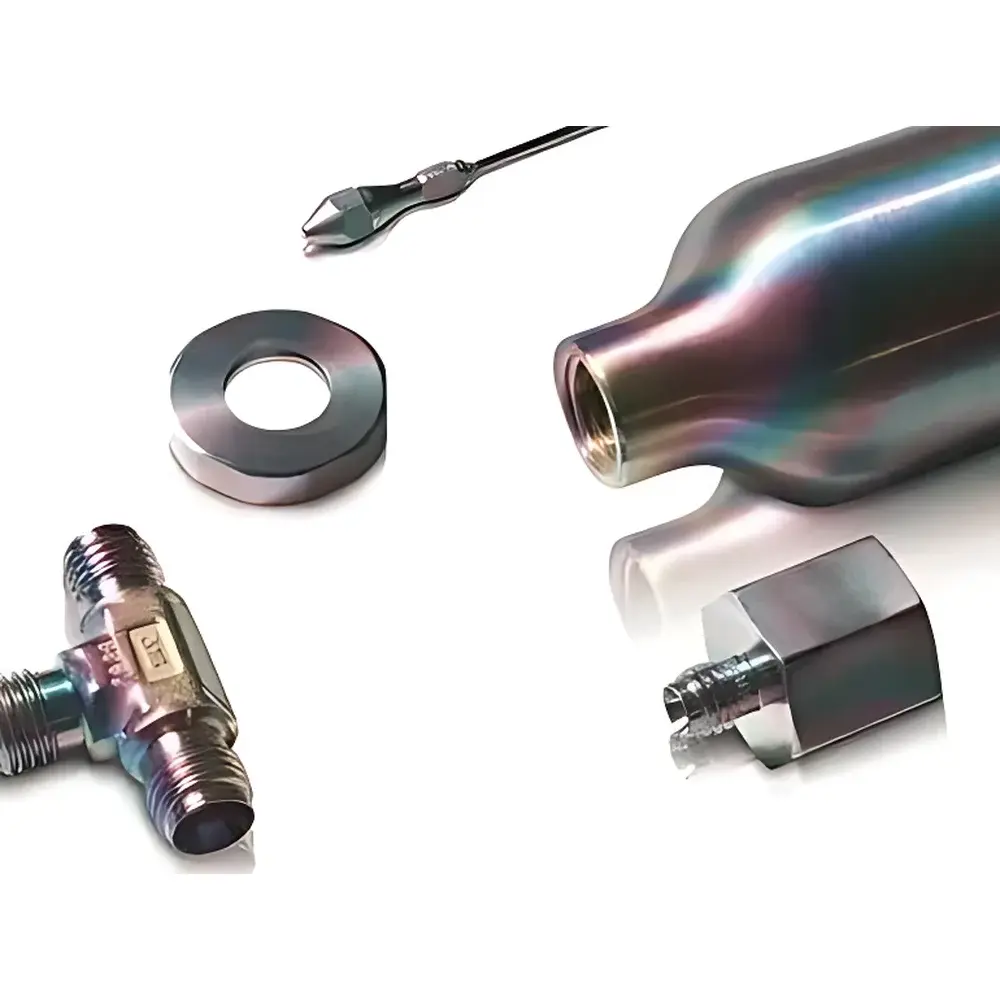
SilcoTek SilcoNert-2000 Inert Surface Passivation Coating System
| Brand | SilcoTek |
|---|---|
| Origin | USA |
| Manufacturer Type | Authorized Distributor |
| Product Category | Imported |
| Model | SilcoNert-2000 |
| Pricing | Upon Request |
| Coating Material | Hydrogenated Amorphous Silicon with Surface Alkylation |
| Deposition Method | Thermal Chemical Vapor Deposition (Non-Plasma) |
| Max Operating Temperature | 450°C (inert), 400°C (oxidizing) |
| Substrate Compatibility | Stainless Steel Alloys, Ceramics, Glass, Titanium, Specialty Metals |
| Max Dimension | 78 in (198 cm) |
| Geometry Flexibility | Full 3D Conformality |
| Thickness Range | 100–500 nm |
| Contact Angle (Hydrophobicity) | ≥65° |
| pH Stability Range | 0–8 |
| Patent Numbers | US 6,444,326 & US 6,511,760 |
Overview
SilcoTek SilcoNert-2000 is a high-performance, chemically inert surface passivation system engineered for critical components in elemental analysis instrumentation—particularly gas chromatography (GC), atomic absorption spectroscopy (AAS), inductively coupled plasma mass spectrometry (ICP-MS), and trace-level sulfur, mercury, and ammonia analyzers. Unlike conventional silanization or electropolishing, SilcoNert-2000 employs a patented thermal chemical vapor deposition (CVD) process to deposit a conformal, hydrogenated amorphous silicon (a-Si:H) film that is subsequently surface-alkylated to yield an ultra-low-reactivity barrier. This non-plasma, line-of-sight-independent coating eliminates active surface sites responsible for analyte adsorption, catalytic decomposition, memory effects, and peak tailing—enabling reliable sub-part-per-trillion (ppt) detection limits and quantitative reproducibility across demanding elemental workflows.
Key Features
- True Conformal Coverage: Thermal CVD enables uniform, pinhole-free coating of complex geometries—including capillary tubing interiors, valve manifolds, transfer lines, microfluidic channels, and porous frits—without shadowing or thickness gradients.
- Ultra-Low Reactivity: Surface alkylation yields a hydrophobic, chemically saturated interface with contact angles ≥65°, minimizing interactions with polar, nucleophilic, or redox-active species such as H₂S, Hg⁰, NH₃, Cl₂, HF, and organometallics.
- Thermal & Chemical Robustness: Stable up to 450°C under inert atmospheres and 400°C under oxidizing conditions; compatible with aggressive cleaning protocols (e.g., O₂ plasma, piranha solution) without delamination or degradation.
- Regulatory-Ready Performance: Eliminates carryover and calibration drift—supporting compliance with ISO/IEC 17025 method validation requirements, EPA Method 1631 (mercury), ASTM D5191 (vapor pressure), and USP for inert surfaces in pharmaceutical elemental impurity testing.
- Material Agnostic Adhesion: Bonds covalently to stainless steel (316, 304, 17-4PH), fused silica, alumina, quartz, titanium alloys, and specialty superalloys—no intermediate adhesion layers required.
Sample Compatibility & Compliance
SilcoNert-2000-coated components maintain integrity across aqueous, gaseous, and solvent-based matrices. The coating’s pH stability (0–8) supports compatibility with acidic digestates (e.g., HNO₃/HCl mixtures per EPA 6020B), basic eluents in ion chromatography, and volatile organic carrier solvents (e.g., methanol, acetonitrile). Its inertness has been validated per ASTM E2913-21 (standard guide for evaluating surface reactivity of analytical hardware) and meets the surface inertness criteria referenced in ICH Q3D for elemental impurity control strategies. All coated parts are fully compatible with GLP/GMP audit trails when integrated into validated instrument platforms.
Software & Data Management
While SilcoNert-2000 is a passive hardware enhancement—not a standalone instrument—it integrates transparently into existing laboratory data systems. Coating certification includes batch-specific traceability documentation (coating date, CVD run ID, substrate lot number, thickness verification via ellipsometry), enabling full chain-of-custody alignment with 21 CFR Part 11-compliant LIMS and electronic lab notebooks (ELNs). Users may embed coating history directly into instrument method files (e.g., GC methods in OpenLab CDS or Chromeleon) to ensure analytical traceability from sample introduction to final report.
Applications
- Trace mercury speciation in environmental water and flue gas using cold vapor AAS or CVAFS
- Ultra-low sulfur detection (<10 ppb) in fuels per ASTM D7039/D7111 via GC-SCD or GC-PFPD
- Ammonia monitoring in semiconductor process gases (SEMI F57) and biopharmaceutical cell culture headspace
- Stable delivery of reactive hydride-forming elements (As, Se, Sb) in hydride generation AAS/ICP-MS
- Reducing memory effects in multi-element ICP-MS analysis of geological digests containing refractory halides
- Passivating microreactors and catalytic sampling interfaces in online process analyzers for petrochemical QA/QC
FAQ
Is SilcoNert-2000 compatible with ultra-high vacuum (UHV) systems?
Yes—outgassing rates are ≤1×10⁻¹² Torr·L/s·cm² at 25°C (measured per ASTM E595), making it suitable for UHV-compatible GC-MS ion sources and residual gas analyzers.
Can SilcoNert-2000 be applied to pre-assembled instruments?
No—coating requires direct line-of-sight access to all surfaces during CVD. Components must be disassembled and cleaned prior to processing. SilcoTek offers certified refurbishment services for OEM-integrated parts.
Does the coating affect thermal conductivity or electrical resistivity?
The 100–500 nm a-Si:H layer exhibits negligible impact on bulk thermal transfer or grounding integrity; measured thermal conductivity is ~1.5 W/m·K, and volume resistivity exceeds 10¹² Ω·cm—ensuring compatibility with grounded metal manifolds and heated zones.
How is coating thickness verified and documented?
Ellipsometric measurement is performed on witness coupons processed alongside production parts; full thickness reports (mean ± SD) and SEM cross-section validation are included in the Certificate of Conformance.
What is the shelf life of coated components before installation?
When stored in clean, dry nitrogen-purged containers, coated parts retain full performance for ≥24 months. No reconditioning or activation is required prior to use.






