
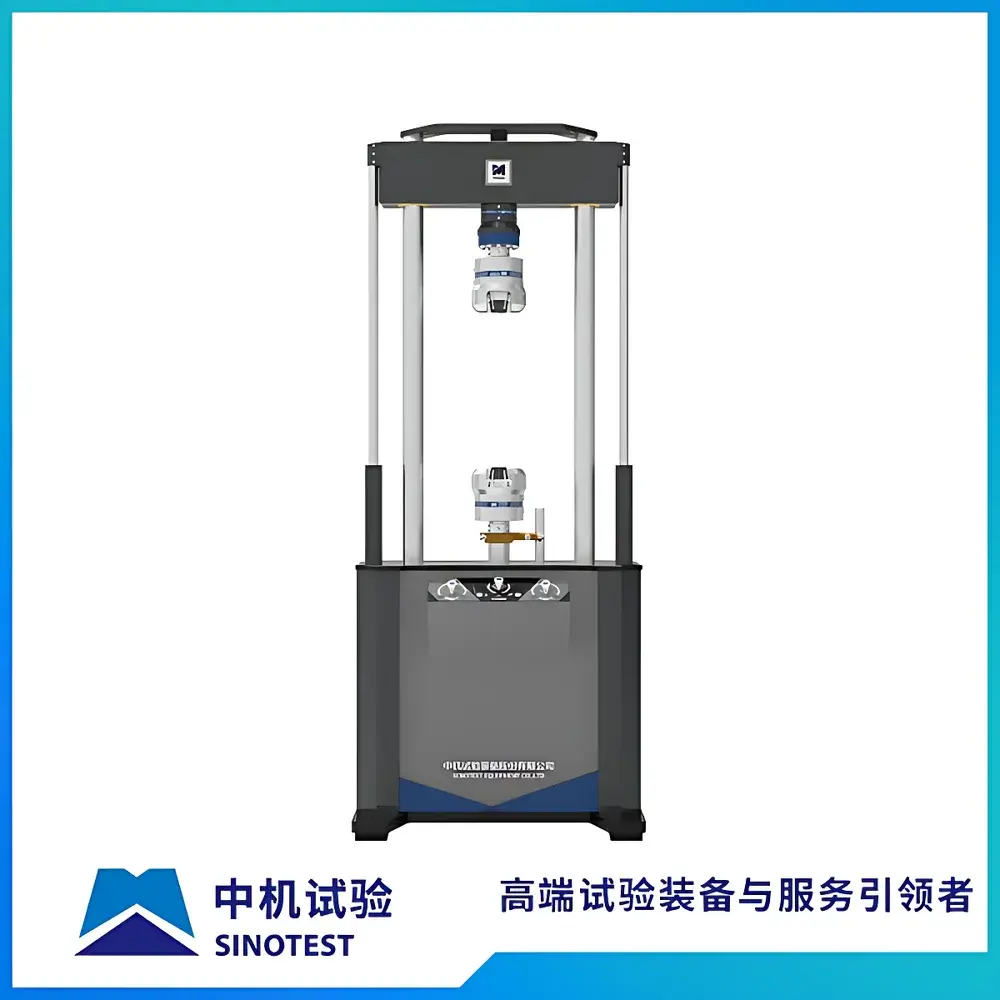
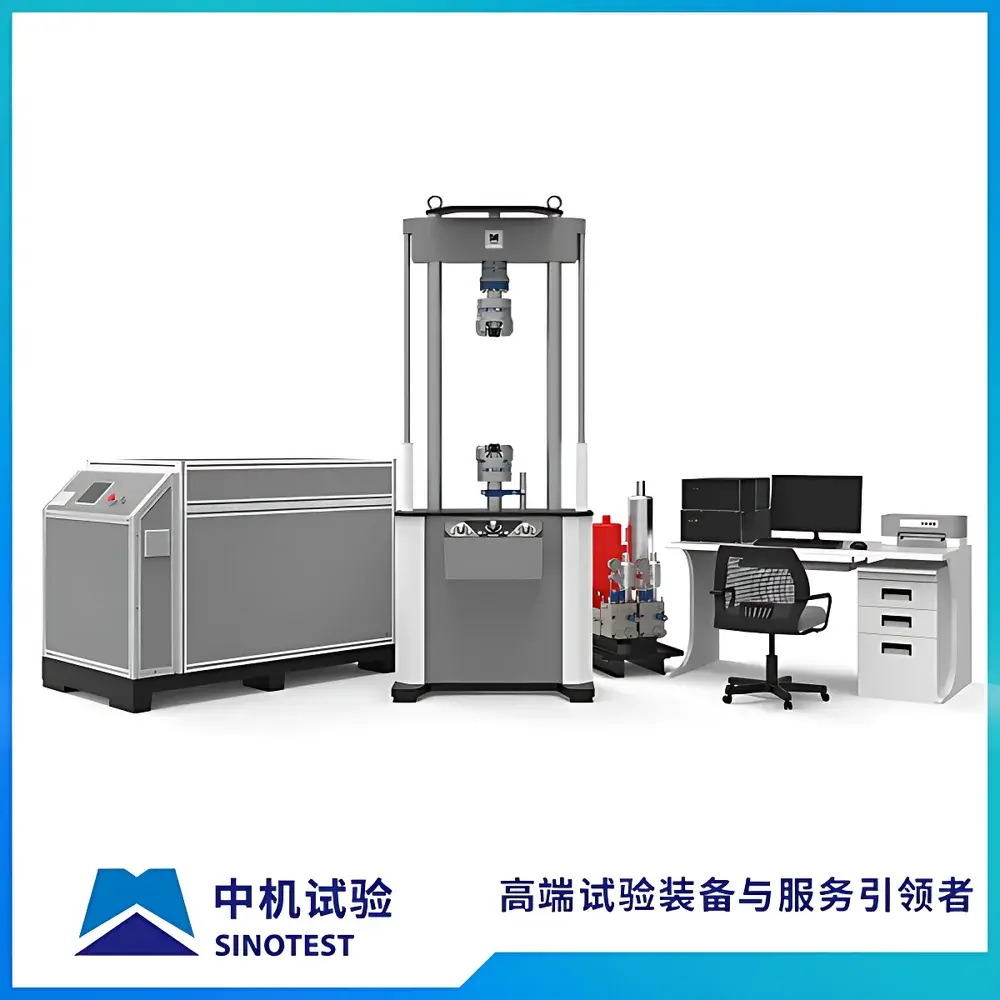
SINOTEST S-Series Electro-Hydraulic Servo Dynamic and Static Fatigue Testing Machine
| Brand | SINOTEST |
|---|---|
| Origin | Jilin, China |
| Manufacturer Type | Direct Manufacturer |
| Product Category | Domestic |
| Model | SDS / SD |
| Price Range | USD 14,000 – 42,500 |
| Instrument Type | Electro-Hydraulic Servo Fatigue Tester |
| Maximum Test Load | 50–300 kN |
| Frequency Range | 5–50 Hz |
| Host Weight | 700–1500 kg |
Overview
The SINOTEST S-Series Electro-Hydraulic Servo Dynamic and Static Fatigue Testing Machine is a high-performance, dual-mode mechanical testing system engineered for precision-controlled cyclic loading under both static and dynamic conditions. Based on classical servo-hydraulic actuation principles—leveraging closed-loop feedback control of hydraulic pressure, flow, and piston displacement—the system delivers repeatable, traceable force and displacement waveforms across a broad frequency spectrum. Designed for structural integrity validation and material fatigue life prediction, it supports sinusoidal, block, random, and user-defined waveform generation in tension-compression, bending, torsion, and combined loading configurations. Since its inception in the 1970s—when SINOTEST developed China’s first electro-hydraulic servo dynamic testing system—the platform has evolved through rigorous engineering iteration to meet international R&D and quality assurance requirements in aerospace, automotive, rail, energy, and advanced manufacturing sectors.
Key Features
- High-rigidity, four-column monolithic load frame with optimized column spacing and crosshead guidance for minimal parasitic bending and axial alignment stability
- Patented hydrostatic bearing-supported servo actuators—eliminating elastomeric seals, friction, stiction, and wear while delivering superior lateral stiffness and self-centering capability
- Dual-mode operation: seamless transition between quasi-static tensile/compression tests (per ISO 6892-1, ASTM E8/E9) and high-cycle fatigue testing (up to 50 Hz)
- Integrated digital controller with real-time PID tuning, waveform synthesis engine, and adaptive inertia compensation algorithm for improved phase fidelity at higher frequencies
- Modular architecture supporting optional high-speed actuation (up to 20 m/s piston velocity), extended stroke packages, environmental chambers (-70°C to +350°C), and multi-axis coordination
- Comprehensive safety architecture including emergency stop interlocks, pressure relief valves, overload cut-off, and hardware-based motion limit switches
Sample Compatibility & Compliance
The S-Series accommodates specimens ranging from standard metallic coupons (e.g., ASTM E606 dog-bone, ISO 1099 notched bars) to large-scale components such as welded joints, turbine blades, composite laminates, and biomedical implants. Its modular fixture interface supports wedge, hydraulic, pneumatic, and custom-designed grips—including torsional chucks compliant with GB/T 12443 and ISO 12106. The system meets essential regulatory and methodological frameworks: ISO 1099 (metallic materials—fatigue testing), ASTM E466 (constant amplitude axial fatigue), ASTM E606 (strain-controlled fatigue), ASTM E1823 (fracture toughness terminology), GB/T 3075, GB/T 26076–26077, GB/T 24176, and EN 6072. Full audit trail functionality—including user authentication, parameter change logging, and electronic signature support—is available to satisfy GLP, GMP, and FDA 21 CFR Part 11 requirements when paired with validated software modules.
Software & Data Management
Control and analysis are executed via SINOTEST’s proprietary TestMaster™ software suite—a Windows-based application built on deterministic real-time kernel architecture. The interface provides intuitive test sequence programming, live waveform visualization (force vs. displacement, stress vs. strain, hysteresis loops), automated pass/fail evaluation against user-defined criteria (e.g., stiffness degradation >15%, cycle count at crack initiation), and export to CSV, Excel, or universal MDF4 formats. All raw data—including sensor timestamps, analog channel sampling (≥10 kHz), and controller internal states—are stored with metadata (operator ID, calibration certificate ID, environmental conditions). Version-controlled test methods can be archived, recalled, and locked per SOP. Optional integration with LabView, MATLAB, or Python APIs enables custom algorithm deployment for machine learning–based damage prognosis or digital twin synchronization.
Applications
- High-cycle fatigue (HCF) and low-cycle fatigue (LCF) characterization of alloys, superalloys, and additively manufactured metals
- Fatigue crack growth rate (da/dN) and threshold ΔK determination per ASTM E647 and ISO 12108
- Cyclic deformation behavior, ratcheting, and creep–fatigue interaction studies under controlled temperature environments
- Component-level durability validation of fasteners, springs, suspension arms, and structural welds
- Fracture mechanics testing—including KIc, J-integral, and CTOD measurements per ASTM E399, E1820, and ISO 12737
- Calibration and verification of strain gauges, extensometers, and load cells per ISO 376 and ASTM E4
FAQ
What standards does the S-Series support for fatigue testing?
It natively supports GB/T 3075, GB/T 26076–26077, ISO 1099, ASTM E466, ASTM E606, and EN 6072—with optional method libraries for ASTM E647, ISO 12108, and ASTM E399.
Can the system perform torsional fatigue tests?
Yes—when equipped with the optional torque actuator module and torsional fixtures compliant with GB/T 12443 and ISO 12106.
Is remote monitoring and diagnostics supported?
Standard Ethernet connectivity enables secure remote access for real-time status monitoring, firmware updates, and diagnostic log retrieval via HTTPS-based web interface.
What is the typical lead time for factory acceptance testing (FAT)?
FAT is scheduled within 10 business days after mechanical and hydraulic commissioning, with full documentation including calibration certificates, traceability records, and performance verification reports.
Does SINOTEST provide application engineering support post-installation?
Yes—dedicated application engineers assist with method development, specimen preparation, data interpretation, and staff training, including ISO/IEC 17025-aligned uncertainty analysis workshops.



