
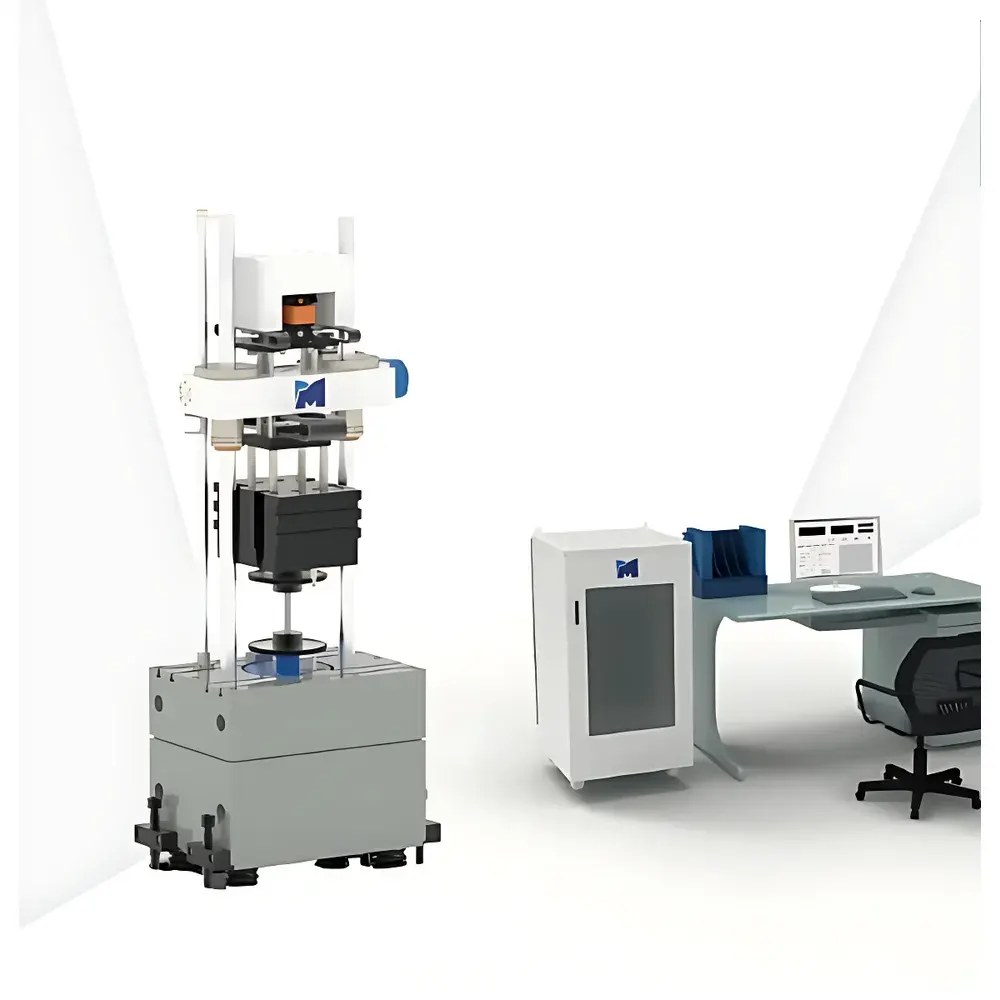
SINOTEST G Series High-Frequency Fatigue Testing Machine
| Brand | SINOTEST |
|---|---|
| Origin | Jilin, China |
| Manufacturer Type | Direct Manufacturer |
| Product Line | GPS Series |
| Maximum Test Load | 500 kN |
| Frequency Range | 60–300 Hz |
| Machine Weight | 1,200–7,500 kg |
| Load Accuracy (Mean Load) | ±0.5% of reading (4–100% FS) |
| Load Ripple (Alternating Load) | ±0.5% FS |
| Mean Load Stability | ±0.5% FS |
| Compliance Standards | JB/T 5488–1991, JJG 556–2011, GB/T 2611, GB/T 3075, HB 5287, ISO 1099 |
Overview
The SINOTEST G Series High-Frequency Fatigue Testing Machine is an electromagnetic resonance-driven fatigue testing system engineered for high-cycle, high-precision mechanical endurance evaluation of metallic materials and structural components. Operating on the principle of mechanical resonance—where electromagnetic excitation synchronizes with the natural frequency of the test specimen–load train assembly—the system achieves stable, energy-efficient cyclic loading at frequencies ranging from 60 to 300 Hz. This resonant architecture enables rapid accumulation of fatigue cycles while minimizing thermal drift and actuator power consumption, making it particularly suitable for high-volume fatigue life mapping, S–N curve generation, and fatigue limit determination under controlled stress ratios. Designed for laboratory and industrial R&D environments, the G Series supports both open-loop and closed-loop control configurations and integrates seamlessly into standardized testing workflows aligned with international fatigue metrology practices.
Key Features
- Electromagnetic resonance excitation system delivering high-fidelity sinusoidal loading with minimal harmonic distortion across the full 60–300 Hz operational band.
- Robust dual-column or four-column frame architecture (depending on GPS submodel), constructed from high-strength steel with optimized dynamic stiffness to suppress parasitic vibrations and ensure load path integrity.
- Precision load cell with traceable calibration, providing mean load measurement accuracy of ±0.5% of reading (within 4–100% of full scale) and alternating load stability of ±0.5% FS.
- Digital servo controller with real-time waveform monitoring, cycle counting, and automatic frequency tracking to maintain resonance during specimen degradation or stiffness change.
- Modular fixture interface compatible with standardized grips, hydraulic wedge clamps, and custom-designed adapters for specimens including bolts, gear teeth, chain links, connecting rods, and fine-diameter reinforcing bars (down to Ø3 mm).
- Integrated safety interlocks, overload protection, and emergency stop circuitry compliant with IEC 61508 SIL 2 functional safety requirements.
Sample Compatibility & Compliance
The G Series accommodates a broad spectrum of metallic specimens—from raw material coupons and machined notched bars to finished fasteners and aerospace-grade forged components. Its modular load train design permits rapid reconfiguration for axial tension–compression, rotating bending (with optional accessory), or push–pull configurations. All hardware and firmware implementations adhere strictly to national and international fatigue testing standards, including GB/T 3075 (metallic materials—fatigue testing—axial force-controlled method), ISO 1099 (metallic materials—fatigue testing—axial force-controlled method), and ASTM E466 (standard practice for conducting force-controlled constant amplitude axial fatigue tests). Calibration procedures follow JJG 556–2011 (verification regulation for axial-force fatigue testing machines), and structural verification conforms to GB/T 2611 (general requirements for testing machines). The system is fully documented for GLP-compliant laboratories and supports audit-ready calibration records per ISO/IEC 17025.
Software & Data Management
Control and analysis are executed via SINOTEST’s proprietary FatigueTest Pro software, a Windows-based platform supporting multi-channel synchronized acquisition (load, displacement, strain, temperature), real-time FFT spectral analysis, and automated test sequence scripting. Software features include waveform synthesis (sine, block spectrum, amplitude-modulated, asymmetric R-ratio profiles), conditional termination logic (e.g., stiffness drop >5%, cycle count threshold, crack detection signal), and export to CSV, XML, or MDF4 formats for post-processing in MATLAB, Python, or commercial fatigue life prediction tools (e.g., nCode DesignLife). Audit trails, user access levels, electronic signatures, and data immutability options satisfy FDA 21 CFR Part 11 and EU Annex 11 requirements for regulated environments.
Applications
- High-cycle fatigue characterization of automotive drivetrain components (axles, CV joints, suspension links) under road-spectrum-equivalent loading.
- Aerospace material qualification per MIL-HDBK-5J and AMS specifications, including notch sensitivity assessment and dwell-fatigue interaction studies.
- Academic research on microstructure–fatigue property relationships in advanced high-strength steels, titanium alloys, and additively manufactured nickel superalloys.
- Quality assurance testing of fasteners per ISO 898-1 and ASTM F606, including proof load, clamp load retention, and cyclic loosening behavior.
- Development and validation of fatigue life models for civil infrastructure reinforcement (e.g., seismic-resistant rebar, prestressed concrete tendons).
- Supporting ISO 12107 and ASTM E1823 fracture mechanics testing when coupled with compliance-calibrated crack-mouth-opening-displacement (CMOD) fixtures.
FAQ
What types of fatigue tests can the G Series perform?
It supports symmetric (R = –1), asymmetric (R > –1), pulsating unidirectional (R = 0), block-spectrum, and amplitude-modulated fatigue tests—all under closed-loop load or strain control.
Is the system suitable for testing small-diameter specimens such as M4 bolts or Ø2 mm wires?
Yes, with appropriate high-precision grips and reduced-capacity load cells (optional), the system maintains metrological integrity down to 1% of full-scale load, enabling reliable testing of miniature components.
Does the controller support real-time frequency tracking during test progression?
Yes—the digital servo controller continuously monitors system resonance and automatically adjusts excitation frequency to compensate for specimen stiffness reduction due to crack growth or plastic deformation.
Can test data be exported for third-party fatigue analysis software?
Absolutely. FatigueTest Pro exports time-series data in industry-standard formats (CSV, MDF4) and includes metadata tags for load channel scaling, sampling rate, and calibration coefficients—ensuring full traceability in downstream analysis pipelines.
What documentation is provided for regulatory audits?
Each unit ships with a Factory Calibration Certificate (traceable to NIM China), Installation Qualification (IQ), Operational Qualification (OQ), and comprehensive maintenance logs—fully aligned with ISO/IEC 17025 and GMP/GLP documentation frameworks.



