
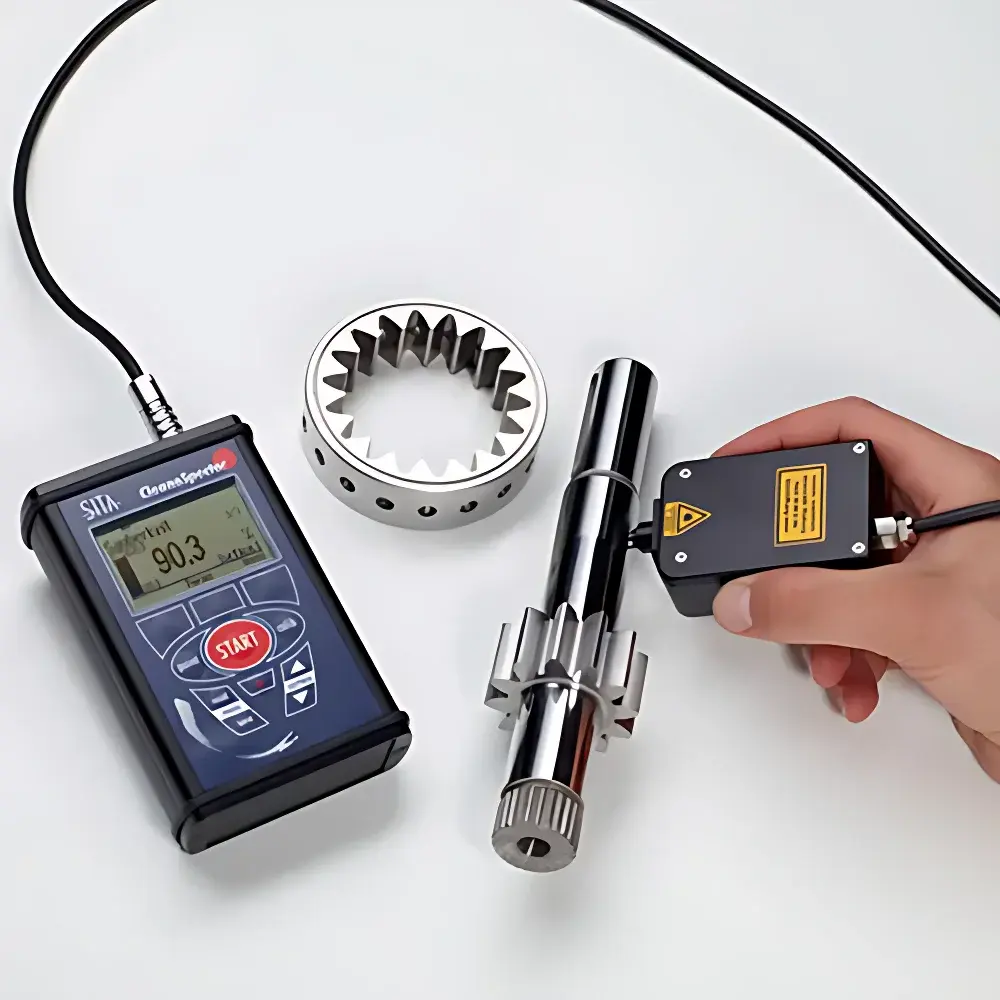
SITA CleanoSpector Surface Contamination Analyzer
| Brand | SITA |
|---|---|
| Origin | Germany |
| Model | CleanoSpector* |
| Measurement Principle | UV-Induced Fluorescence |
| Detection Target | Hydrocarbon-based contaminants (oils, greases, coolants, cleaning agents, fingerprints) |
| Output Unit | % Cleanliness (relative to calibrated clean reference surface) |
| Calibration | Auto-calibration on certified clean metal surface |
| Reference Surfaces | Steel, aluminum, copper, brass, gold, glass |
| Spot Diameter | 1 mm |
| Optimal Working Distance | 4 mm |
| Power Supply | Rechargeable Li-ion battery or AC adapter |
| Weight | 320 g (including probe and handle) |
| Compliance | Designed for ISO 8502-3, ASTM D7417, VDA 19.1, and GLP-aligned process validation |
Overview
The SITA CleanoSpector Surface Contamination Analyzer is a handheld, non-contact optical instrument engineered for rapid, quantitative assessment of hydrocarbon-based surface contamination on metallic and glass substrates. It operates on the principle of ultraviolet-induced fluorescence (UV-F), where a precisely tuned UV-LED (peak emission at 365 nm) excites organic residues—such as machining oils, coolants, lubricants, residual cleaning agents, and human skin lipids—causing them to emit characteristic fluorescent radiation. A high-sensitivity photodiode within the probe detects this emitted fluorescence intensity, which correlates directly with contaminant mass per unit area. The device converts raw signal intensity into a normalized cleanliness value expressed as a percentage: 100% represents a reference surface verified free of detectable hydrocarbon contamination under defined calibration conditions; lower values indicate progressively higher levels of residue. Unlike gravimetric or solvent-extraction methods, the CleanoSpector delivers immediate, repeatable results without sample destruction, consumables, or operator-dependent interpretation—making it suitable for in-line process verification, incoming inspection, and root-cause analysis in regulated manufacturing environments.
Key Features
- One-button operation with real-time display of % cleanliness and statistical metrics (min, max, mean, standard deviation across multiple points)
- Temperature-invariant measurement performance: internal thermal compensation ensures stable calibration across ambient ranges from 5 °C to 40 °C
- Robust, ergonomic handheld design weighing only 320 g, optimized for extended use in production cells or lab settings
- Fixed-focus optical geometry with 4 mm working distance and 1 mm spot diameter—no alignment required
- Surface-agnostic calibration protocol: supports user-defined reference surfaces including stainless steel, aluminum, copper, brass, gold, and float glass
- No sensitivity to surface topography: validated across Ra values from 0.05 µm (mirror-polished) to 6.3 µm (ground), eliminating bias from roughness-related scattering
Sample Compatibility & Compliance
The CleanoSpector is validated for use on flat or gently curved conductive and non-conductive surfaces, including cold-rolled steel strips, aluminum extrusions, stamped automotive components, medical-grade stainless steel parts, and precision glass optics. It complies with the physical measurement principles outlined in ISO 8502-3 (surface cleanliness by fluorescence), ASTM D7417 (standard test method for determining surface cleanliness of metals using UV fluorescence), and VDA 19.1 (German Automotive Industry Association guideline for part cleanliness). While not a direct compliance tool for FDA 21 CFR Part 11, its data output structure—including timestamped measurements, operator ID tagging, and audit-ready CSV export—supports integration into GLP/GMP documentation workflows when paired with validated SOPs and electronic record systems.
Software & Data Management
Measurements are stored internally (up to 10,000 records) and exportable via USB or Bluetooth to the optional CleanoSpector PC software. This application enables batch reporting, trend charting over time, comparative analysis between cleaning cycles or supplier lots, and generation of PDF-certified reports compliant with internal quality requirements. All exported files include metadata: date/time stamp, operator ID, probe serial number, calibration status, and measurement location coordinates (when used with optional positioning fixtures). The system supports traceability through configurable user access levels and maintains an immutable log of calibration events and firmware updates—facilitating readiness for external audits under IATF 16949 or ISO 13485 frameworks.
Applications
- Pre-coating verification prior to painting, powder coating, or PVD/CVD deposition to prevent adhesion failure
- Pre-weld inspection in automotive body shops and battery module assembly lines to eliminate porosity and spatter
- In-process monitoring of aqueous and solvent-based cleaning lines for steel strip, engine blocks, or surgical instruments
- Validation of ultrasonic cleaning efficacy in electronics assembly and microelectromechanical systems (MEMS) fabrication
- Supplier qualification testing for Tier-1 automotive components requiring VDA 19.1-compliant cleanliness thresholds
- Root-cause investigation of delamination in laminated safety glass or bonding failures in EV battery housings
FAQ
Does the CleanoSpector quantify absolute contaminant mass (e.g., mg/m²)?
No—it provides a relative cleanliness index (%), calibrated against a clean reference surface. Absolute quantification requires correlation with gravimetric or FTIR validation studies specific to your contaminant matrix and substrate.
Can it distinguish between different types of oils (e.g., mineral vs. synthetic)?
Not spectrally—fluorescence intensity reflects total hydrocarbon load, not chemical identity. However, consistent spectral response profiles enable discrimination when combined with controlled process knowledge (e.g., known coolant type in a closed-loop system).
Is certification available for ISO/IEC 17025 traceability?
The instrument itself is not accredited, but SITA provides factory calibration certificates traceable to NIST-standard reference surfaces. End-users may establish in-house calibration verification protocols aligned with ISO/IEC 17025 requirements.
How frequently must the probe be recalibrated?
Calibration is performed automatically before each measurement session using a clean reference tile. No periodic recalibration is required unless physical damage occurs or environmental exposure exceeds specified limits (e.g., condensation ingress, UV lens abrasion).
Can the device be integrated into automated production lines?
Yes—via optional industrial Ethernet or IO-Link interfaces, and compatible with robotic arms using the CleanoSpector Inline variant, which supports continuous scanning modes (linear, XY-grid, or 3D path-following) for roll-to-roll or palletized part inspection.



