
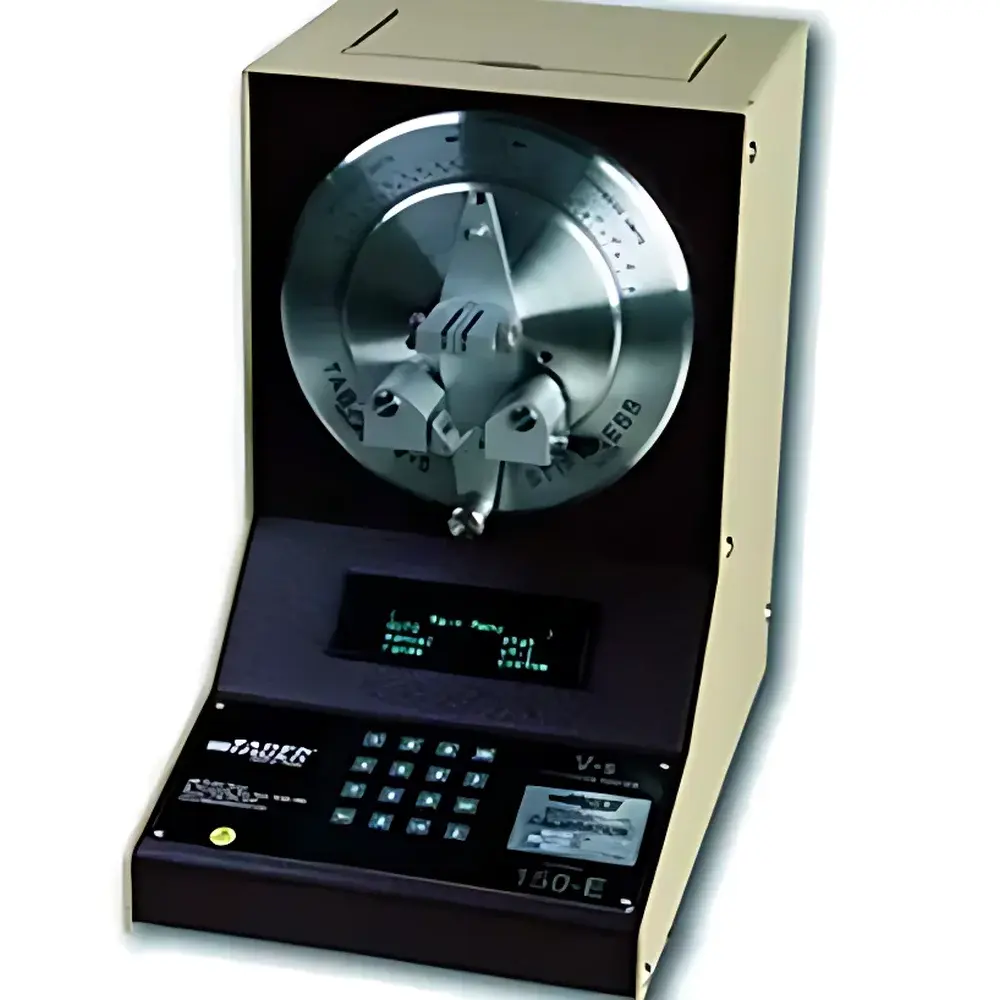
Taber 150-E Stiffness Tester
| Brand | Taber |
|---|---|
| Origin | USA |
| Model | 150-E |
| Sample Thickness Range | 0.1–5.5 mm |
| Applicable Materials | Paper, Foil, Thin Metal Sheets, Plastic Films, Cardboard, Rubber, Melamine Board, Vinyl, Wires, Tubing, Textiles, Felt, Leather |
| Drive Mechanism | Constant-Speed Motor with Gear-Driven Rotating Disc |
| Measurement Principle | Pendulum Deflection Under Controlled Torsional Load |
| Output | Analog Dial or Digital Display (Configurable) |
Overview
The Taber 150-E Stiffness Tester is an electromechanical instrument engineered for the precise quantification of material resistance to bending—commonly referred to as stiffness or flexural rigidity—under standardized torsional loading conditions. It operates on the classical pendulum deflection principle: a specimen is clamped at its upper end between precision-machined jaw blocks mounted concentrically on a gear-driven rotating disc, while its lower end is secured between two adjustable compression rollers coupled directly to the disc. Upon activation, a constant-speed motor rotates the disc at a fixed angular velocity, applying a controlled torsional moment to the specimen. This induces angular displacement of a calibrated, freely swinging pendulum arm; the resulting deflection angle is linearly correlated to the material’s inherent stiffness and is read directly from a high-resolution analog scale or optionally via a digital display module. The instrument conforms to the mechanical foundation of ASTM D747 (Standard Test Method for Apparent Bending Stiffness of Plastics by the Fixed-End Method) and ISO 2493-1 (Paper and Board — Determination of Bending Resistance — Part 1: Taber Method), serving as a primary reference tool in quality control laboratories where repeatable, operator-independent stiffness data are required for thin-sheet materials.
Key Features
- Robust cast-iron base and precision-ground aluminum housing ensure long-term dimensional stability and vibration damping during dynamic testing.
- Constant-speed DC motor with regulated feedback loop maintains consistent rotational speed (±0.5% tolerance) across extended test cycles, minimizing torque drift.
- Interchangeable jaw inserts and roller sets accommodate diverse specimen geometries—including irregular edges and non-uniform thicknesses—without compromising clamping uniformity.
- Dual-scale analog dial (0–100 arbitrary units) with vernier-assisted reading capability enables rapid visual assessment; optional digital transducer upgrade supports RS-232/USB output for automated data capture.
- Calibration traceability supported through NIST-traceable reference standards and documented calibration procedures aligned with ISO/IEC 17025 requirements.
Sample Compatibility & Compliance
The Taber 150-E accepts flat, flexible sheet specimens ranging from 0.1 mm to 5.5 mm in thickness and up to 60 mm in width. Verified compatibility includes uncoated and coated papers, aluminum and copper foils, PET and PVC films, corrugated and solid fiberboard, vulcanized rubber sheets, thermoset laminates (e.g., phenolic and melamine-faced panels), extruded vinyl profiles, textile weaves and knits, needle-punched felts, and split or full-grain leathers. All test configurations comply with the sample preparation, conditioning (23 °C ± 1 °C, 50% RH ± 2%), and reporting conventions specified in ASTM D747, ISO 2493-1, TAPPI T 543, and JIS P 8143. Instrument design meets CE marking requirements for electromagnetic compatibility (EMC Directive 2014/30/EU) and low-voltage safety (LVD Directive 2014/35/EU).
Software & Data Management
While the base 150-E model operates as a standalone mechanical tester, optional firmware-enabled digital modules integrate with Taber’s proprietary StiffnessSuite™ software (v3.2+). This platform provides real-time torque-angle curve visualization, automatic unit conversion (mN·m, gf·cm, ozf·in), statistical batch analysis (mean, SD, CV%, min/max), and export to CSV, PDF, or XML formats. Audit trails—including operator ID, timestamp, calibration status, and environmental log metadata—are maintained in accordance with FDA 21 CFR Part 11 and EU Annex 11 requirements when deployed in regulated GMP/GLP environments. Data integrity is enforced via role-based access control and electronic signature workflows.
Applications
- Quality assurance of packaging substrates—evaluating fold endurance of folding cartons, blister pack thermoforms, and pharmaceutical foil lidding.
- R&D screening of polymer film formulations for stiffness-toughness trade-offs in flexible electronics encapsulation.
- Consistency monitoring of coated paper grades used in premium print media and label stock manufacturing.
- Validation of composite laminate bending performance in automotive interior trim and architectural surfacing applications.
- Comparative benchmarking of natural fiber-reinforced bioplastics against petroleum-based alternatives under standardized humidity-controlled conditions.
FAQ
What is the minimum and maximum specimen thickness the Taber 150-E can accommodate?
The instrument is validated for specimens between 0.1 mm and 5.5 mm thick. Specimens outside this range require custom fixture adaptation and method validation per ISO 17025.
Does the 150-E meet regulatory requirements for pharmaceutical packaging testing?
Yes—when operated with documented calibration, environmental monitoring, and audit-trail-enabled software, it satisfies USP , ASTM D747, and ICH Q5C stability protocol expectations for stiffness-related package integrity assessments.
Can the 150-E be integrated into an automated production line?
Not natively; it is a benchtop manual-load instrument. However, third-party robotic sample handlers and PLC-triggered digital modules have been successfully deployed in Tier-1 packaging OEM facilities under validated integration protocols.
Is operator training required for compliant use?
Yes—Taber-certified training (available onsite or remotely) covers clamp alignment verification, pendulum zeroing procedure, environmental preconditioning adherence, and outlier identification per ASTM E178 guidelines.
Related Products






