
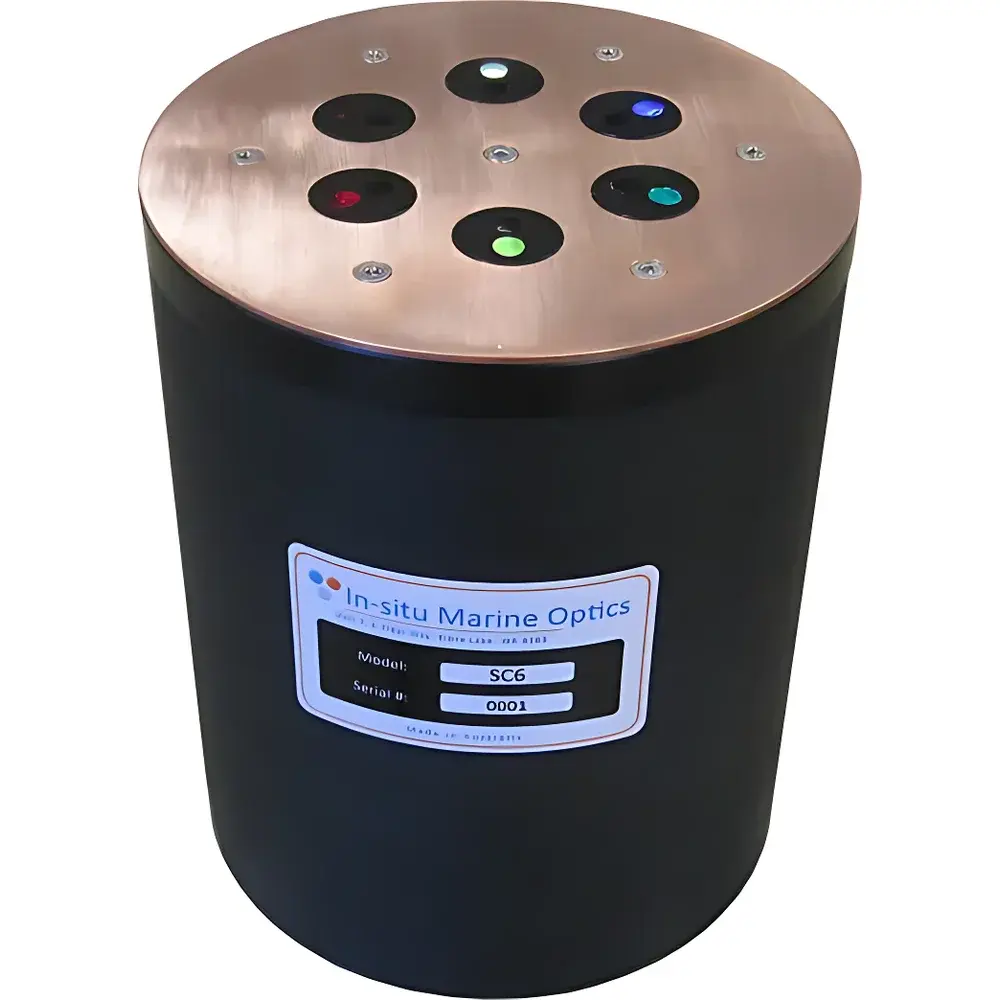
In-situ Marine SC3/SC6 Backscattering Sensor
| Brand | In-situ Marine |
|---|---|
| Origin | Australia |
| Manufacturer Status | Authorized Distributor |
| Origin Category | Imported |
| Model | SC3/SC6 |
| Price | Upon Request |
| Scattering Angle | 120° |
| Ambient Light Rejection | Yes |
| Interference Suppression | Modulated Frequency per Channel |
| Reference Photodiode | Per LED Channel |
| Bb(λ) Range (Standard) | 0–1 m⁻¹ (Factory-Configurable) |
| Resolution | 5.0 × 10⁻⁴ m⁻¹ (Typ.) |
| Chlorophyll-a Range | 0–100 µg/L (Factory-Configurable) |
| Sensitivity | 0.01 µg/L |
| ADC Resolution | 16-bit |
| Sampling Frequency | 7 Hz (Configurable) |
| Communication Protocol | RS-232 @ 19200 bps |
| Input Voltage | 7–24 VDC |
| Power Consumption (Sampling) | 150 mA @ 12 VDC |
| Connector | MCBH6M |
| Length | 100 mm (including connector + 36 mm protrusion) |
| Diameter | 80 mm (SC3) or 125 mm (SC6) |
| Weight (Air) | 700 g |
| Housing Material | Acetal, Quartz, Copper Faceplate |
| Depth Rating | 300 m |
| Operating Temperature | −10 to +40 °C |
Overview
The In-situ Marine SC3/SC6 Backscattering Sensor is a high-precision, multi-wavelength optical instrument engineered for quantitative in situ measurement of the volume scattering function at 120°—a critical parameter for deriving the backscattering coefficient Bb(λ). Based on calibrated, modulated LED excitation and synchronous photodiode detection, the sensor operates on the principle of angularly resolved optical backscatter, enabling robust discrimination of particulate and dissolved optically active constituents in marine, estuarine, lacustrine, and riverine environments. Its design adheres to established oceanographic conventions for spectral backscattering quantification (e.g., IOCCG Protocols, NASA SeaBASS standards), supporting rigorous validation of bio-optical models and satellite-derived remote sensing products. The SC3 variant integrates three discrete excitation/emission wavelength pairs optimized for standard marine applications; the SC6 extends this capability to six independently configurable channels, facilitating advanced spectral deconvolution of overlapping optical signals from chlorophyll-a (Chl-a), colored dissolved organic matter (CDOM), and hydrocarbon contaminants.
Key Features
- Triple- or six-channel spectrally selective backscatter detection with factory-configurable excitation and emission wavelengths
- Modulated LED drive architecture with per-channel reference photodiode monitoring, enabling real-time drift compensation and long-term signal stability
- Optically hardened components: non-yellowing, scratch-resistant quartz windows and acetal housing rated to 300 m depth
- High dynamic range (>80 dB) and low-noise analog front-end, supported by 16-bit ADC digitization
- Onboard storage of calibration coefficients—including temperature-dependent corrections—for traceable, post-deployment data reduction
- PIN-compatible mechanical and electrical interface with standard oceanographic CTDs, moorings, AUVs, and profiling systems (e.g., Sea-Bird Electronics, RBR, Teledyne Webb)
Sample Compatibility & Compliance
The SC3/SC6 is validated for continuous operation in natural waters ranging from oligotrophic open ocean (Bb ≈ 10−4 m−1) to turbid estuaries and dredge plumes (Bb up to 1 m−1). Its 120° scattering geometry conforms to the widely adopted definition of Bb in the Ocean Optics community (e.g., IOCCG Report No. 5). The sensor meets IEC 60529 IP68 ingress protection requirements and complies with ISO 17025-aligned calibration traceability when used with NIST-traceable reference standards. Its RS-232 output supports integration into GLP/GMP-compliant environmental monitoring workflows, and time-stamped, checksummed data packets are compatible with FDA 21 CFR Part 11 audit trail requirements when deployed with compliant data loggers.
Software & Data Management
Raw voltage outputs and internally normalized digital counts are transmitted via ASCII-formatted RS-232 frames at user-selectable intervals (default 7 Hz). In-situ Marine provides the open-source SCx-Toolbox (Python-based) for conversion to physical units using stored calibration polynomials and thermal correction tables. Output variables include calibrated Bb(λ), derived Chl-a concentration (µg/L), CDOM absorption slope (nm−1), and hydrocarbon fluorescence index (HFI). All metadata—including firmware version, temperature, pressure (when interfaced), and calibration timestamps—is embedded in netCDF4-compliant files, ensuring FAIR (Findable, Accessible, Interoperable, Reusable) data handling per NOAA and EU Copernicus guidelines.
Applications
- Validation and vicarious calibration of ocean color satellite sensors (e.g., Sentinel-3 OLCI, Landsat-9 OLI-2, PACE HARP2)
- Time-series monitoring of suspended sediment dynamics in coastal zones, reservoirs, and regulated rivers
- Discrimination of phytoplankton functional types via multi-spectral backscatter signatures
- Early detection of petroleum hydrocarbon intrusion in port and offshore infrastructure surveillance
- Integration into autonomous platforms (gliders, profilers, ferryboxes) for synoptic spatial mapping of optical water types
- Supporting biogeochemical model initialization and data assimilation (e.g., ROMS, FVCOM, GOTM)
FAQ
What is the primary optical measurement principle employed by the SC3/SC6?
It measures angularly resolved backscattered radiance at 120° using intensity-modulated LEDs and lock-in-amplified photodiode detection to isolate the signal from ambient light and electronic noise.
Can the Bb(λ) range be extended beyond the standard 0–1 m−1?
Yes—In-situ Marine offers factory recalibration for extended ranges (e.g., 0–5 m−1) with corresponding adjustments to gain settings and linearity validation.
Is the sensor compatible with third-party data loggers and telemetry systems?
Yes—its RS-232 interface uses standard framing (8N1, 19200 bps), and command-response protocols are documented in the publicly available SCx Communication Manual.
How is temperature dependence handled during long-term deployments?
Each unit ships with a full temperature-compensation lookup table derived from laboratory characterization across −10 to +40 °C; coefficients are applied in real time or during post-processing.
Does the SC3/SC6 support NMEA-0183 or SDI-12 output formats?
No—it natively outputs ASCII RS-232 only; protocol translation requires external gateway hardware or software-level parsing.







