
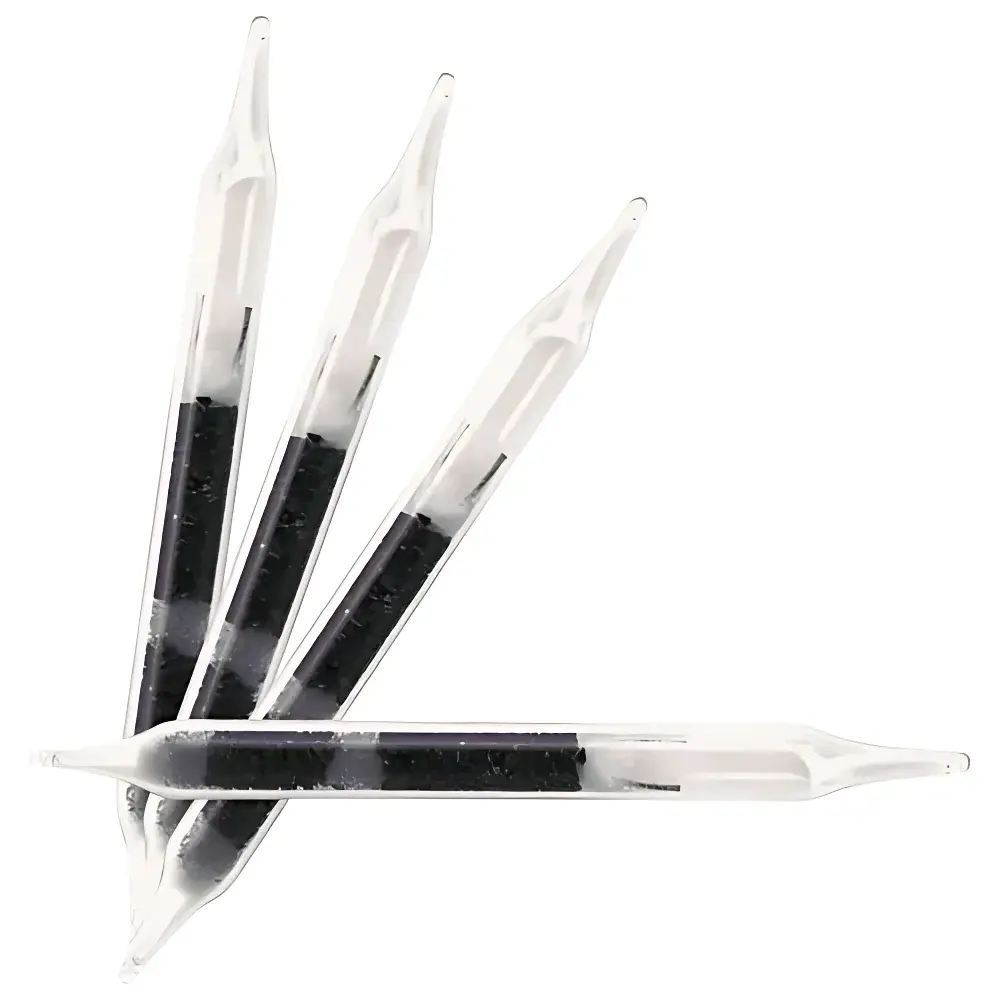
SKC Anasorb CSC Activated Carbon Sorbent Tubes
| Brand | SKC |
|---|---|
| Origin | USA |
| Manufacturer Type | Authorized Distributor |
| Product Category | Imported |
| Model | Anasorb CSC Activated Carbon Sorbent Tube |
| Pricing | Available Upon Request |
Overview
The SKC Anasorb CSC Activated Carbon Sorbent Tubes are precision-engineered passive sampling devices designed for the quantitative collection and stabilization of volatile organic compounds (VOCs) in workplace air and ambient environmental monitoring applications. Based on the fundamental principle of physical adsorption—where non-polar and moderately polar analytes are retained on high-surface-area activated carbon via van der Waals forces—these tubes provide a robust, standardized platform compatible with thermal desorption–gas chromatography–mass spectrometry (TD-GC-MS) and solvent elution–GC analysis workflows. First commercialized by SKC in 1973, the Anasorb CSC series represents over five decades of iterative refinement in sorbent tube design, including proprietary coconut-shell-based activated carbon with ultra-low native background interference, tightly controlled sorbent mass tolerance (±1% accuracy), and metrologically validated sieve sizing to ensure batch-to-batch consistency.
Key Features
- Double-bed or triple-bed configuration with front/back sections enabling breakthrough indication—critical for verifying sample integrity per NIOSH Method 1501 and OSHA Method 1005;
- Optimized tube geometry (e.g., 6 mm × 70 mm, 8 mm × 110 mm, 10 mm × 160 mm) engineered for uniform pressure drop and laminar flow distribution across the sorbent bed, minimizing channeling and improving analytical reproducibility (>97% inter-lot consistency in recovery studies);
- Low-background, acid-washed coconut-shell activated carbon (Anasorb CSC) with surface area >1000 m²/g and pore size distribution optimized for C₃–C₁₂ hydrocarbons, aromatics, ketones, esters, and halogenated solvents;
- Consistent sorbent mass loading (e.g., 100/50 mg, 400/200 mg, 350/350/350 mg) achieved via gravimetric dispensing under ISO/IEC 17025-accredited conditions;
- Chemically inert borosilicate glass construction with PTFE-lined aluminum end caps to prevent contamination during storage and transport;
- Optional chemically modified variants—including potassium hydroxide-impregnated carbon (for acidic gases), tert-butylcatechol-coated carbon (for ozone-sensitive aldehydes), and sodium hydroxide–silica gel–charcoal combinations (for multifunctional capture of acids, bases, and neutrals).
Sample Compatibility & Compliance
These sorbent tubes are validated for use in regulatory-compliant air sampling protocols mandated by U.S. federal agencies and international standards bodies. They meet or exceed performance criteria specified in NIOSH Manual of Analytical Methods (NMAM) Chapters 1501, 1502, and 2541; OSHA Methods 1005, 1018, and 1020; ASTM D5466–22 (Standard Test Method for Determination of VOCs in Air Using Sorbent Tubes); and EPA Compendium Method TO-17. Each lot undergoes rigorous QC testing—including blank analysis (95% for target VOCs), and retention capacity verification—to support GLP/GMP-aligned data reporting and FDA 21 CFR Part 11–compliant audit trails when integrated with SKC’s AirCheck™ Smart Pumps and associated calibration logs.
Software & Data Management
While the sorbent tubes themselves are passive consumables, their integration into compliant sampling programs is supported by SKC’s digital ecosystem. The AirCheck Connect mobile application and desktop portal enable traceable field logging—including pump calibration records, flow rate validation, sampling duration, environmental parameters (T, RH), and tube lot traceability. All metadata are exportable in CSV or XML formats compatible with LIMS platforms and electronic laboratory notebooks (ELNs). For laboratories performing thermal desorption, the tubes are fully compatible with ATD-X autosamplers (Markes International), UNITY-xr (Markes), and TD-30 (Shimadzu), supporting automated method transfer and instrument control via vendor-neutral ASCII-based method files.
Applications
- Occupational hygiene monitoring for solvents (e.g., benzene, toluene, xylene, n-hexane, MEK, acetone) in manufacturing, painting, printing, and pharmaceutical cleanroom environments;
- Indoor air quality (IAQ) assessments targeting off-gassing from adhesives, carpets, furniture, and building materials;
- Environmental site investigations (Phase I/II ESAs) for soil vapor intrusion and landfill gas migration studies;
- Method development and validation for emerging contaminants such as terpenes, glycol ethers, and fluorinated VOCs;
- Reference material generation and proficiency testing programs administered by AIHA-LAP, LLC and UK NEQAS.
FAQ
What distinguishes Anasorb CSC from generic activated carbon tubes?
Anasorb CSC uses proprietary coconut-shell carbon processed to minimize native volatiles and metal impurities—resulting in lower method blanks and higher signal-to-noise ratios in GC-MS analysis.
Can these tubes be used for formaldehyde or hydrogen sulfide sampling?
No—standard Anasorb CSC is not suitable for highly polar or reactive species. For formaldehyde, SKC recommends the Anasorb 747 (coated with 2-hydroxy-3-methoxybenzaldehyde), and for H₂S, the Anasorb SC (zinc oxide–impregnated charcoal) is recommended.
Is thermal desorption the only approved analytical approach?
No—both thermal desorption (per TO-17) and solvent desorption (per NMAM 2541) are validated, though thermal desorption offers superior sensitivity and reduced solvent waste.
How should unused tubes be stored?
Store unopened tubes at 4 °C in original packaging; avoid exposure to direct sunlight, ozone, or high humidity. Once opened, use within 24 hours or reseal with fresh end caps and store in a desiccator.
Are custom sorbent configurations available?
Yes—SKC offers OEM and custom-packed configurations (e.g., multi-bed combinations, alternative sorbents, specialized coatings) under ISO 9001–certified manufacturing controls, subject to minimum order quantities and lead-time scheduling.







