
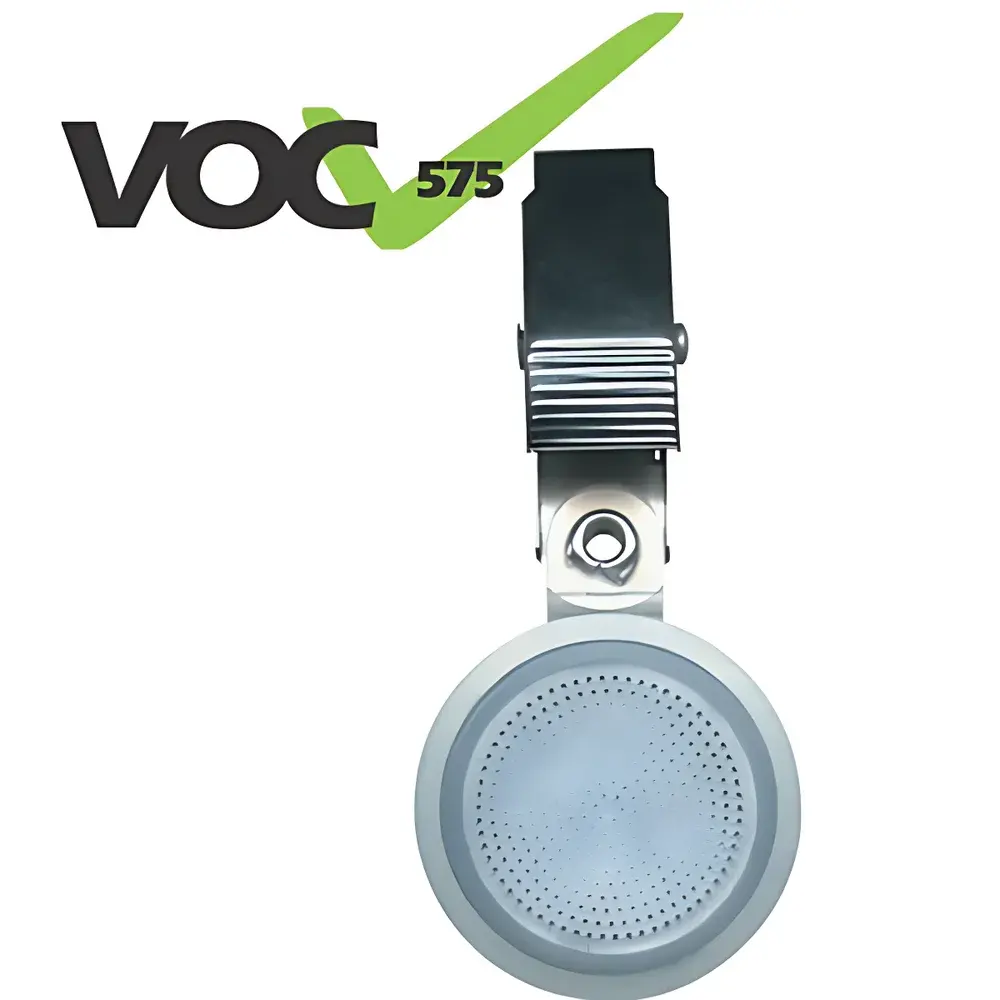
SKC VOC Chek 575 Passive Organic Vapor Sampler
| Brand | SKC |
|---|---|
| Origin | USA |
| Model | VOC Chek 575 |
| Instrument Type | Portable |
| Compliance | ASTM D6246-08, ANSI/ISEA 104-1998 (R2009) |
| Sampling Principle | Diffusion-based passive collection |
| Target Analytes | Benzene, toluene, xylene (BTX), ethylbenzene, perchloroethylene, trichloroethylene, methyl ethyl ketone (MEK), methyl isobutyl ketone (MIBK), styrene, butyl acetate, ethylene oxide (specialized variant), methanol (specialized variant) |
| Adsorbent Options | Activated charcoal, Carbopack™ X, Carbograph™ 1TD, and other SKC-certified sorbents |
| Validated Exposure Durations | 15 min–24 h (compound- and configuration-dependent) |
| Reporting Limit Compatibility | GC-FID, GC-MS, HPLC-UV |
Overview
The SKC VOC Chek 575 Passive Organic Vapor Sampler is a diffusion-controlled, pump-free monitoring device engineered for the quantitative assessment of occupational and environmental exposure to volatile organic compounds (VOCs). Operating on Fick’s law of molecular diffusion, the sampler relies on the natural concentration gradient between ambient air and the internal adsorbent bed to achieve time-integrated collection without external power or mechanical components. Its design conforms to the fundamental principles outlined in ASTM D6246-08 (“Standard Practice for Determining the Performance of Passive Samplers”) and aligns with the performance and labeling requirements specified in ANSI/ISEA 104-1998 (R2009), ensuring consistency with industrial hygiene sampling protocols used across North America and internationally. Unlike active sampling systems requiring calibrated pumps, flow meters, and battery management, the VOC Chek 575 eliminates operational variability introduced by flow rate drift or operator error—making it especially suitable for routine personal monitoring, area surveys, and indoor air quality assessments where logistical simplicity and reproducibility are critical.
Key Features
- Diffusion-based passive operation: No pump, no power source, no flow calibration required.
- Validated sampling rates (ks, in cm³/min) for over 300 VOCs—including benzene, toluene, xylenes, ethylbenzene, perchloroethylene, trichloroethylene, MEK, MIBK, styrene, and butyl acetate—determined under controlled laboratory conditions per OSHA and ASTM guidelines.
- Dual-chamber design with precision-machined diffusion barrier ensures consistent radial diffusion geometry and minimizes edge effects.
- Interchangeable adsorbent cartridges: Compatible with SKC’s range of thermally desorbable and solvent-desorbable media—including activated charcoal, Carbopack™ X, Carbograph™ 1TD, and specialized formulations for ethylene oxide and methanol.
- Robust polycarbonate housing rated for use across temperature ranges from –10 °C to +40 °C and relative humidity up to 90% non-condensing.
- Calibration traceability: Each lot undergoes independent verification of uptake kinetics and breakthrough capacity against NIST-traceable standards.
Sample Compatibility & Compliance
The VOC Chek 575 is validated for use in accordance with multiple OSHA analytical methods—including OSHA Method 51, 52, 1005, 1006, and 1007—as a technically equivalent alternative to active sampling when deployed within its documented exposure duration windows (e.g., 15-minute short-term exposure limit (STEL) assessments, full-shift 8-hour TWA evaluations, and 24-hour indoor air monitoring). Its adsorbent selection directly influences analyte retention efficiency and prevents back-diffusion; proper pairing—such as Carbograph™ 1TD for low-boiling compounds like ethylene oxide or methanol—is essential to maintain integrity during transport and storage. The device supports GLP-compliant workflows when integrated with chain-of-custody documentation and laboratory reporting aligned with ISO/IEC 17025-accredited analysis (GC-FID, GC-MS, or HPLC-UV). All configurations meet the physical and performance criteria defined in ANSI/ISEA 104-1998 (R2009) for personal sampling devices.
Software & Data Management
While the VOC Chek 575 itself is hardware-only and requires no embedded firmware or connectivity, its integration into enterprise-level exposure monitoring programs is supported via SKC’s free online tools—including the VOC Sampling Rate Calculator and Adsorbent Selection Guide. These web-based utilities allow industrial hygienists to input target analytes, expected concentrations, and sampling duration to retrieve compound-specific ks values, recommended adsorbent types, and estimated detection limits based on standard GC-FID or GC-MS analytical protocols. For laboratories performing batch analysis, raw chromatographic data may be imported into LIMS platforms supporting ASTM E2500-17 (Guide for Specification, Design, and Verification of Pharmaceutical and Biopharmaceutical Manufacturing Systems) or FDA 21 CFR Part 11–compliant audit trails. SKC provides comprehensive method transfer documentation—including SOP templates, QC checklists, and calibration verification reports—to facilitate internal validation and regulatory readiness.
Applications
- Occupational exposure assessment in manufacturing, printing, painting, adhesive application, and dry cleaning facilities.
- Indoor air quality investigations in offices, schools, and residential buildings following renovation or material off-gassing events.
- Baseline and post-abatement monitoring during asbestos or lead abatement projects where co-occurring VOC sources exist.
- Compliance screening for EPA Toxic Release Inventory (TRI) reporting thresholds and state-level air toxics programs.
- Research-grade exposure modeling in epidemiological studies requiring large-scale, low-cost, time-integrated datasets.
- Emergency response triage for suspected VOC releases where rapid deployment and minimal field training are essential.
FAQ
What is the maximum recommended sampling duration for the VOC Chek 575?
Sampling duration depends on analyte volatility, ambient concentration, and selected adsorbent. For most common VOCs (e.g., toluene, xylene), 8-hour full-shift sampling is validated; for lower-concentration environments or higher-boiling compounds, 24-hour deployments are supported with appropriate adsorbent selection.
Can the VOC Chek 575 be used for compliance with OSHA PELs?
Yes—when deployed per manufacturer instructions and analyzed using OSHA-approved methods (e.g., OSHA Methods 1005/1006), data generated with the VOC Chek 575 are accepted by OSHA as legally defensible for regulatory compliance determinations.
Is thermal desorption compatible with all VOC Chek 575 configurations?
No—only configurations using thermally desorbable adsorbents (e.g., Carbopack™ X, Carbograph™ 1TD) support direct thermal desorption. Charcoal-based versions require solvent desorption (e.g., CS₂ or CS₂/CS₂–methanol mixtures) prior to GC analysis.
How does humidity affect sampling performance?
Relative humidity up to 90% has been shown to have negligible impact on uptake kinetics for most target VOCs when using SKC-validated adsorbents; however, prolonged exposure above 90% RH may reduce effective capacity for polar compounds such as methanol.
Are there peer-reviewed publications validating the VOC Chek 575?
Yes—multiple studies published in American Industrial Hygiene Association Journal, Journal of Occupational and Environmental Hygiene, and Annals of Work Exposures and Health document its performance across diverse workplace settings and compound classes.
Related Products







